
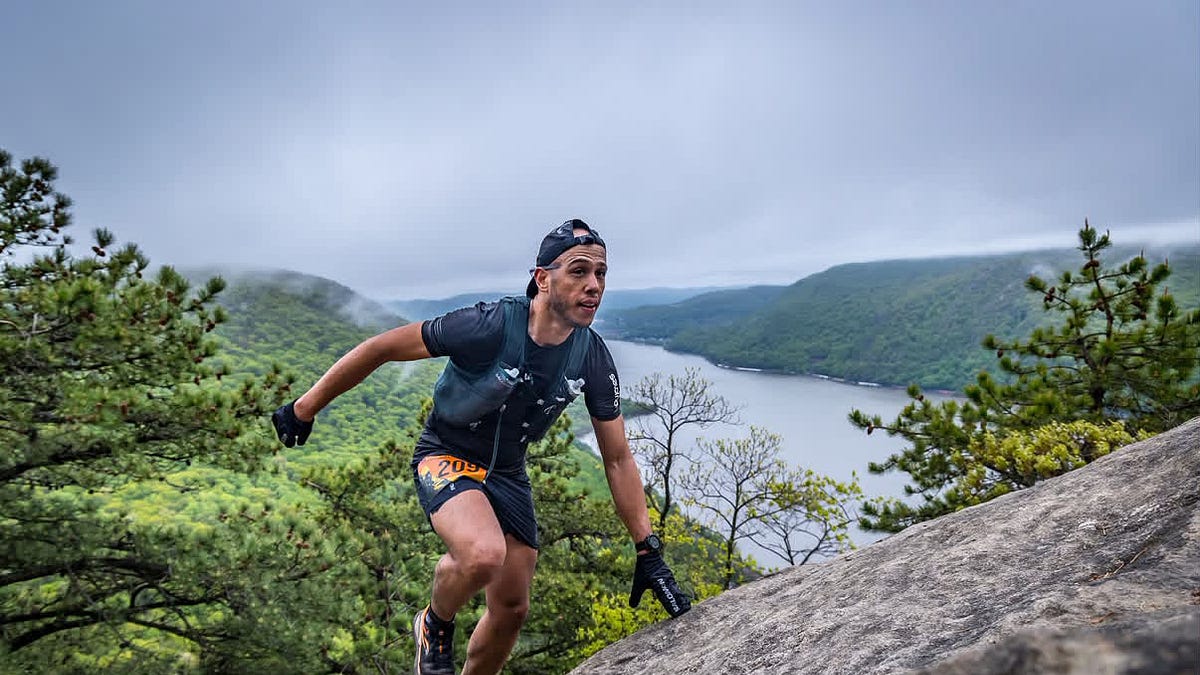
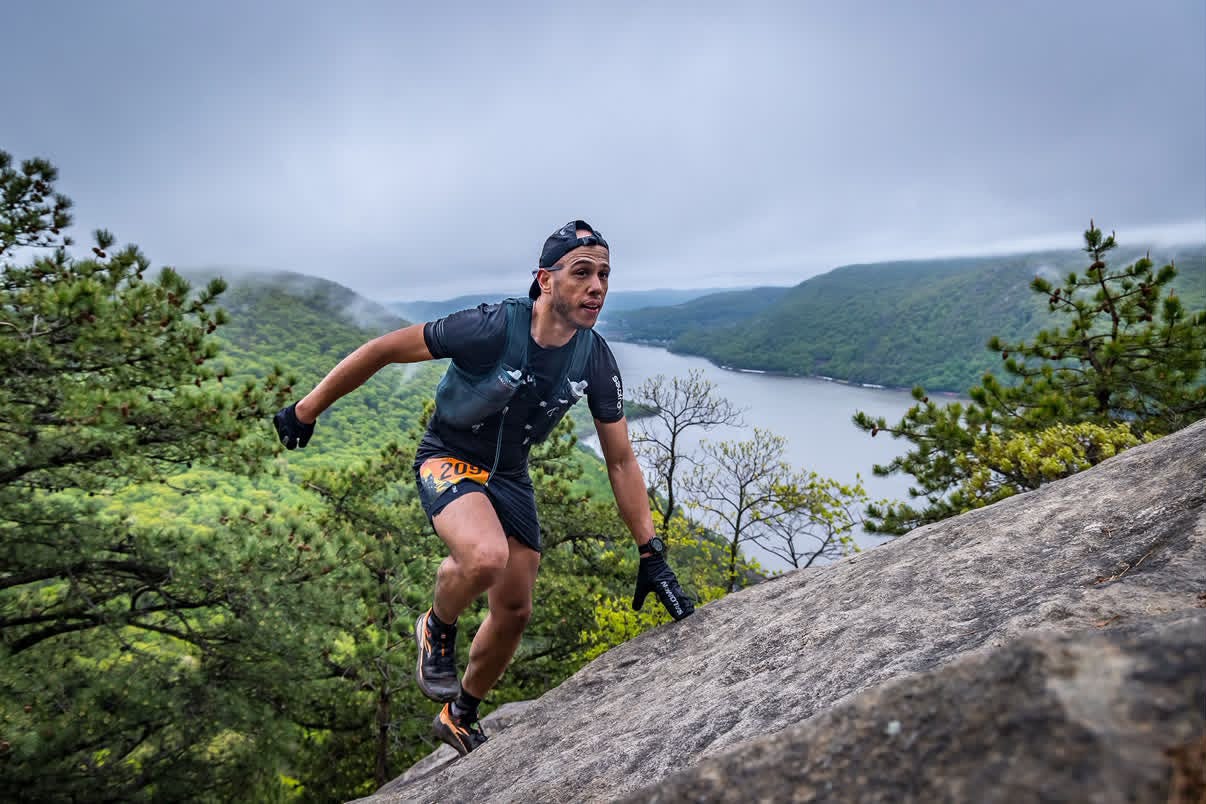
 Felipe at the 2024 Breakneck Marathon in Beacon, NY
Every year growing up, Felipe Toribio remembers his dad traveling from their native Dominican Republic for the New York City Marathon. Felipe never traveled with him for the race, but would always try to spot his dad running across the Verrazzano-Narrows Bridge on TV.
“Obviously we didn’t [see him], but it was kind of a cool tradition that my sister and I had,” he recalls.
At the time Felipe never really had the goal of running the race himself, and didn’t start running consistently until his mid-20s—over a decade after he and his family moved to the U.S. From there he got involved with BridgeRunners and later Old Man Run Club, becoming a captain of the latter while signing up for races and marathons across the globe.
However it’s been on the trails where Felipe’s found his true calling, both due to the sheer number of hours you spend outdoors for ultra training to ‘how engaged you are physically and mentally to the terrain.’ He says the main impact he wants to have on the New York City running community is to get others out on the trails more as well, part of the reason he now helps organize his own annual race—a 50-miler from Bear Mountain to Central Park.
We spoke with Felipe to discuss how he found BridgeRunners and Old Man Run Club, the origins of his BearBones ultra trail race, his experience running UTMB Mont-Blanc this past August and more.
This interview has been edited for length and clarity.
Can you give a quick intro of where you’re from, what brought you to New York City and your initial origins of how you got into running?
Yeah, so originally from the Dominican Republic, moved to the U.S. at age 11 or so. We moved around a little bit throughout the U.S. We first went to Miami, then we came up to the Northeast, between New York and Jersey. I went to high school in three different states: Florida, New York and Jersey…. Went to college at Brooklyn College, and then a few years later moved into Brooklyn and have been here since.
As far as running is concerned, my dad was a runner. He ran the New York City Marathon all throughout the ’90s—this is when we were living in the DR—’91, ’92, ’93. We never traveled, it was just my dad that was traveling…. But it was like, he’s going to New York to do the marathon, and that was the coolest thing. We would watch the coverage on the TV, and we would try to spot him over the bridge. Obviously we didn’t, but it was kind of a cool tradition that my sister and I had. And then he would come back with the medals and the plaques and all of that, and that was really cool.
So obviously he would train at home, and sometimes I would go with him to the training runs. He would train a lot at a college campus that we had nearby, he also had a little crew with him, like a run club, that would travel together to New York and do the marathon. And they would also put races together over in the DR—very similar, weirdly enough, to unsanctioned-style races, like half marathons and stuff. This was the early ’90s, I don’t know if they’re still happening actually.
I was never really a runner. I played baseball, because that’s just what Dominicans do. And I started running again maybe in my mid-20s. I had a friend who was running, and he had one of the running apps, and that was a little motivation for me, ‘Okay, I’ll run with you.’ And I have the history of my dad. And then it just rolled from there. Went little by little—my first 5k I think was the Roosevelt Island 5k, I remember we were trying to break 30 minutes, and got in by like 10 seconds. And then, little by little, kind of grew from there.
When your dad was doing the marathon back in the ’90s, was it your goal to always do that too? When did that become a goal?
It was something that was in the back of my head, ‘Eventually I’ll maybe try to run the marathon.’ It was never really a goal. I never really enjoyed running as much as I do now.
He would always try to encourage me to run, he was very proud of those days. And he was still running into his 50s and 60s—not marathons, but casually he would go to the park and do three, four miles. But it was never really a goal of mine until I started running with my friend, and then eventually went into some of the clubs and started realizing what the potential in running can be, in terms of a social life, and in terms of personal growth and all that stuff.
Can you talk through the early clubs or crews you were involved with?
So BridgeRunners, this was maybe 10 years ago, they came across my feed…. I saw their Instagram, and to be 100 percent, it was mostly about—I was seeing the pictures, and there were people that kind of looked like me. There were other Dominicans, a lot of other people of color…. I decided to go to BridgeRunners one day just because of that. It was as simple as that.
My first run I think was Global Running Day. And if you know BridgeRunners…. You never know what the mileage is going to be. You don’t know the route. You kind of just go with open plans. You might get home at one in the morning. So my first run, we ran out of the Lower East Side, ran down to the ferry, took the ferry to Brooklyn, ran by the Belt Parkway, and we finished at Spumoni Gardens, pizza in Bay Ridge. This was my introduction into BridgeRunners, and I loved it. I loved how random it was, and how everybody waited for each other every few miles. There were a lot of stops, we took pictures. It was something to look forward to every week. I started meeting the people there, started getting closer to people like Mike Saes, and learning so much from him.
“I loved how random it was…. It was something to look forward to every week”
So BridgeRunners was kind of a staple back in the day. A lot of people who started running in New York City, in the crew culture of New York City, started with Bridge, and they spread out to other clubs and started their own thing. It feels like everything started with Bridge, at least that wave of run culture, because there are definitely different waves.
How did that eventually get you into races and marathons, and what were those initial goals?
It’s one of those things where the people that you’re around define what your goals are. So hanging out with a lot of BridgeRunners, people that were traveling all over the world, doing Majors or doing ultras, those types of things—I wanted to do those things, right?…. I felt like that was my people, this is who I want to hang out with.
So my first marathon was I think 2017, I did the Philly Marathon, there were a few other BridgeRunners doing it. And then after that, in 2018 we went to The Speed Project, and I was the driver for BridgeRunners. And that was another window that opened into my running journey, the relay ultra scene. Just meeting other people at The Speed Project, other people from other crews all over the world, this connection with the overall running community around the globe. And finding races and looking for races was kind of through that connection. In 2019 we went to Berlin, and we met up with the Berlin Braves over there….
And then with that came the goals. After we said, ‘Okay, we’re going here, we’re going there,’ it’s like, ‘All right, what might my goal be? Do I want to go for some specific time?’ Things like that.
You’re very involved with Old Man Run Club as well. How did you find and get involved with them?
So Old Man Run Club came out of one of the Nike Moonshot years. After the marathon, people still wanted to do long runs and hang out, and that’s how Old Man came to be. And a lot of the OMRC people were the same—it was BridgeRunners people. It was people from Brooklyn Track. There were people from other clubs around the city that also wanted to do long runs.
I met the founders in an ultra run, it was Mike Saes’s birthday run…. And they were like, ‘Yeah, just come on Saturday. We do long runs.’ This was early 2019, and I just started going every Saturday. And I didn’t become a captain until a few years later.
Again, it was the same people that I was seeing on Wednesday nights at Bridge, I would see them on Saturday. And that was the cool thing back then with the NYC run culture, where the different clubs kind of share the same people. There was the run on Saturday. Queens had Queens Rebels on Thursdays. Brooklyn Track had their thing. And WRU Crew has their thing on Monday. And we all kind of went to all those runs throughout the week.
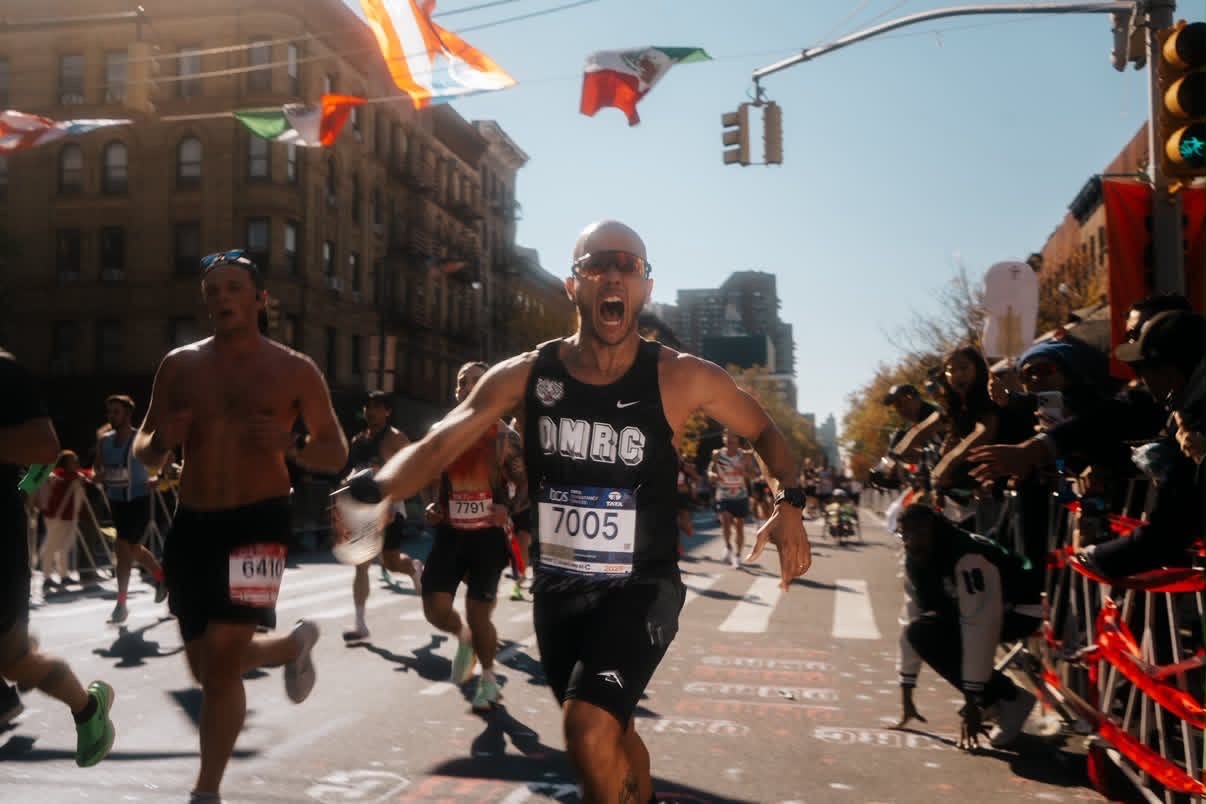 Felipe has run the New York City Marathon three times, including last November | Photo by @quentinmui.photos
You’ve been very into ultras over the last several years, you said that started with The Speed Project. Can you talk through what first attracted you to ultras, those first initial races, and how it expanded from there?
Yeah, so TSP introduced me to that sort of world, even though TSP is not an individual ultra, but it’s a relay ultra. The first ultra that I signed up for officially was the Comrades Marathon. So Comrades is about a 90k in South Africa. A friend, Nacho from BridgeRunners, did it in 2018, and he showed us some pictures and videos. And there were some other friends as well, they were going to go back in 2019, and I said I want to go back with you, just because it looked awesome….
During that training, I decided to sign up for some other trail ultra races, I did a few 50ks training up to the 55-miler. I did a trail race in Utah, the Zion 50k, and I did the North Face 50k in Bear Mountain, which used to be a very popular race here. Sadly it’s no longer there, but it was kind of a big introduction to trail races for the New York City community.
So doing those races during my training introduced me more into the ultra trail community, and how much I love just being out in the mountains for long periods of time. Comrades is a road ultra-marathon, so it had nothing to do with ultra trail. But it was during that training that made me fall in love with ultra trail running. I was going to Bear Mountain almost every weekend training, Cold Spring, doing the Palisades, all that stuff.
And then once we went to Comrades and we did it, it was the most amazing race that I had ever been to, completely different from anything I had experienced before. And from then it was like, ‘What other possibilities are out there? Can I go to Cali? Can I go to Arizona? Can I go to other ultras that I might like?’ And that’s kind of all I wanted to do.
Anything else you want to touch on in terms of what really hooked you to those races compared to the traditional road racing scene?
Yeah, so many things. One is I enjoy being outdoors and spending a lot of time outdoors. If you’re doing an ultra-marathon and you need to train, that means that you need to spend a lot of time outdoors, and I love that. I just love putting my vest on and going out for six, seven hours, even if it’s just a hike. There’s something about escaping the city. We’re here day in and day out, taking the train, going to work nine to five, coming back, and we feel the grittiness of the city and everything around us. We go to bars and we go to restaurants, and it’s very busy all day, all week. And whenever I went out to the outdoors, to the mountains, to the trails, it was a huge mental disconnect for me, and I really enjoyed that. Being able to breathe what felt like different oxygen really drew me in.
And then another aspect about the trails is not having to worry too much about what I think are unnecessary things in the road running scene. Things like the BQs, and having to do specific paces and track things, that’s not really my vibe. And not to say that’s not necessary—if I wanted to do well in an ultra trail, those things are necessary, obviously. But I just didn’t enjoy them as much.
“You have to be concentrated in every movement of your body. You have to know where you’re stepping, what the next three steps are…. Whenever I finished a trail run, I felt that runner’s high came so much easier”
And another thing that I love about just trail running in general is how engaged you are physically and mentally to the terrain during the run. You have to be concentrated in every movement of your body. You have to know where you’re stepping, what the next three steps are. So just that mental engagement—it reminds me of climbing, bouldering, where you’re on the whole time. You can’t let go, otherwise you’ll fall. And whenever I finished a trail run, I felt that runner’s high came so much easier. And it felt so good, just letting my brain get back into it after a longish trail run of being engaged the whole time. So I really, really enjoy that. It’s a necessary kind of mental workout for me.
You also help organize and put on some of your own unsanctioned ultra races, whether it’s Bell to Bull or Bear Mountain down to Central Park. Can you talk through the origins of that? What motivated you to want to organize races at a high level, and those specific ones in particular?
So for me, it started from helping out other races, just volunteering and stuff. First, it was with Bell to Bull. Bell to Bull is a race that Nacho started, and I’m kind of helping him out with that. It’s a race that goes from Philly to New York, from the Liberty Bell to the Charging Bull. Two runners share one bike. So we put that together, obviously unsanctioned, and we try to keep costs very low and registrations very low, and it was just all about spending a good day out, and having people just suffer, and that was kind of cool….
BareBones came about just from those trails—I run those trails all the time. And I love routing things. I have like a million routes on my Strava. I’m constantly routing and checking out what’s the mileage, what’s the distance from here to there, how long it would take, what’s the elevation, what’s the terrain. So because I’m running in Bear Mountain all the time, and I’m running in the Palisades all the time, it was kind of an obvious thing. Why don’t we just run it? Why don’t we just run from Bear Mountain to the city, right?
And Nacho helped me out with that. So it was both of us, we were like, ‘All right, let’s make this as bare bones as possible.’ Easy name, right? And then we routed a 50-mile course, and it was like 20 bucks or something like that, as simple as possible, pizza and beers after, and then see who shows up. And the first year, like 25 people showed up, and it was like, ‘Oh shit, this is awesome. How cool is that?’ And this year, this was our second year, the same amount of people. And the first year I ran it while also race directing, which was really cool and hard. But we had a blast, and we hope to keep doing that every year.
People I’m sure have ideas for races in the back of their heads all the time. What motivated you to take this idea and turn it into an actual race?
The main goal for me was to show people how easy it is to get from New York City to the trails upstate. Because there are a lot of people in New York City that want to run trails, but it’s just inaccessible to them. Or maybe they just don’t know anyone that can show them around, or they don’t understand how close the trailhead is to the train station. So the first year of BareBones was kind of like, ‘Okay, let’s show people how easy it is to get there’….
And because we had the experience from Bell to Bull and from some other races that BridgeRunners had put together that I had also volunteered at, I had some idea of what’s happening. I knew what I wanted to do and what I didn’t want to do. I didn’t want to have any T-shirts, or any brand collabs, or anything like that, because that just added more work for us. Nacho and I were like, ‘Less is more, right? Let’s just keep it simple.’ It’s one of these Fat Ass events—I don’t know if you’ve heard of that, but it’s just a group of friends running from point to point.
So we just picked a date, we made the Instagram post—we used the same account from Bell to Bull, switched it up to BareBones—and just put it out into the community, and people showed up. So it didn’t feel that hard to put together. It was something that I felt like I just had to do, and we love doing it.
You just did UTMB [Mont-Blanc] this year, I’m sure that was a long time coming. What was that experience like?
Oh my god, yeah, very long time coming. So since I got into trail ultra running back in 2019, I kind of discovered UTMB then. And it was one of those races where like, ‘Eventually maybe I’ll do it. That thing is so long, it’s far from here.’ And then also, the process to get into UTMB itself is not easy. You have to do other qualifying races and collect stones and put yourself in the lottery and do some of their races as well. So I’ve been doing a few other 100s, just to collect what they call stones, which are essentially lottery tickets. And I never thought that I was going to get in. And I got lucky—or unlucky….
UTMB itself was an amazing experience. It’s once in a lifetime. It was my first time in Chamonix and in France, and the mountains were just insane. Nothing compares to that here in New York, obviously. I had my mom and sister also go out. My wife was there. And my dad passed away last year in September, so it was also our big trip together since then, so it meant a lot to the family as well. It was a beautiful experience.
It was definitely the hardest race I’ve ever done. It took me 39 hours. I would have hoped to finish a little faster than that, but got it done. Another cool thing was that I was the only Dominican this year. I think fewer than 10 Dominicans have done it ever. Not a lot of Dominicans are out there doing ultra trail runs.
“Sometimes I still wake up in the middle of the night thinking I’m there, thinking I’m still doing some of those climbs. It was horrible, but beautiful at the same time”
So yeah, there’s just so much to say about UTMB. It was an amazing experience. It was hard. I was hallucinating. Sometimes I still wake up in the middle of the night thinking I’m there, thinking I’m still doing some of those climbs. It was horrible, but beautiful at the same time.
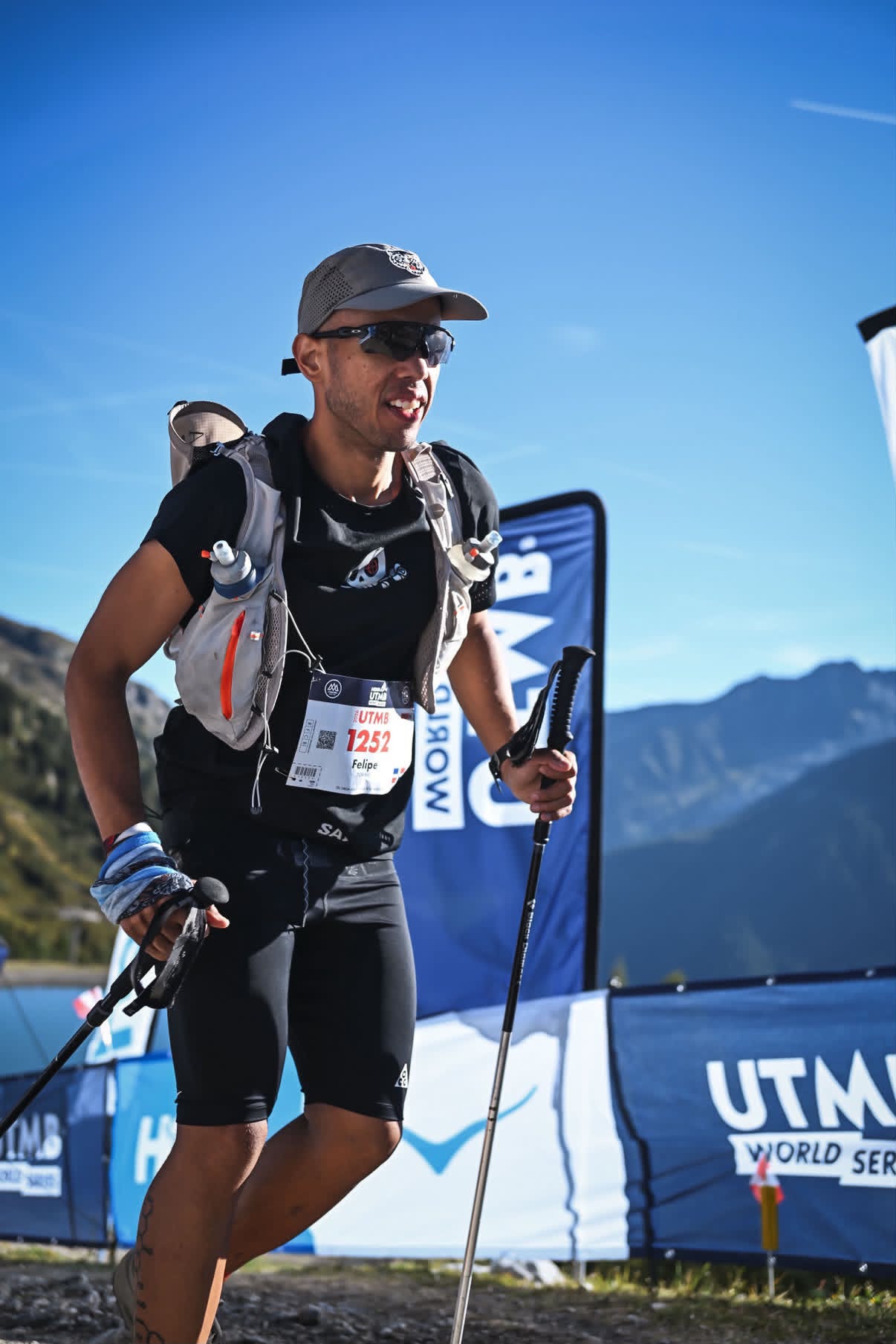 Felipe at UTMB Mont-Blanc this past August
Any specific topics that I didn’t ask about that you’d like to touch on, or any closing thoughts?
I did kind of mention it before, but I do have this big goal in my impact in the New York City running community—not that it’s a big impact, but it’s some—and that is just to get people out into the trails. And that’s why every year I’m always either doing races like BareBones, or I’m taking people on trail runs. Earlier this year we did Rim-to-Rim-to-Rim, we did the Grand Canyon, and that was with some of the OMRC peeps. And I’m always organizing these types of trail adventures.
“I want people to get out of the city and enjoy nature and enjoy the outdoors. The trails are so accessible to us, even though they seem to be so far from where we are”
And the only reason I do it is—obviously I love doing it myself, on a selfish level. But also, I want people to get out of the city and enjoy nature and enjoy the outdoors. The trails are so accessible to us, even though they seem to be so far from where we are. And it just takes a little bit of work. But that’s kind of what my personal journey is taking me toward. I’m coaching now, for example, and it’s only for trail ultra running, just because of that.