
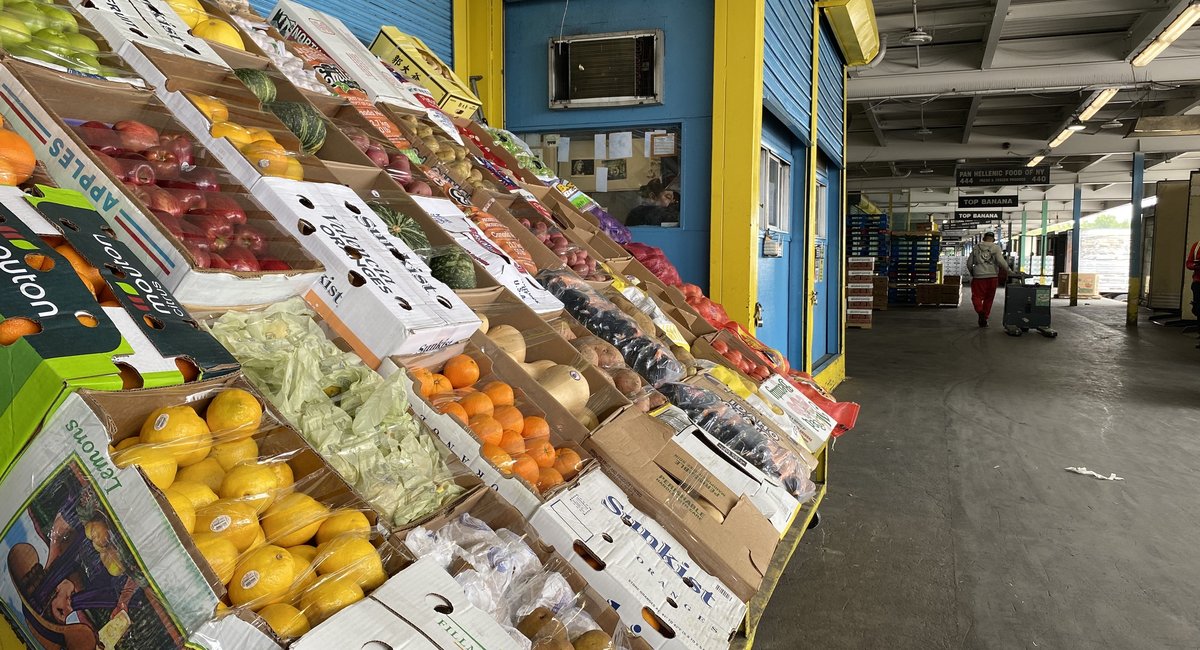
Pressure is mounting on Mayor Zohran Mamdani to revive a $650 million plan to reduce pollution at Hunts Point Produce Market in the South Bronx, where diesel-spewing refrigerated trailers contribute to some of the worst air quality in the city.
The wholesale produce market, which provides as much as 60% of the city’s fruits and vegetables, relies on as many as 1,000 refrigerated trailers running around the clock to keep food cold. Each trailer produces emissions equivalent to 330 truck trips on the Cross Bronx Expressway every day, according to a press release from Gov. Kathy Hohcul earlier this year.
After years of planning and negotiations, then-Mayor Eric Adams last year announced a plan to modernize the market, which is the largest of its kind in the country.
As part of the project, four warehouses would have been replaced by two modern facilities that would eliminate the need for the refrigerated trailers. Gothamist exclusively reported last week details on how the deal fell apart amid concerns from the cooperative of produce operators about the new facility’s design.
Mamdani has suggested the Adams administration’s plan – which was slated to receive hundreds of millions of dollars in state and federal funding – is now dead in the water. But some officials are urging him to take a second look.
City Comptroller Mark Levine described the project as “one of the most important economic development projects in New York City.”
“For a lot of reasons, we cannot let this fail,” Levine said. “You can’t leave 1,000 diesel trailers running 24-7 as a refrigeration solution in a modern American city. That’s just not acceptable.”
The South Bronx, which is one of the poorest urban areas in the country, has some of the dirtiest air in the city and high rates of respiratory illness. The refrigerated trailers, along with the trucks coming and going from the market and traffic on the Cross-Bronx Expressway, are big contributors to the pollution that gave the South Bronx the nickname “Asthma Alley.”
“The South Bronx is always kind of neglected,” said Kayla Tolentino, a 26-year-old who stood outside a building near the Hunts Point subway station. “It always gets a bad reputation.”
Tolentino, who works at BronxWorks, a social services organization, said she was diagnosed with asthma when she was six weeks old. One in five children in the area develop asthma.
Elaine Cruz, 69, said she was prescribed an inhaler about 10 years ago. “You can feel it,” she said about the pollution. “The quality of the air is very thick.”
Sitting on a corner outside a bodega on Hunts Point Avenue, Jason Johnson, 39, was visiting his old neighborhood. He said he developed asthma at 7 years old, and moved upstate four years ago because he wanted his children to breathe cleaner air.
“I come down here and I’m always congested,” he complained. “Mamdani should jump on this ASAP.”
Speaking on WNYC’s “The Brian Lehrer Show,” Mamdani blamed Adams officials for rushing the deal. He said the project’s current iteration “is not one that’s moving forward,” but added that the city has not given up on “electrifying or modernizing more of the market.”
Paul Williams, who heads the think tank Center for Public Enterprise, said the Hunts Point plan is aligned with Mamdani’s affordability agenda. The mayor has a plan to create five city-owned grocery stores, the first of which will open in Hunts Point.
“Securing and investing in the supply chain for groceries in New York City creates grocery affordability for all 8 million New Yorkers, not just in the neighborhoods where the proposed city-owned stores are,” Williams said.
Nate Bliss, a former Economic Development Corporation official who spent years assembling the plan, penned an op-ed last week in City & State arguing that Mamdani should revise – but not scrap – the plan.
“Fresh scrutiny can uncover better approaches, protect public dollars and ensure that projects reflect the current priorities,” he said. “But there is a difference between reassessing a project and starting from scratch.”
“New York cannot afford to repeatedly discard this accumulated momentum whenever leadership changes,” he added.
Some residents expressed faith that the new mayor could pay attention to their long-ignored neighborhood.
“He’s been implementing some really good things,” Cruz said. She cited Mamdani’s plans to open city-run grocery stores to increase access to fresh, affordable food and the introduction of more portable public bathrooms.
Not far from the market, the city is working with a nonprofit to build 96 units of affordable housing. The site will also be the home of Mamdani’s first municipal grocery store.
But she also wondered whether private companies in the South Bronx that rely on polluting trucks and trailers would sacrifice their bottom line to help the community.
“So would they even take the time to think of the people living in the communities and doing something about the quality of the air?” she said. “I’m not too confident in that.”