
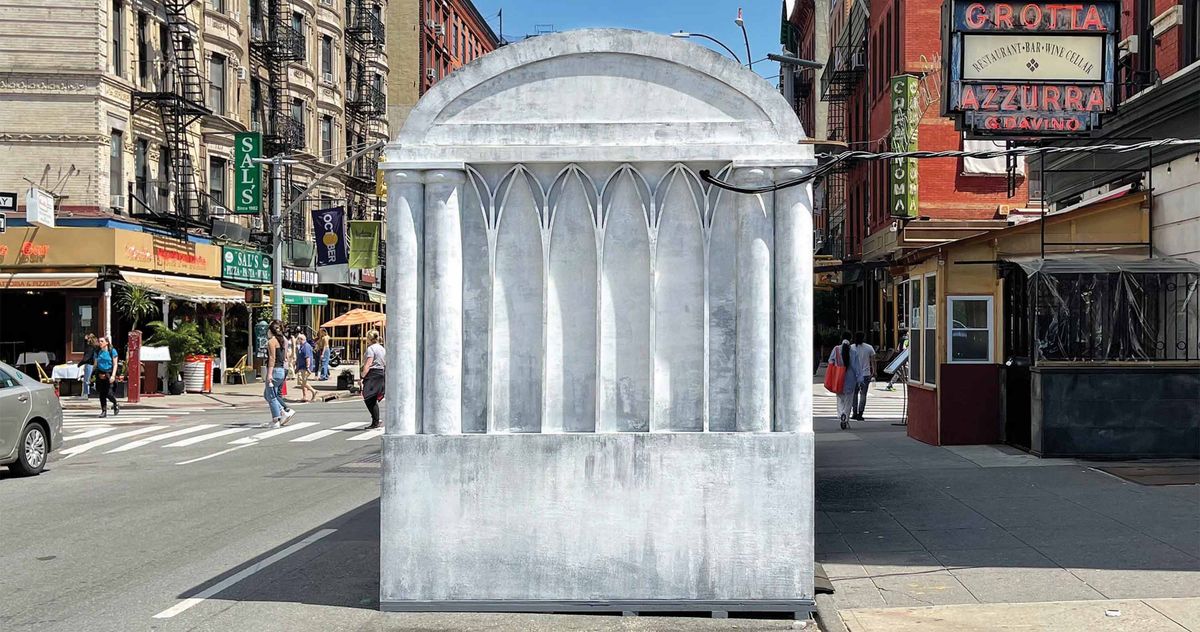
One thing a lot of New Yorkers did during the quarantine years was walk. In the evenings after many hours of working at home, I would go out and pace off 20, 40, sometimes 60 blocks to loosen up and shake off the cabin fever. So did the graphic designer Penny Hardy: “My husband was at home, my daughter was at home, and I was like, ‘I am so not going to work at home.’” The moment the tightest restrictions were lifted, she started walking to her Chinatown office, “just because I had to get out.” She’s not a professional photographer, but she set up a project for herself: “Okay, every morning you’re going to think of a theme, and you have to find three photos that capture that theme in completely different ways, so that walking to work every day wasn’t so boring.” She used no equipment more elaborate than her phone’s camera.
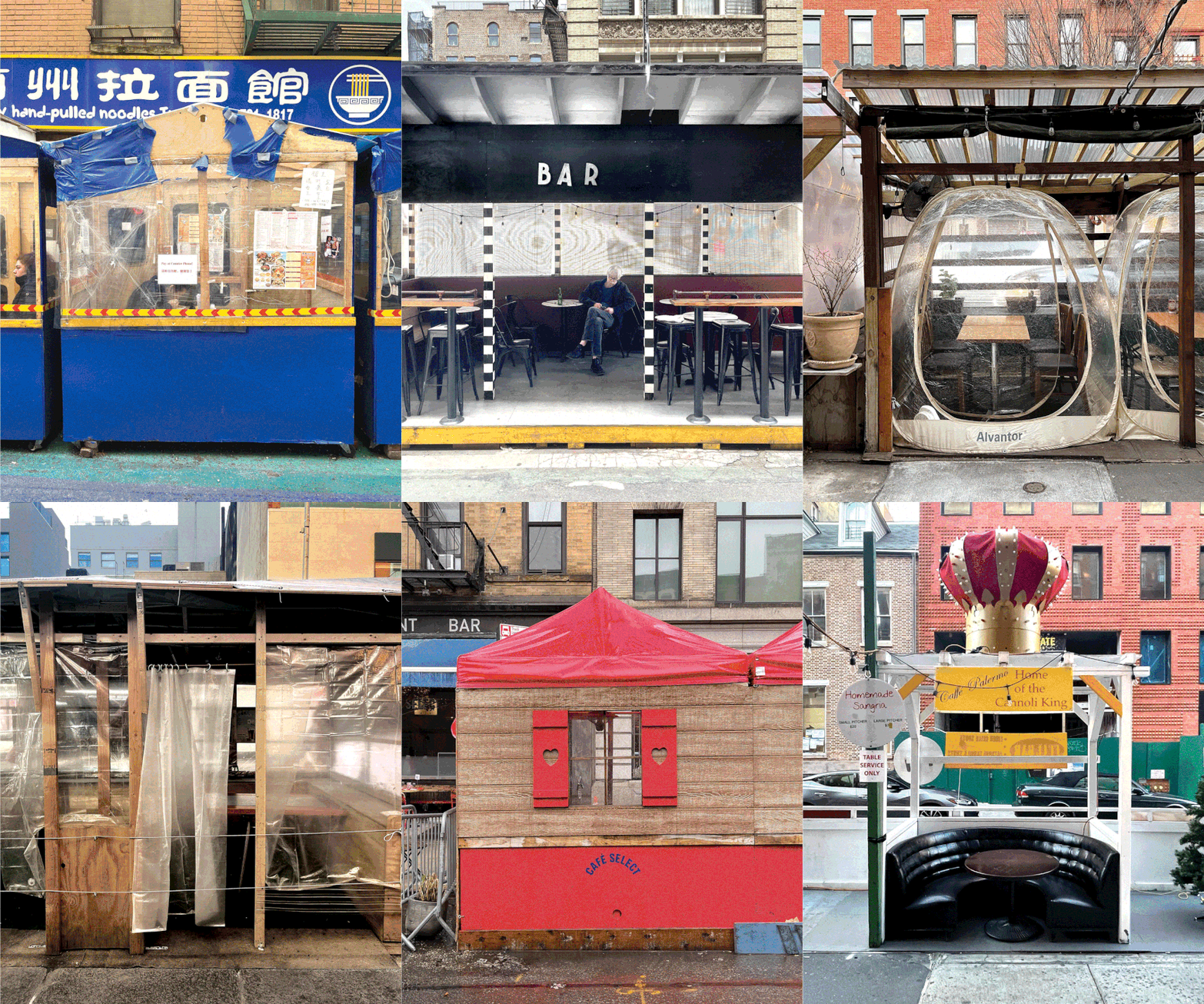
What she ended up making, semi-advertently, is a document of the first woolly, barely controlled era of the curbside dining shed, and you can spend time with it via a petite book, Pandemic Architecture, out from Blurring Books this month. It reminds us that there was, at first, absolutely no template for what one of those structures was supposed to look like. The crudest ones were just flakeboard and two-by-fours banged together. From there, the materials, forms, and finishes grew wild and irregular. Operating window sashes? Palm-frond quasi-tropical roofs? Plastic sheeting that made it seem as though you were drinking your mimosa in a decontamination bubble? Sure, why not? Cannoli King, in the remaining trace of Little Italy, plunked a charmingly janky crown on top and a semi-circular black-vinyl banquette within. They all occupied a huge aesthetic swath, from kinda grim to awesomely odd. Every one was different.
Photographs by Penny Hardy
Hardy was primed to appreciate such designs: Her studio specializes in branding for architecture firms, both of her late parents were architects, and she’s married to an architect as well. (Her father, Hugh Hardy, specialized in restorations of major historic buildings like Radio City Music Hall; New York once went salvage-shopping with him.) “I understand architecture,” she says, “but hiring an architect is just not something most people can do. It’s a luxury. So I love this spirit of people being like, I can be an architect too.” The bizarro choices of texture, the inconsistency, and the plain old weirdness of some of these structures are all things you’d never see from a pro — which supplies a different kind of pleasure hit. It’s sort of the inverse of Bernd and Hilla Becher’s renowned water-tower typology photographs, which aimed to document fine-grained differences among ostensibly similar utilitarian structures, twinning consistency with variety. Here, the family resemblances are faint at most. What ties these undesigned designs together is the curb line, always at about the same level, and Hardy’s choice to frame them all tightly on the page. Some of the more colorful sheds here come off almost like abstract paintings or assemblages.
Photographs by Penny Hardy
It’s also a document of a highly evanescent type of building. By 2023, as restaurants got their indoor spaces back open and began to get back on their financial feet, the city tightened up its outdoor-dining rules, restricting them to the warmer months (until the reversal a couple of weeks ago). The Adams administration set in place a firmer approval process and began standardizing the designs, trading the splintery free-for-all for something polished and safer and probably less vermin-friendly. But although the physicality of the streetery has grown less weird, its legacy seems to have settled into our understanding of city life. A lot of New Yorkers really did discover for the first time that taking some curb space away from parking lanes was an urban intervention worth considering. “Before, it was always like, Oh, I want to go to Paris and sit in one of those cafés on the street: How idyllic,” Hardy says. “That was not something we did in New York. And post-COVID, the street is this communal social place that it was not before.” We need not mourn the weird first-gen sheds: They were built to endure a season or three at most, and they served their purpose, like NASA booster stages dropped off into the sea. We kept the important part: the streetside taco experience within.
Pandemic Architecture: NYC Dining Sheds 2020–2024 will be published by Blurring Books on October 13.
Sign Up for the Curbed Newsletter
A daily mix of stories about cities, city life, and our always evolving neighborhoods and skylines.
Vox Media, LLC Terms and Privacy Notice