
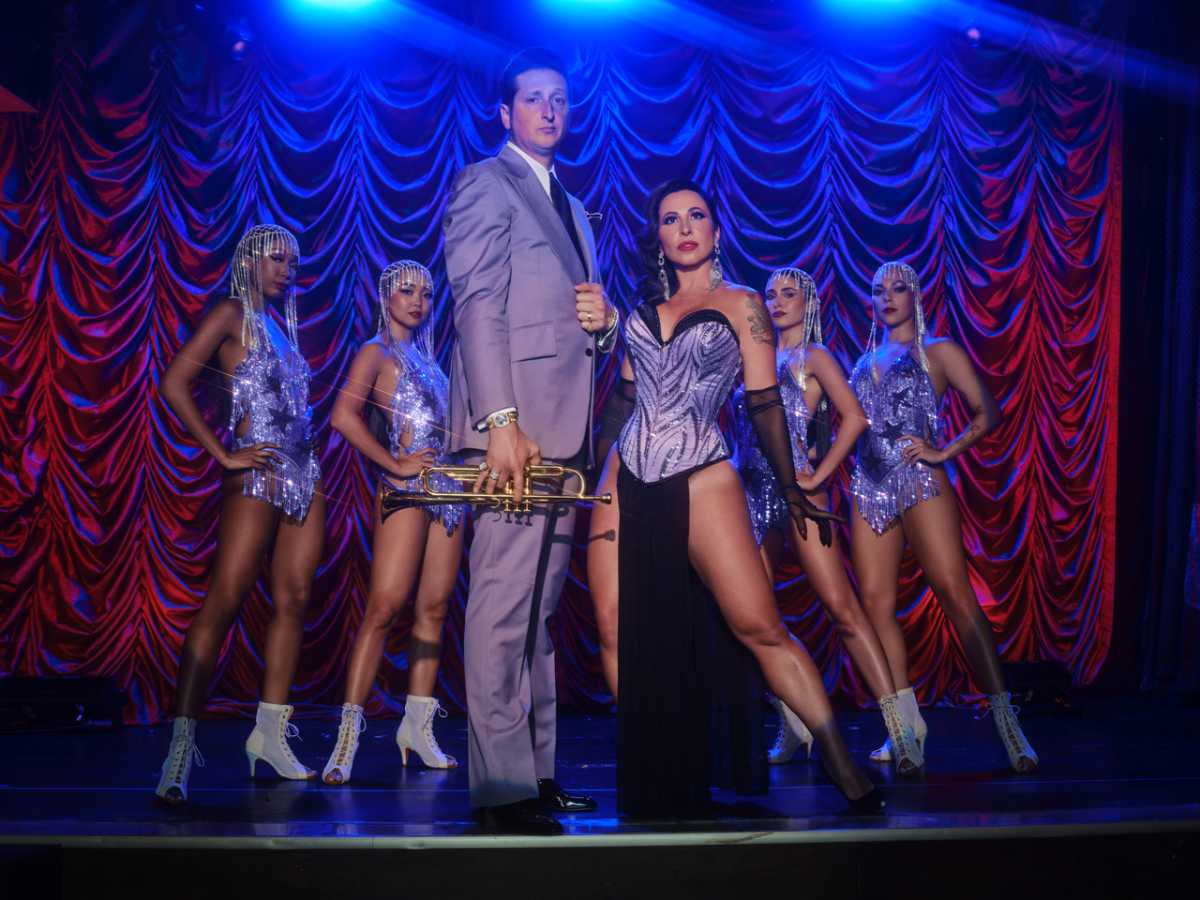
For more than two decades, Brian Newman has made a living out of moving between worlds.
There are the glamorous ones: stages with Lady Gaga, performances with Tony Bennett, packed clubs and hotel lounges, red carpets and international tours. Then there is Marine Park, where children ride their bikes down the block, the butcher knows his customers by name and, as Newman puts it, you can still “walk, talk and engage every time you walk out your door.”
The contrast is part of what makes Newman’s career feel distinctly New York.
A singer and trumpet player, Newman arrived in New York in 2003 with little more than a U-Haul, $500 and the determination to find a way to stay. He waited tables, took gigs wherever he could find them and scoured Craigslist for opportunities. More than 20 years later, he has built a career that has taken him around the world — while continuing to make Brooklyn home.
“I just started beating the pavement and looking for work, waiting tables, whatever I could do to stay here,” Newman told Brooklyn Paper. “At the same time, I was taking gigs off of Craigslist and just trying to meet as many people as I could and really just make those connections.”
He had come to the city with a simple conviction: that he had something to say.
“I knew there was something that I had to say to the world and something that I could do to make people feel good,” he said. “That was really my goal.”
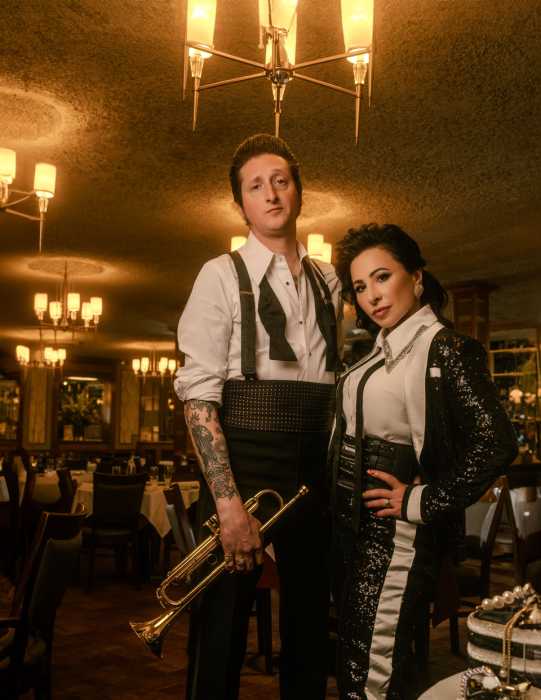 Trumpeter Brian Newman moved from Ohio to New York City in 2003, with just $500 and a dream to make it in the lively music scene.Photo by Ab Sesay
The philosophy has followed him through nearly every chapter of his career.
Newman’s path eventually led him to Gaga, then Bennett, including a now-famous night at the Robin Hood Gala. Newman was in Cleveland visiting his parents when Gaga called and asked if he could make it to the Javits Center that evening. His father drove him to the airport immediately. When he arrived, a cart was waiting to whisk him through the airport — a first glimpse of a world far removed from the one he had entered in 2003.
Angie Pontani, Newman’s wife and creative partner, brought his suits to the city for the performance.
Bennett happened to be there.
“I remember him coming backstage and just saying to Gaga, ‘We should do a record together,’” Newman recalled, referencing the birth of the 2014 album “Cheek to Cheek.”
The collaboration with Bennett followed, as did years of work with some of the biggest names and venues in entertainment.
But Newman is wary of describing any of it as a single “I made it” moment.
“I don’t know if I ever feel like that,” he said.
In the show business, he and Pontani joke, the distance between glamour and grit can be remarkably short.
“One day you’re on the red carpet and the next day you’re getting changed in a bathroom,” Newman said.
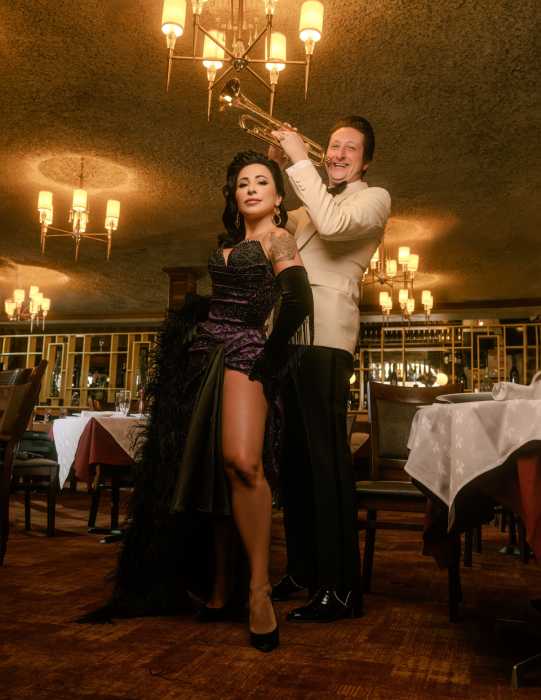 Aside from his solo pursuits, Brian Newman serves as Lady Gaga’s bandleader.Photo by Ab Sesay
For Newman, the more meaningful milestone has been less about the fame than sustainability: paying the bills, finding good work and creating spaces where other artists can do the same.
That has meant becoming not only a performer but a curator of New York nightlife. He has programmed music at the Roxy Hotel, worked at the Rose Bae and the Oak Room at The Plaza, and developed shows that bring musicians, dancers and performers into the same room.
His creative partnership with his wife grew from that same intersection.
Pontani, a longtime burlesque dancer, producer, choreographer and costumer, has spent years working to push burlesque farther into mainstream culture. Together, she and Newman produce their After Dark show, where live jazz and burlesque meet in a deliberately unpredictable format.
“I’m so spoiled rotten as a burlesque dancer to be able to perform with this band,” she said. “It’s almost ruined me in a sense because now when I go out and I work on my own, I’m like, ‘Oh, I have to perform to a track?’”
With a live band, she said, a performance can stretch and respond to the room.
“We can make that song five minutes. I can change where the bumps are. We can ride the wave of energy with the audience together,” Pontani said. “When we’re on stage together, it’s like I’m a member of the band.”
The couple’s working relationship is not always as harmonious backstage.
“We have two different working styles when it comes to pre-production,” Pontani said. “But we meet on stage and we’re good.”
Newman laughed.
“Yeah, all bets are off on stage,” he said.
Once, after a particularly heated argument before a show in Las Vegas, the pair took the stage and somehow turned their frustration into one of their best performances.
“We were literally looking in our eyes,” Newman said. “I was playing trumpet. She was dancing and…”
Pontani said, “I was hissing at him.”
“Everybody said, ‘You guys were great tonight,’” Newman recalled.
“We’re like, ‘That’s ’cause I wanna kill him!’” Pontani said.
That ability to turn tension into energy is part of what the couple sees as the larger purpose of live entertainment: getting people out of their own heads and into a shared moment.
Newman said his experiences with Bennett and Gaga only reinforced something he already believed — that the work ultimately comes down to people.
“It just solidified for me that this is the way to act,” he said. “It’s all about people. It’s all about your craft, your music and bringing people to that and creating happiness and life and love.”
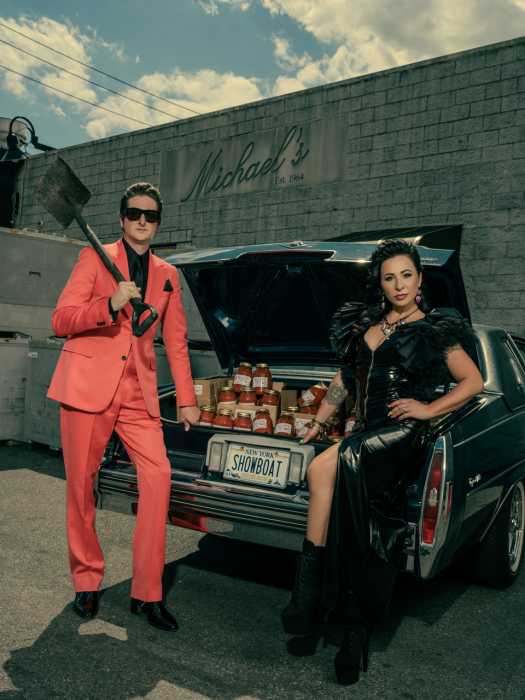 Brian Newman and his wife Angie Pontani have been longtime collaborators, combining music and burlesque.Photo by Ab Sesay
That philosophy also informs how Newman thinks about New York’s music scene. He has watched the city’s nightlife change over the more than 20 years he has worked here. But rather than focusing on what has disappeared, he is interested in what can still be built.
“I never got into the jazz culture. I don’t like the ego, I don’t like the cliquiness of it,” Newman said. “I’m not trying to impress a bunch of jazz musicians. I’m trying to bring love and light and music to people in a fun way and like, as an entertainer.”
His larger mantra is simple: “There’s room for everyone.”
“And if you don’t see a space for you, you have to create it,” he said.
It’s a philosophy that seems fitting for a musician who has spent his career moving between the old and new versions of the city.
Newman’s musical influences stretch across generations, from Cole Porter and Louis Armstrong to Nirvana, Sting, Thin Lizzy and Earth, Wind & Fire and Bruce Springsteen. He sees no contradiction in putting them in the same musical universe.
For him, they are all part of the same evolving American musical tradition.
“Their influences were Cole Porter and Louis Armstrong and those guys,” Newman said of earlier jazz musicians. “But for me, my influences come from growing up in the ’90s and the 2000s and in the ’80s even. We do so much of that era of music.”
His latest album, “Songs for Lonely Lovers,” leans into the older side of that equation.
The record, which will receive a vinyl release at a party at Lincoln Square’s Joanne Trattoria on Nov. 6, draws heavily from the Great American Songbook and from the intimate recordings Tony Bennett made with pianist Bill Evans. Newman wanted the record to feel less like a polished studio artifact and more like a moment captured in a room.
“The songs all have depth. The lyrics are heartbreaking at times,” he said. “And those kind of songs, all the sad ones always make me happy. That sounds cheesy, but it lifts you up.”
The recording process was similarly stripped down. Newman worked with a small group of musicians, including pianist Caelan Cardello, recording live rather than building the songs through layers of separate tracks.
“Everything’s live, not processed and not overdubbed,” Newman said. “It just captures the moment, and I hope people feel they can get sucked into the moment that we were in when we were recording it.”
He imagines the record being played in all kinds of settings: at dinner, during a breakup or, ideally, somewhere with the atmosphere of an old New York jazz club.
“If you could be in like a smoky bar, if they still allowed smoking in bars — that’s where I would love to listen to it play,” Newman said.
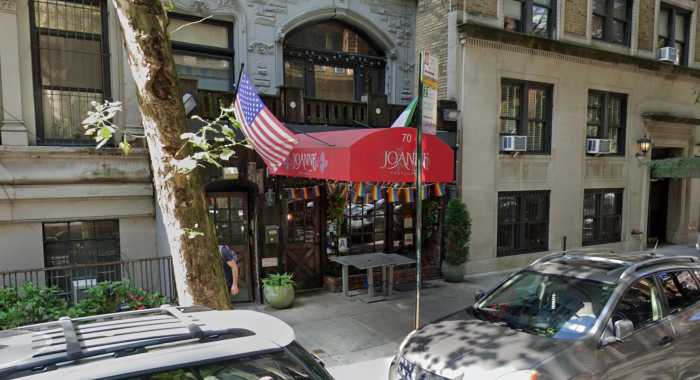 The vinyl release party for Brian Newman’s “Songs for Lonely Lovers” will take place at Joanne Trattoria on Nov. 6, owned by the Germanotta family.Photo courtesy of Google Maps
The choice of Joanne for the vinyl release is fittingly personal. Nov. 6 is Pontani’s birthday, and the couple chose the venue because it feels less like a concert hall than a gathering place. It’s also owned by Gaga’s family.
“I would love to spend my birthday at Joanne’s, because it feels like family,” Pontani said. “And it’s an intimate space, so we really want that vibe to be like almost like a family party.”
That sense of family extends beyond the stage.
Newman and Pontani have lived in several Brooklyn neighborhoods over the years, including Williamsburg and Kensington, before settling in Marine Park. For them, the move was not simply about space. It was about finding a version of city life that still felt like a neighborhood.
“I personally love the small community feelings of Brooklyn neighborhoods before they become fully gentrified, and you still have so much of that here,” Newman said.
There are butchers and multigenerational families. Their daughter can ride her bike around the block. Neighborhood children run in and out of their house.
“We love that,” she said.
The city is still close enough to remain part of daily life. But in Marine Park, the couple has something that can feel increasingly elusive in New York: room.
“We have a yard,” Newman said.
For artists who spent years chasing opportunity through Manhattan clubs, hotel lounges and tiny stages, that may be its own kind of luxury.
Newman remembers when Brooklyn was simply the more affordable place to live. Now, he sees his neighborhood as something more precious.
“I feel like this is the last vestige of some affordability for artists,” he said.
It is perhaps fitting that a musician whose career has been built on crossing boundaries — between jazz and rock, burlesque and live music, old standards and contemporary influences, neighborhood bars and international stages — would find his center in a place that still feels, to him, like a neighborhood.
The red carpets will come and go. So will the clubs, the tours and the next big gig.
But in Marine Park, there is a yard. There are neighborhood kids. There are familiar faces on the block.
And there is still a place to come home to.