
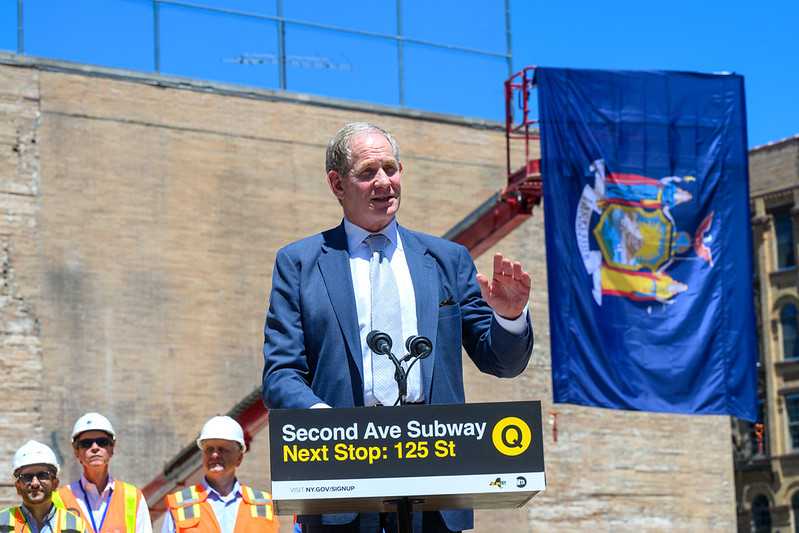
Central Harlem business and community leaders implored MTA Chair and CEO Janno Lieber on Monday to include them in the decision-making process as the transit agency continues to study the possibility of expanding the Q line westward below 125th Street to Broadway.
The leaders, with organizations including the 125th Street Business Improvement District and Manhattan Community Board 10, peppered Lieber with their community engagement concerns during an Oct 5. event hosted by the BID at the Studio Museum in Harlem. They expressed fears that the MTA will charge ahead with the possible next phase of the Second Avenue Subway without including local businesses and residents in the planning.
Phase 2 of the Second Avenue Subway, which will expand the Q train from 96th Street and Second Avenue to 125th Street and Lexington Avenue, is currently under construction. It will add three new stations to the line at 106th, 116th, and 125th Streets — an expansion that will connect the transit desert of East Harlem to the subway system.
Phase 1 of the project, which was completed in 2017, extended the Q to 96th Street and Second Avenue — fulfilling a decades-long quest to establish a subway line below Second Avenue, albeit only a fraction of what has been sought.
During the event, Manhattan Community Board 10 Chair Marquis Harrison, addressing Lieber, said that engaging with the MTA “can sometimes feel like we’re being told what is going to happen rather than being asked what should happen.”
“What will the MTA commit to doing differently to ensure that Community Board 10 and its residents of Central Harlem have a formal, meaningful, and continuing role in shaping the planning, design, construction, mitigation, and any future and westward expansion of the Second Avenue Subway?” Harrison asked Lieber.
Barbara Askins, president and CEO of the 125th Street BID, also aired her concerns to Lieber. She urged the MTA boss to collaborate with local leaders in developing a new approach to community engagement — including by notifying businesses right away about changes to construction plans.
“Work with the community and come up with a different model that works to keep the businesses going,” Askins said.
Lieber: There’s ‘always room for improvement’ on Second Avenue Subway planning
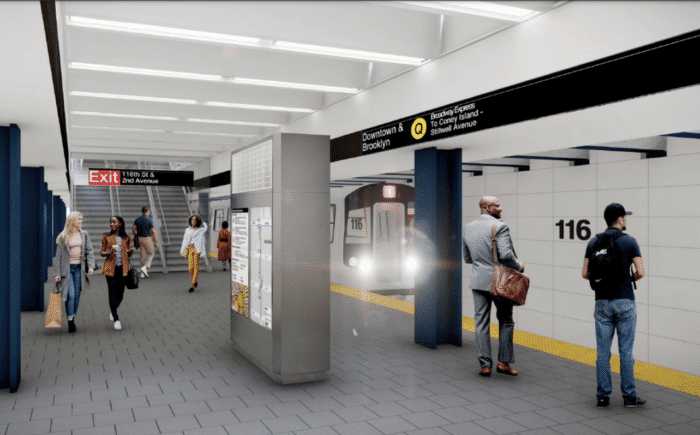 A rendering of the Second Avenue Subway extension to East HarlemMTA
The MTA chair responded by pointing out that there will be a formal community engagement process if and when the project enters the required environmental review stage. He also noted that the MTA has a “formal outreach team” whose job it is to hear from local residents and get them involved in the project.
But Lieber acknowledged that there is “always room for improvement.”
“Let me reassure you: this idea is at the early stages,” Lieber said. “So just the fact that you’ve heard about it in concept does not mean that we’re just running ahead without talking to anybody. The process of engagement and the environmental review is just beginning because it’s an idea the governor funded only a couple of months ago. So let’s get the discussion going.”
The project’s proposed westward expansion phase became the focal point of Monday’s event after Gov. Kathy Hochul committed funding to design and engineering for it in the state budget earlier this year. Her allocation followed the MTA’s completion of a feasibility study that looked at the possibility of keeping the tunnel boring machines, currently digging out part of the East Harlem phase, running across 125th Street to Broadway.
However, it is hardly a done deal, and the East Harlem section is not slated to be finished until 2032.
The pleas from Central Harlem leaders come as local officials and business owners in East Harlem have raised concerns about how the construction on Phase 2 has already negatively impacted their bottom lines.
According to published reports and a recent op-ed, penned by Queens City Council Member Shanel Thomas-Henry (D-Queens) and area Council Member Elsie Encarnacion and published in amNewYork, local businesses have seen sizable drops in their daily sales since construction on Phase 2 began. For instance, the two council members cited one case of a florist telling them that on some days they are making just 1% of their pre-construction average daily sales.
Business owners have said the issue stems from construction fencing, around where the MTA is digging out the new tunnel and stations on Second Avenue, making it difficult for pedestrians to see their storefronts.
“Long-standing businesses are on the verge of total collapse, and there is far too little clarity about what will happen to those businesses being displaced by construction,” the lawmakers wrote. “Simply put, without intervention, they will not survive if assistance is not guaranteed.”
The lawmakers called on the MTA to establish a “mitigation fund” that could reimburse small businesses for lost revenue and other financial impacts of construction.
But Lieber insisted that the MTA has already been taking steps to temper any disruption the construction is causing to businesses along Second Avenue.
“Even on the construction right-of-way, where we have to put up fences, we’re putting up signage to identify every business, so people will know they’re still open for business,” Lieber said. “And we are also prioritizing buying goods and services from folks in the community.”