
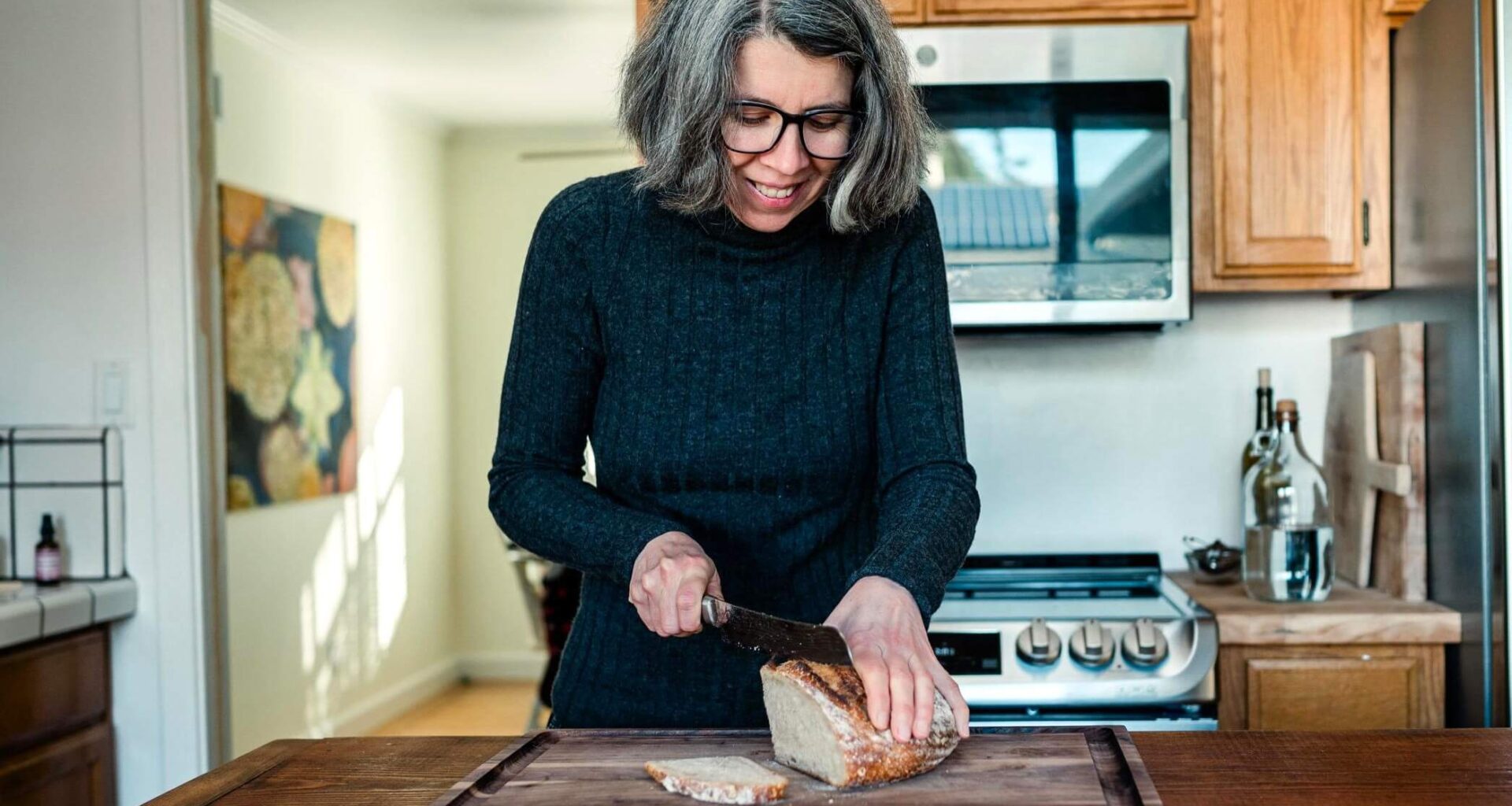
Long before lockdowns led the rest of us to develop codependent relationships with our sourdough starters in 2020, Anne-Marie Bonneau had declared hers — named Heloise after a tragic Middle Ages figure who was ultimately dispensed to a nunnery — a “dud.”
Bonneau was already well acquainted with baking bread when she created Heloise and began experimenting with sourdough. Her mother-in-law ran a bakery and taught Bonneau years earlier using dry yeast, though she left an offhand comment hanging in the air: “Now a real baker will use yeast that they capture to make their bread.”
It took Bonneau a couple of decades before she took on her mother-in-law’s implicit challenge in 2013, after she read Michael Pollan’s Cooked: A Natural History of Transformation (available on Amazon and Thriftbooks), which, she says, has a big section on sourdough. “Okay,” Bonneau remembers thinking, “I’m gonna try this.” Her loaves, however, didn’t rise as she would have liked, and Heloise, her first sourdough starter, took the heat.
In hindsight, she wonders if she was too hard on Heloise. She was “just fine,” Bonneau says now. Nonetheless, Heloise was out (“eaten, which is a thing people sometimes do,” Bonneau says. “I probably turned her into crackers”), and Eleanor — named after Eleanor of Aquitaine, and who recently turned 12 — was in.
Success wasn’t immediate. “It took time,” Bonneau says. “I started to take notes. … That way, if I did want to change one little thing, there’d be a note of it, and then I could later on look back and see, ‘Okay, well, how did that loaf turn out with that one change?’” She experimented, making small tweaks, such as changing whole-wheat for spelt flour. Her “tons and tons of notes,” included bits about her day, as much diary as troubleshooting guide. Though it took a while, Bonneau eventually — and consistently — produced loaves she was happy with.
Indeed, she’s so confident in her sourdough that she started to offer classes via her website, Zero-Waste Chef. A class is a great way of demystifying the process, she says. But once people see how easy it is, they’re often surprised. “One woman who took it said, ‘Really? That’s it?’ I think she wanted her money back.” Bonneau laughs. “Yeah, it’s simple when someone shows you!”
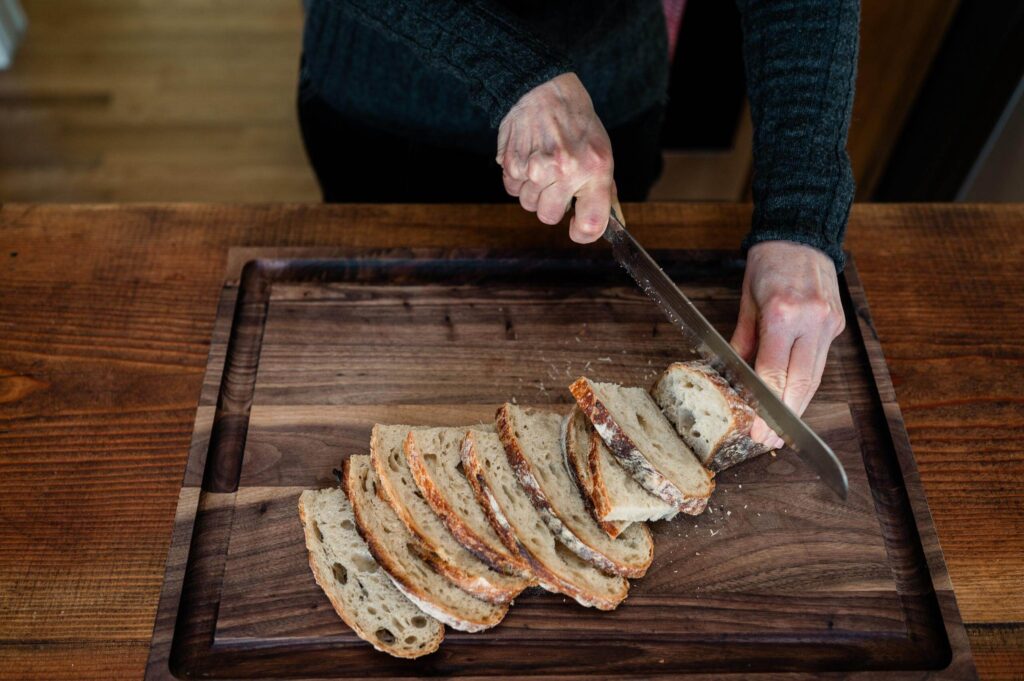 Anne-Marie Bonneau slicing sourdough bread. – Photo by Sree Sripathy
If you can’t take a class (Bonneau is currently living with her 94-year-old mother in Canada and hasn’t been offering them lately), she suggests getting a starter from a friend who’s got one, or even buying one from a local vendor or online. Otherwise, you can make it on your own using her recipe below.
And then … be patient, something Bonneau admits she wasn’t with Heloise. There’s a smell that throws people off, she says. “It will smell really bad,” she says, “And a lot of people think, ‘Oh, I ruined it,’ and they throw it out — hopefully to composting.” The smell, she promises, will go away, if you keep feeding it. (See box for tips.)
On the day we spoke, Bonneau had a friend coming over that evening for some sourdough coaching. The friend had bought a banneton basket — used to “proof” sourdough, the fermentation process by which bread rises — and a scale. Bonneau doesn’t go in for gadgets much herself, though she says a scale is nice to have. That way, you’re not stuck counting cups of flour only to have your phone buzz mid-count and, she says, “you start looking at cat videos” and lose track. Though also not necessary, she adds, “a grain mill is an awesome thing to have.” While she hasn’t milled all her flour, she sometimes mills about 60% of it, and “it’s amazing.” It’s so good, in fact, that her daughter, returning home from school one day and taste-testing a loaf, turned to her mother to announce, “you have a problem now.” Bonneau nodded. “Yeah, now I have to always grind my own flour.”
The thing with a sourdough starter, Bonneau notes, is that “it’s alive, it’s full of live cultures,” which creates a connection between a baker and their bread. Much more so, say, than baking a dozen chocolate chip cookies or cooking a pot of soup. “If anything happens to Eleanor, I’ll be sad,” she said. “It’s like a pet.”
To those who are struggling with their own starters, Bonneau recommends taking some pressure off. “They don’t have to make bread right away. They can make pancakes or crackers … until they get the hang of feeding it. Once your starter comes to life and you start feeding it regularly … it’s just so easy.”
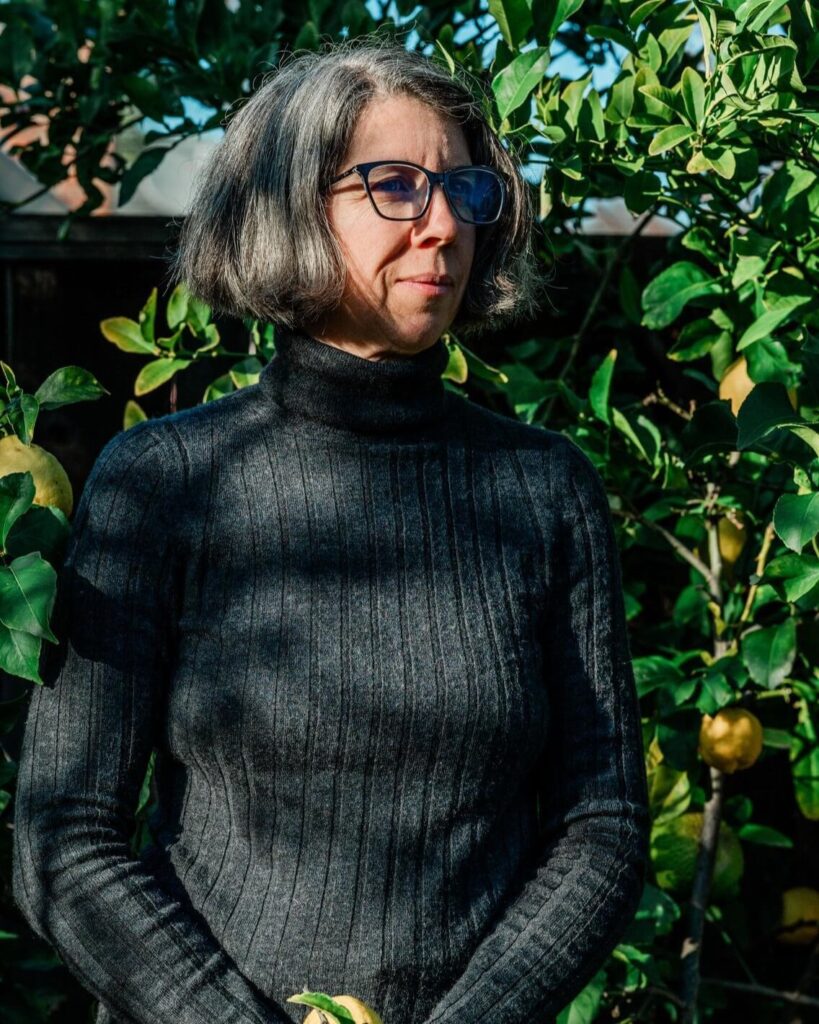 Anne-Marie Bonneau. – Photo by Sree Sripathy
The ease is a big part of what Bonneau loves about sourdough. “It’s three ingredients: flour, water, salt. That’s it. That’s all you need to make the best bread.”
She steers clear of making 100% whole-wheat flour bread because, she finds, it turns out “too dense. Others might be better at it.” Instead, she always adds a bit of all-purpose flour. Her tried-and-true ratio is 60% whole-wheat flour, 25% rye, and 15% all-purpose.
She bakes her bread in Dutch ovens. “That imitates a professional baker’s oven that injects steam into the interior of the oven,” she says. She bakes a loaf at 450°F for 20 minutes with the lid on, and then checks on it. “That’s when you know if it’s risen. I always brace myself, ‘Did it rise?’” Presuming it did, she continues baking for another 23 to 25 minutes with the lid off. You can bake without a Dutch oven, she says, but you won’t get that nice, somewhat shiny crust.
Bread is a simple food, one that exists in some form or another in every culture in the world. Sourdough specifically traces a history back to the Egyptians in 3,500 BCE. And yet, we’re still trying to master the perfect loaf. Our Queen of Sourdough is close, even as she continues to reach for perfection. “I live in Silicon Valley with a whole bunch of billionaires,” Bonneau says, “and when I pull my little bread out of the oven and I slice into it and eat it, I know that no one is eating bread better than that. Even though I’m just in my little humble kitchen, there’s no billionaire eating better bread.”
Let’s Get this Party Starter-ed!
So, you’ve taken a class, followed Bonneau’s recipe below, or bought your starter. Now, Bonneau says, let it sit. Stir it every day. After a few days, you might see a couple of bubbles. Wait. Do not feed it yet, though many do. “By doing that, they remove a lot of the yeast that’s just getting started in there and then it just dies,” Bonneau says.
You’ll begin to notice a smell. This is where a lot of people think there’s something wrong, Bonneau says. “It probably won’t smell good. It’s possible it will smell fruity, but I find it usually doesn’t smell that good … like bad cheese or dirty socks. You’ll know the aroma.”
When you smell it, then it’s time to feed your starter. “If you’re unsure, just wait. A day … even a little longer.” Then feed it. Feeding involves removing most of your starter, then adding lukewarm water and flour to what remains. (Get the full instructions below.) You’ll need to feed it for several days before it’s ready to be used in cooking, but you can save the “discard” to use in other recipes, like the Easy 5-Ingredient Biscuits and the Ultimate Pumpkin Sourdough Discard Muffins below.
It’s not necessary to name your starter, Bonneau says, but she does suspect we’ll take better care of it.
Recipes!