
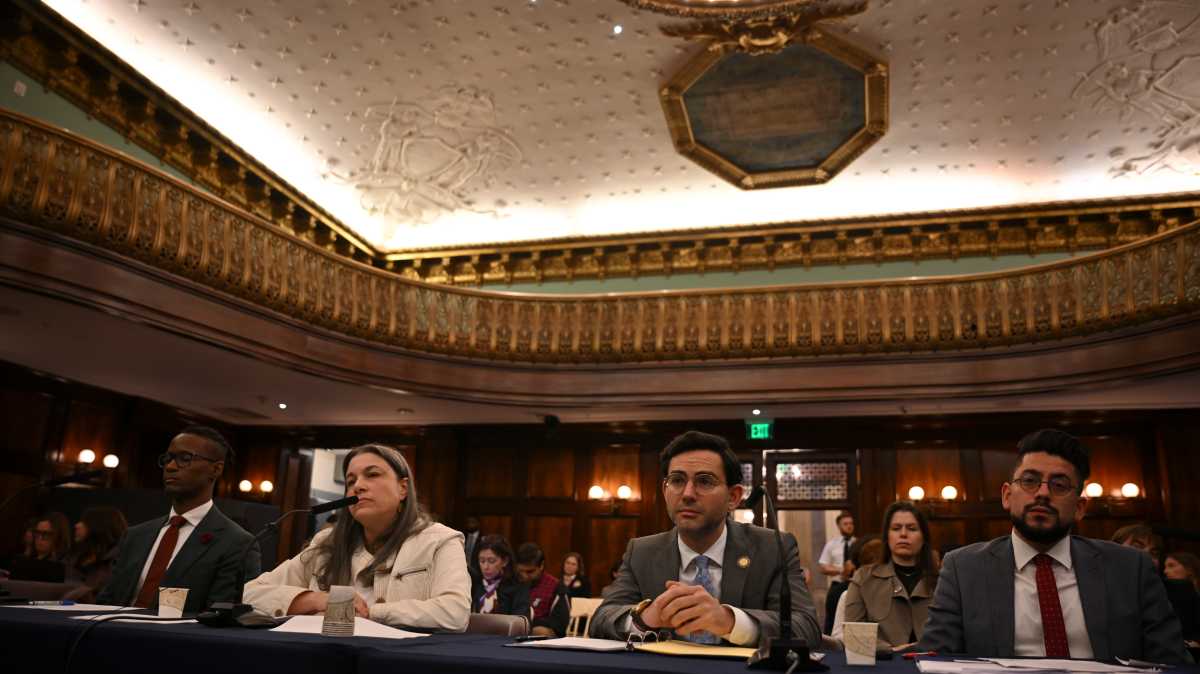
New York City says it is prepared to defend its computer systems from AI-powered attacks. Keeping tabs on how its own workers are using the technology is another story.
At a marathon City Council hearing Monday, officials in the Mamdani administration acknowledged that the city cannot technically monitor employees’ use of outside AI tools, is still staffing the office charged with overseeing algorithmic systems, and does not yet know how the technology could reshape its workforce.
The admissions offered a different side of the AI risks lawmakers spent much of the day examining. Earlier, representatives from OpenAI, Anthropic, Meta and Google were questioned under oath about safety testing and increasingly autonomous systems, while former industry researchers warned about the potential consequences if those safeguards fail.
For city government, one of the more immediate concerns is what officials called “shadow” AI use, in which workers or agencies turn to tools outside the city’s approved systems.
Sarah Milstein, OTI’s deputy commissioner for strategic advisory services, said the city has distributed an AI contract rider intended to address intellectual property, security, privacy and the use of city data when agencies purchase software. She also said the city’s contract with Microsoft prevents the company from using city worker data to train its models.
But when lawmakers asked about city workers using outside AI tools or personal accounts, Milstein acknowledged a significant blind spot.
“In terms of the shadow use, which I think is probably both at the individual and at the agency level, we are not in a technical position to monitor that,” Milstein said.
When Council Member Julie Won (D-Queens) asked who would police such use, particularly when constituent data could be involved, Milstein said she would follow up.
NYC staffing Office of Algorithmic Accountability to help check AI
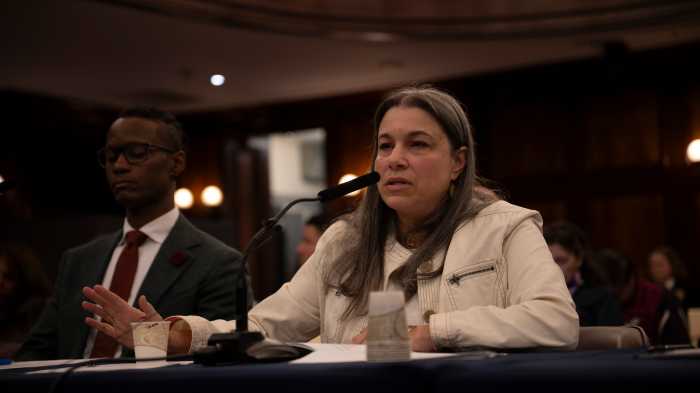 Sarah Milstein, deputy commissioner for strategic advisory services at the Office of Technology and Innovation. Photo by Lloyd Mitchell
The city is also still staffing the Office of Algorithmic Accountability, which is charged with assessing algorithmic tools submitted by agencies for risks including discriminatory decision-making.
Milstein said six new positions were funded for the office and that OTI hoped to announce a director “in the next week or two.” She said finding candidates with both AI expertise and an understanding of city government has been a challenge.
Council Speaker Julie Menin questioned the pace of the rollout, arguing that the office was supposed to be operating by June and that OTI had failed to complete required rulemaking.
Milstein disputed that, saying OTI is “fully compliant with the law,” and that rulemaking will continue this fiscal year.
Outside experts later questioned whether the city has enough capacity to enforce the AI rules it already has, much less new ones.
Julia Stoyanovich, an NYU professor and director of the university’s Center for Responsible AI, told lawmakers that the city “does not have an AI law problem as much as it has an enforcement problem.”
She pointed to Local Law 144, which regulates certain automated employment decision tools, saying it has generated two complaints and no penalties in three years.
“The kill switch won’t help if no one is there to pull it, and a whistleblower bounty won’t help if no one is there to act on the report,” Stoyanovich said of proposals before the Council.
The administration also acknowledged that it does not yet know what AI will mean for its own workforce.
OTI is studying how algorithmic tools could affect city employees, with Milstein saying findings are expected to emerge over the course of 2027.
She said state civil service law currently places a moratorium until 2028 on discharging or displacing city and school district workers, or transferring duties they currently perform to an AI system.
Milstein said that gives the city time to examine possible displacement, deskilling and the use of subcontractors as AI becomes more widely adopted.
Mamdani admin confident about cybersecurity
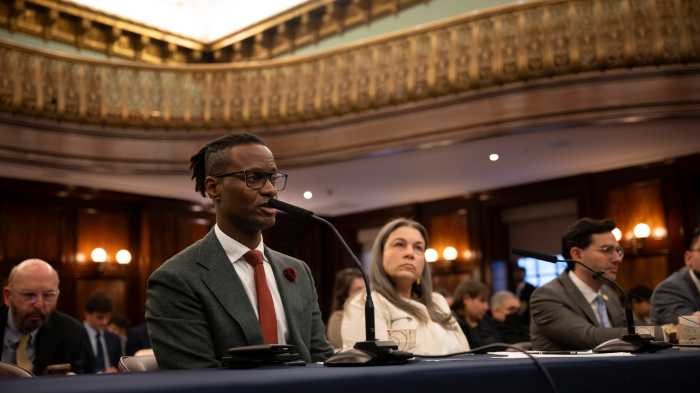 C.J. Dixon, head of New York City Cyber Command, testifies before the City Council on Oct. 5, 2026, during a hearing on artificial intelligence safety and regulation. Photo by Lloyd Mitchell
On cybersecurity, however, the administration struck a more confident tone.
C.J. Dixon, who leads New York City Cyber Command, said the city has around-the-clock detection and response capabilities and that an AI attacker would generally exploit the same underlying computer vulnerabilities as a human attacker.
“We would still respond functionally in the same manner,” Dixon said. “We would just have to do it faster.”
Asked about an AI-driven attack resembling a recent overseas incident raised by a council member, Dixon said the city has the “people, process, technology” and some of the policies needed to respond.
But he drew a distinction between conventional cyberattacks carried out with AI and other risks unique to AI systems, saying not every AI-related threat falls within Cyber Command’s traditional role.
That distinction also surfaced when lawmakers asked whether the city could operate a proposed human “kill switch” for AI systems.
Dixon said he supported the concept “in principle,” but that distributed AI systems make such a switch difficult to implement. Cyber Command and OTI, he said, do not have the authority or technical capability to simultaneously shut down all parts of a system operating across multiple entities.
“It gets harder and harder for any singular solitary entity to turn it off specifically,” Dixon said.
The administration also pushed back on a Council proposal requiring public notice of certain AI safety incidents within 24 hours, saying such a deadline would conflict with current law and could compromise an ongoing cyber investigation.
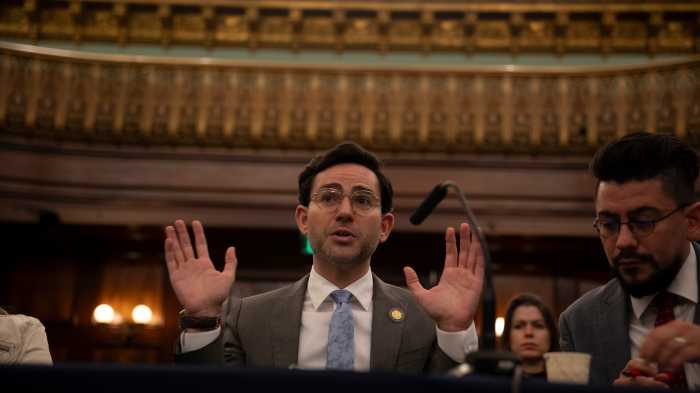 Samuel Levine, commissioner of the Department of Consumer and Worker Protection. Photo by Lloyd Mitchell
Officials also acknowledged that some AI complaints would exceed the city’s expertise.
DCWP Commissioner Samuel Levine said his agency could investigate a worker’s claim that an algorithm resulted in improper pay, for example. But a complaint from an AI-company employee alleging that a frontier model could pose catastrophic dangers would be another matter.
“That is not something we have the capacity to do,” Levine said, pointing instead to the state Attorney General’s office. He said the city has a close relationship with the AG and could help route complaints that fall outside DCWP’s expertise.
Other witnesses later in the hearing urged the city to concentrate on areas where local government has direct authority.
Nathan Sheard of the Electronic Frontier Foundation called on officials to fully staff the Office of Algorithmic Accountability and said it should review autonomous AI systems before agencies deploy them.
Jukay Hsu, founder of Bright Futures, pointed to policing and workforce development as areas where city decisions could have immediate consequences, while also urging officials to preserve New York’s role as a technology hub.