
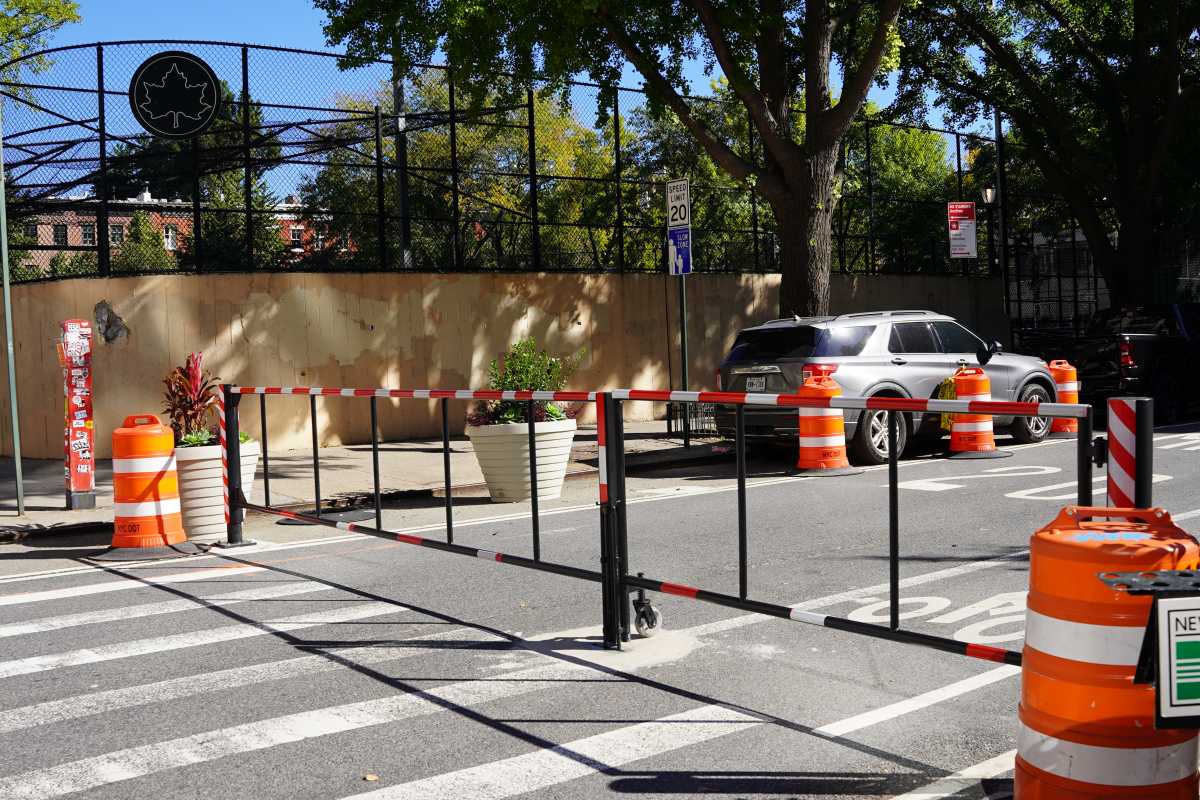
New York City officials gathered with advocates outside of a Lower Manhattan school on Tuesday to usher in the Big Apple’s first permanent “School Street.”
The assembly gathered on Clarkson Street on Oct. 6 to usher in the five boroughs’ first block under its School Streets program, part of its Open Streets program, to be cordoned off by a permanent swing gate. The section of Clarkson Street sits between Varick and Hudson Streets, where both the City-As high school and P.S. M721 are co-located.
The metal swing gates are located on both ends of the street and are affixed to the roadbed; they can be closed to block vehicles throughout the school day and opened to allow traffic the rest of the time. The gates will be shuttered between 10:30 a.m. and 3 p.m. every school day, allowing for students to use the road space for recess, pick-ups and drop-offs, and other outdoor activities.
Those gathered christened the new gates with a ceremonial swing.
The Clarkson Street gates’ permanent installation makes them stand out from methods used for all of the city’s other School Streets. Those have instead been blocked off by movable metal gates, a design city Department of Transportation Commissioner Mike Flynn said has led to challenges.
“It made sense as an interim step, but had a lot of challenges in terms of who’s moving it? Who’s maintaining it? Where does it go? How do you make sure someone doesn’t walk away with it?” Flynn said. “What is so exciting about this approach is that it really opens the possibilities to take that creativity with our streets and expand it citywide with something that is really lower maintenance and works better from a variety of standpoints. It may just seem like one modest gate, but actually we see a ton of potential across the city.”
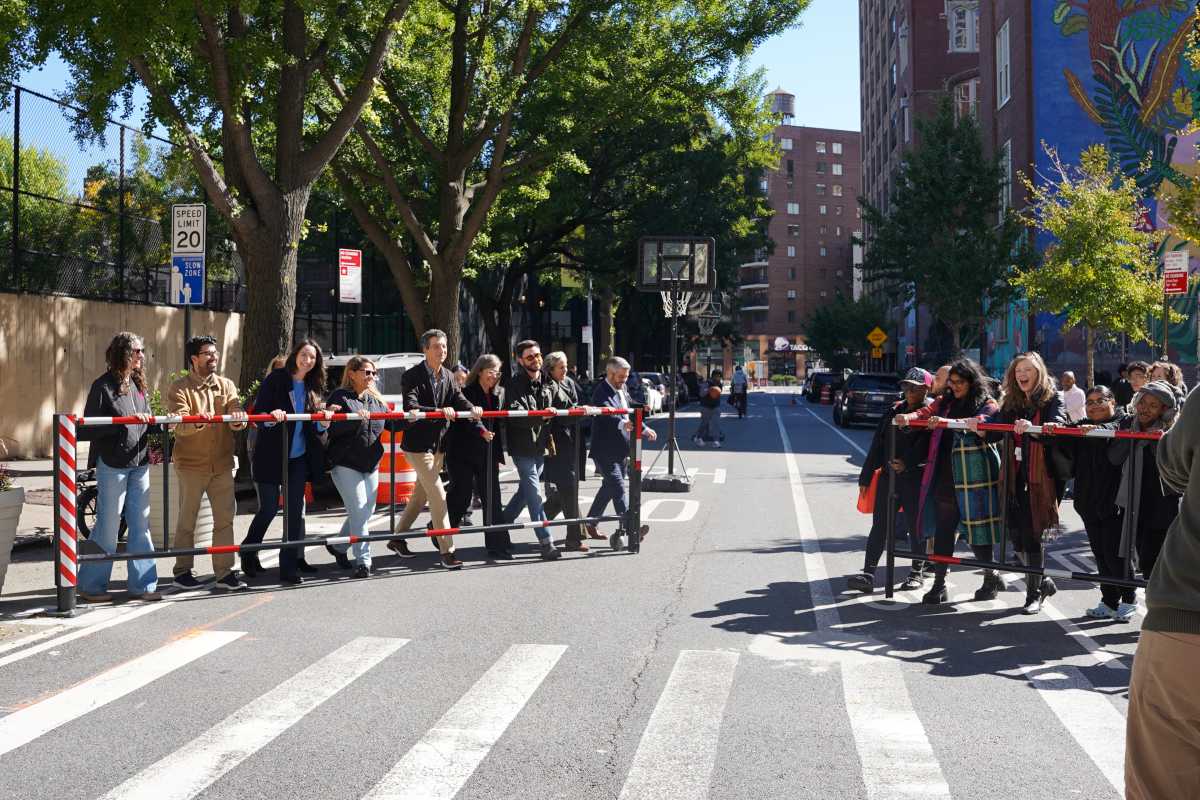 Those gathered christened the new gates with a ceremonial swing.Photo courtesy of Open Plans
The gates are funded by a $100,000 grant that Open Plans won from the Project for Public Spaces, which is supported by the car-manufacturing giant General Motors. It also resulted from over a year of community engagement.
City Comptroller Mark Levine released a report in August finding that the current School Streets model led to low participation in the program. His office reported that over the 2025 to 2026 school year, only 74 schools total participated in the program, with just 48 of those being public schools.
Levine identified a long and cumbersome application process as one of the stumbling blocks to more schools taking part in the initiative.
Open Plans agreed with Levine’s findings in its own report released earlier this year. But the group also recommended using the model that was deployed on Clarkson Street more broadly, by making “school plaza blocks” and “limited entry School Streets.”
“School Streets are essential for providing New York City students with a place to socialize and grow, especially at the over 370 city public schools without on-site recreation space,” said Open Plans Community Planner Sabina Sethi Unni. “This gate creates a sturdy and safer public space that can be used daily, with less administrative burden, opening up new opportunities for outdoor learning and recreation with ease.”
Flynn said that while they have to evaluate how well the swing gate works, it is likely something that DOT can expand more broadly for School Streets and other kinds of Open Streets.
“The hope is that this is something you can really scale up across the city, and would allow us to be a lot more nimble and move a little more quickly, and probably ultimately do it in a more resource-efficient way too for these types of streets, whether it’s in front of schools or other kinds of open streets,” Flynn said.