
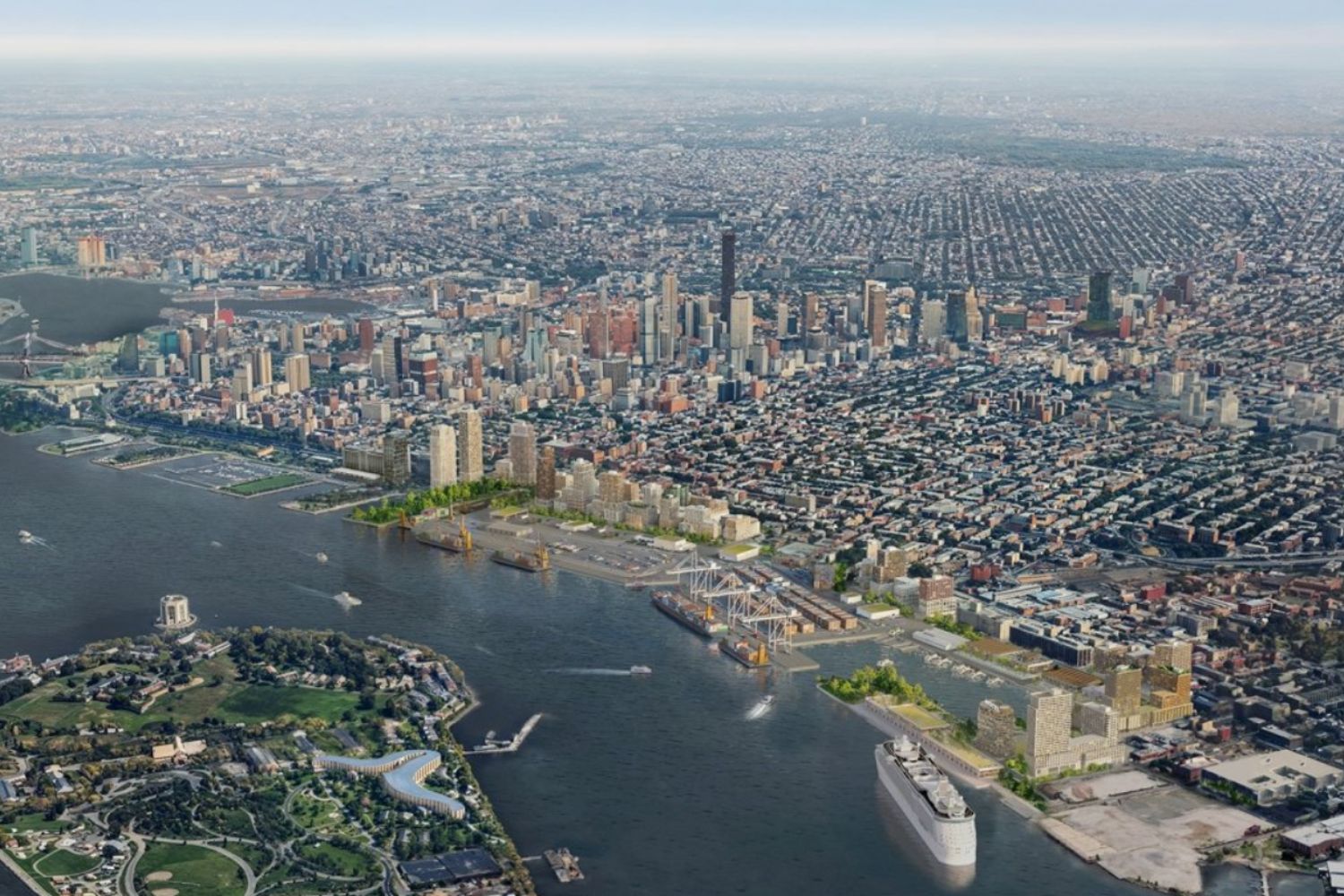
For more than half a century, the Brooklyn Marine Terminal – a once bustling maritime engine on the borough’s western edge – has represented one of New York City’s greatest unrealized assets.
Today, after decades of disinvestment, the 122‑acre waterfront expanse at the Brooklyn Marine Terminal is poised for transformation on a scale rarely seen in American port cities. A newly approved vision plan, led by the New York City Economic Development Corporation (NYCEDC) with Buro Happold as the planning lead, sets the stage for a 21st‑century maritime district that blends climate‑forward industry, affordable mixed‑use development, and next‑generation resiliency infrastructure.
At a moment when coastal cities across the country confront the twin crises of climate adaptation and industrial decline, Brooklyn’s effort stands out: a chance to prototype how aging waterfront industrial areas can be reactivated for both economic justice and environmental stewardship.
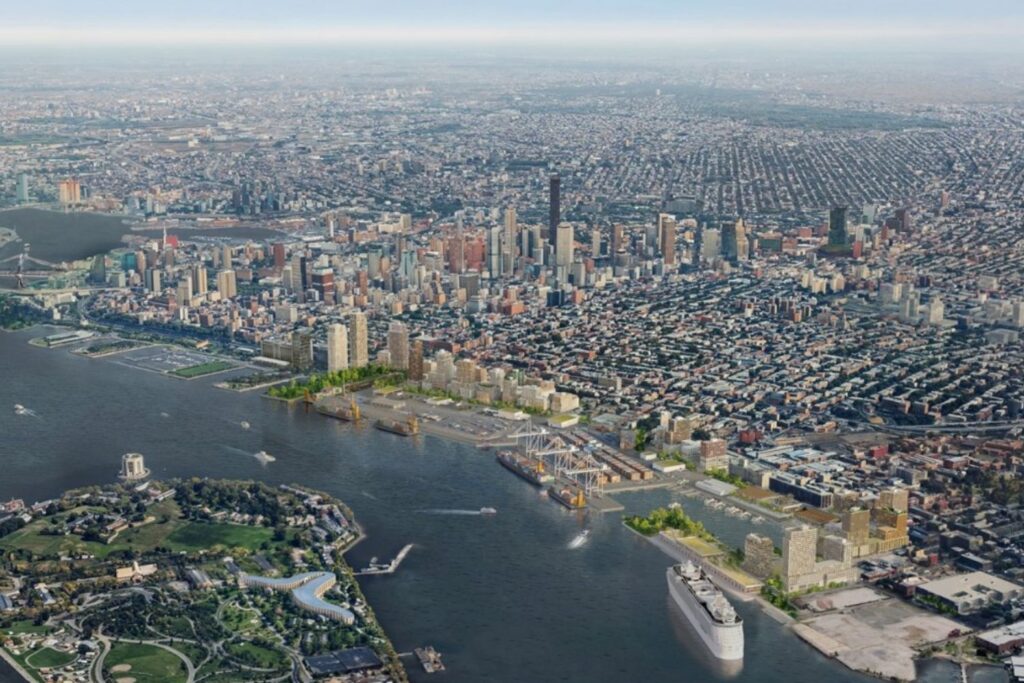 Brooklyn Marine Terminal is being reimagined as a climate-resilient maritime district, combining a modern all-electric port, affordable housing, and next-generation waterfront infrastructure. Image: Adobe Stock.
A modern port for a green maritime future
At the heart of the plan is a 60‑acre, all‑electric port designed to shrink the city’s freight emissions and strengthen supply‑chain resilience. The project forms a key node in New York City’s “Harbor of the Future” strategy, which seeks to reposition the harbor as a testbed for climate innovation and modern logistics.
A central feature is the integration with the Blue Highways system – NYCEDC and NYC DOT’s initiative to divert freight from trucks to maritime routes through expanded barge service, last‑mile solutions, and new waterfront landings. By enabling water‑to‑water cargo transfers, the Brooklyn Marine Terminal is expected to reduce congestion on local streets while creating maritime jobs and supporting emerging green‑industry enterprises.
This port-first strategy signals a broader shift in urban planning: treating maritime infrastructure not as a relic of the industrial past, but as a platform for future‑facing economic sectors – from sustainable goods transfer to climate industries.
An affordable mixed-use district that respects its industrial core
While maritime operations anchor roughly half the site, the other half is envisioned as a thriving mixed‑use district. The plan includes 6,000 new homes, of which at least 40 percent will be permanently affordable, alongside commercial, cultural, and civic spaces.
Renderings and program summaries highlight mixed-use residential buildings at a range of scales framing the perimeter while light industrial uses remain concentrated near existing port operations – balancing job creation with long‑term housing needs. This hybrid‑district model is emerging as a new typology in U.S. waterfront redevelopment: one that accommodates working waterfront livelihoods and livability.
Climate resilience as foundational infrastructure
Given its exposure to sea-level rise and storm surge, the design centers flood protection as a core infrastructure and public realm feature at the Brooklyn Marine Terminal. The plan embeds climate resilience as a primary organizing principle with a landscape-integrated flood wall across the length of the site.
Key measures include raised site elevations, floodwalls, and landscape‑driven stormwater drainage systems – all informed by Buro Happold’s resiliency and infrastructure work. Environmental justice is central to the project’s climate resilience approach, positioning the site to reduce historic environmental harms.
These interventions reflect a new mode of waterfront planning in New York: adaptive reuse at the district scale, where legacy industrial sites become laboratories for climate‑resilient urbanism. Such strategies are increasingly relevant to city agencies and policymakers seeking to unlock value on waterfront sites long sidelined due to environmental constraints.
Community governance and economic inclusion
The redevelopment is structured through a newly formed Brooklyn Marine Terminal Development Corporation and guided by an Advisory Task Force representing local leaders and community stakeholders. This governance model aims to maintain oversight through the General Project Plan process and ensure alignment with community priorities.
Major investments in local housing – including $200 million for NYCHA repairs and a $50 million housing preservation fund – aim to distribute benefits beyond the site boundaries.
Job impacts are projected to be significant: more than 37,000 construction jobs and 2,000 permanent roles tied to maritime, industrial, commercial, and residential uses.
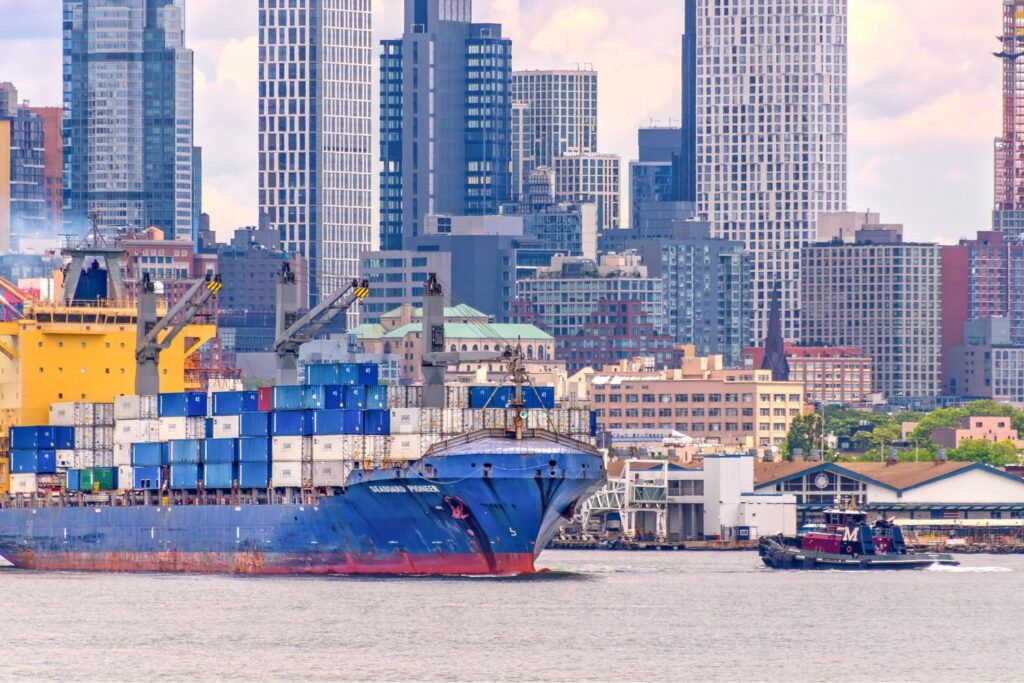 By linking into NYC’s Blue Highways system, the terminal will shift freight from trucks to barges which reduce congestion and create new maritime jobs. Image: Adobe Stock.
A test case for the future of urban waterfronts
If successful, the Brooklyn Marine Terminal redevelopment could become a national model for 21st‑century waterfront planning – where legacy port districts evolve into resilient, mixed‑use hubs for modern industry, climate solutions, and equitable growth.
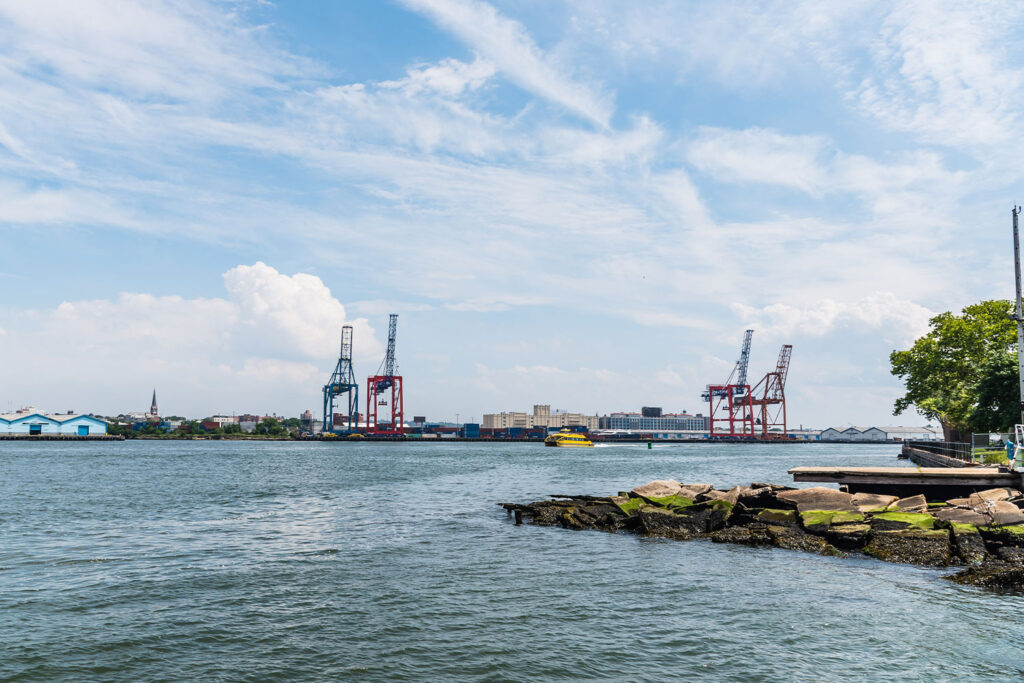 This working harbor will anchor New York’s “Harbor of the Future,” supporting green industry and next‑generation maritime jobs. Image: Adobe Stock.
For urban planners, government officials, and policymakers, the project offers a real‑time case study in how cities reinvigorate underused waterfronts without displacing their industrial heritage. By blending adaptive reuse, climate action, and innovative green industry within a large-scale master plan, it demonstrates the potential of waterfronts not merely to host development, but to reshape the economic and environmental trajectory of the city.
The Brooklyn Marine Terminal may have once represented the city’s industrial past. Today, it is actively shaping its climate‑forward future.