
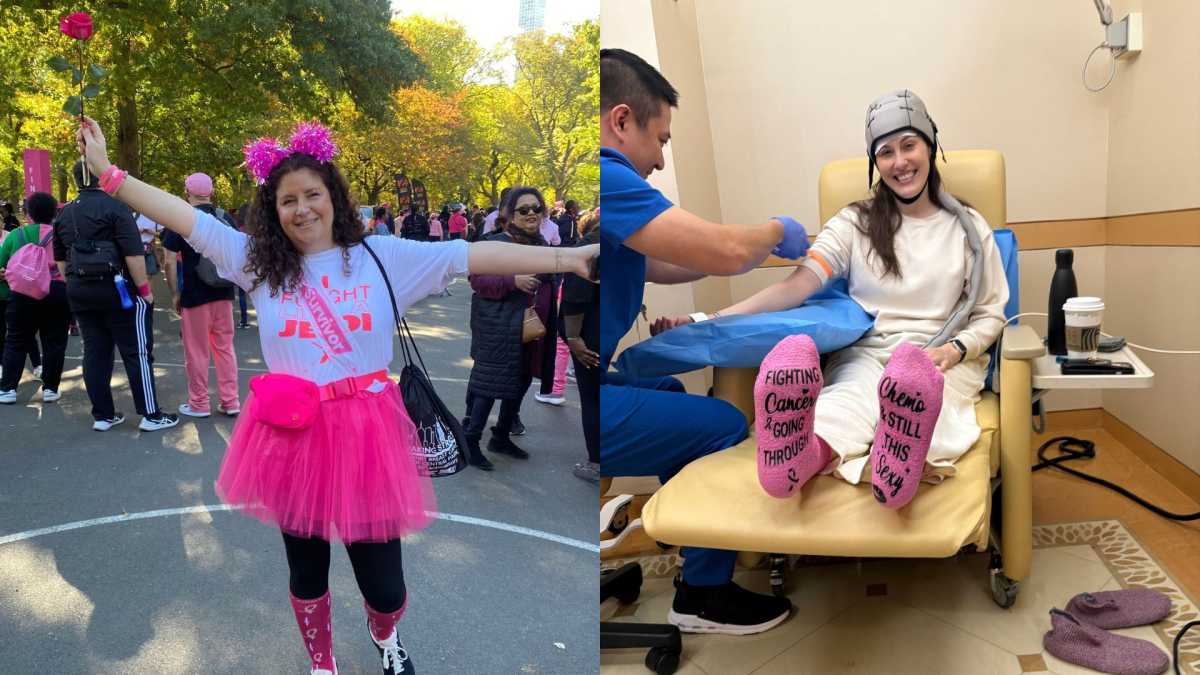
Jacqueline Lukasik and Jenny Maenpass are among the “Faces of Hope” aiming to inspire New Yorkers during Breast Cancer Awareness Month all throughout October.
Both Lukasik and Maenpass are participating in the American Cancer Society’s “Making Strides Against Breast Cancer” walk in Central Park on Oct. 18, and are part of the society’s “Faces of Hope” nationwide campaign, giving a platform to share their experiences with breast cancer and encourage others to support the cause.
For Lukasik, her diagnosis was discovered through an annual mammogram in June 2023. After spending a prolonged amount of time waiting for ultrasound results and additional imaging, a technician told her that a biopsy would be needed. Lukasik began to cry, and soon after she found out she had stage 1 breast cancer.
“I heard the doctor say the word carcinoma,” she remembered, describing the diagnosis as a life-changing shift. She knew her aunt had had breast cancer, but Lukasik had not yet been genetically tested for breast cancer.
She recalls the endless appointments, medical examinations, and waiting for results as one of the most difficult parts of her journey: “I have this thing in me, and I don’t know what it’s doing.”
Lukasik’s workplace became a central part of her support system, during and after surviving breast cancer. On a phone call, she discovered she had breast cancer while at the Morgan Stanley office. The colleagues that she had known for years had surrounded and comforted her. Three years later, her colleagues continue to donate to her fundraiser and join the walk.
 Jenny MaenpassPhoto courtesy of Jenny Maenpass
Maenpaa received her diagnosis through a mammogram that almost didn’t happen. She had read about increasing breast cancer rates among young women. Having met her insurance deductible, she decided to use this opportunity to get screened.
At 39, Maenpaa had no symptoms and no significant family history of breast cancer. On New Year’s Eve 2024, she discovered that she had triple-positive, stage 2A breast cancer.
The diagnosis and the intense treatment, were unexpected for Maenpaa. She underwent chemotherapy, radiation, surgery, and ovarian suppression that triggered menopause. She experienced side effects, including brain fog, slurred words, exhaustion, and anxiety.
As a therapist, Maenpaa had the skills to comprehend emotional responses, but that knowledge could also help her analyze her experience instead of going through it. Her own therapist let her experience both.
“I literally am a therapist and I still wasn’t prepared for how hijacked my body was emotionally and physically,” Maenpaa said in her interview.
Lukasik and Maenpaa have been able to turn their experiences into advocacy. Lukasik’s friends and relatives inform her when they have had their mammograms; she calls herself “the mammogram police.”
Maenpaa inspired her friends to get screened as soon as they could, and says that some found out they had cancer and were able to get it treated sooner. These stories deliver the same message: being in good health and having no known risk factors do not mean someone should postpone screening.
 Jacqueline Lukasik ringing the bell after her radiation treatment.Photo courtesy of Jacqueline Lukasik
Being Faces of Hope ambassadors and honorees gives them the opportunity to extend that message to a wider community. Each honoree commits to raising $5,000. These donations help fund the American Cancer Society’s breast cancer patient services and research.
Lukasik had already done fundraising before becoming an ambassador; sharing her experience now gives her another platform to help people feel less alone and more connected.
During last year’s walk, Maenpaa described seeing billboards sharing research funded by the American Cancer Society that made the movement personal: she realized that research had contributed to treatment for her cancer subtype. She wanted to help and inform others.
Lukasik and Maenpaa recently met at a Faces of Hope event and quickly shared a bond. They now keep in contact through a WhatsApp group chat with other survivors they met through the campaign, becoming an ongoing source of friendship and encouragement.
Lukasik explains it as “a terrible club that nobody wanted to join, but the members are fabulous.”
The Making Strides Against Breast Cancer walk is both a fundraiser and a way to support cancer patients and survivors. People who participate in the walk range from cancer survivors to their supporters.
 Jenny Maenpass
Maenpaa hopes people understand that there should be no shame in having cancer, and that “hearing the word cancer doesn’t have to be a death sentence.”
Lukasik wants to emphasize that there is a community of survivors ready to help people who feel alone in their battle or as a survivor of breast cancer.
Their advice to other women is simple but important: Make time for screenings, and advocate for your health if you feel like something is wrong.
Lukasik has learned to keep life’s smaller problems in perspective. If she had the opportunity to, Maenpaa would tell her 39-year-old self that getting diagnosed with breast cancer would be “the wildest year of your life” —and that she would walk out of the fire.
For more information about the Faces of Hope initiative and its participants, join a team or donate through Making Strides Against Breast Cancer. Info can be found at cancer.org.