
The legal battle over who, exactly, is in charge of the Brooklyn Democratic Party cannot continue until a judge decides which lawyers are authorized to represent the party in court.
Last week, Brooklyn Supreme Court Judge Lisa Lewis declared that former party chair Rodneyse Bichotte Hermelyn’s term ended on Sept. 23. For now, she ruled, the only person with county-wide authority is newly-elected county committee chair Nydia Velazquez.
Velázquez promptly fired the party’s longtime lawyers, Anthony Genovesi and Amy Marion, and hired Margarita López Torres, Jason A. Otaño, and Matthew J. Chachère to represent the party in a new lawsuit filed by party reformer Julio Peña III.
But Genovesi and Marion continued to file court documents claiming to represent Velázquez, despite multiple letters asking them to stop.
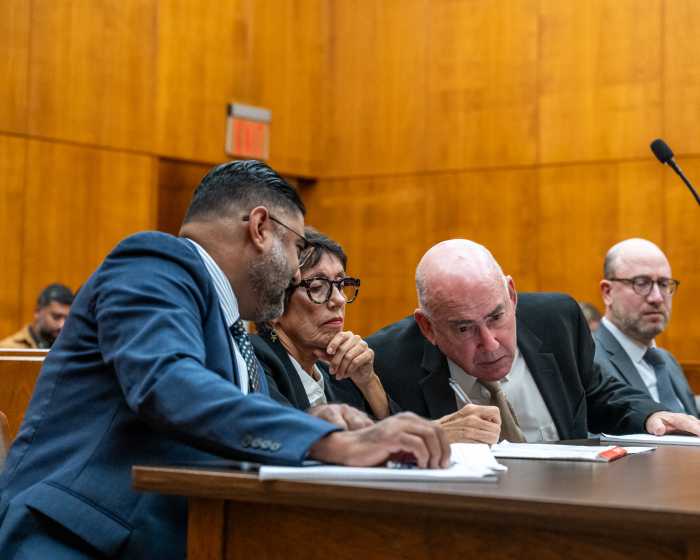 Congresswoman Nydia Velázquez’s lawyers Jason A. Otaño, Margarita López Torres and Matthew J. Chachère at Tuesday’s hearing. Photo by Gabriele Holtermann
On Sunday night, Bichotte Hermelyn and her allies held a meeting — against court orders — where they claim to have elected Nikki Lucas as the new chair of the Brooklyn Democratic Party.
It prompted a flurry of legal activity. Lawyers representing Peña immediately filed paperwork asking Lewis to consider whether Bichotte Hermelyn and her allies in contempt of court.
Genovesi, meanwhile, moved to have Torres, Otanõ and Chachère removed, claiming Lucas had authorized he and his firm, Abrams Fensterman, to take over. In a cease and desist addressed to the trio, Lucas identified herself as the “duly elected Chair” of the party’s executive committee, and said their representation was “terminated effective immediately.”
At a hearing on Tuesday, Brooklyn Supreme Court Justice Peter Sweeney was set to hear arguments over Peña’s suit, which is seeking a declaratory judgement that the since-voided bylaws cannot be used; as well as a motion to intervene filed by Bichotte Hermelyn, Lucas and two other party members seeking to join the suit.
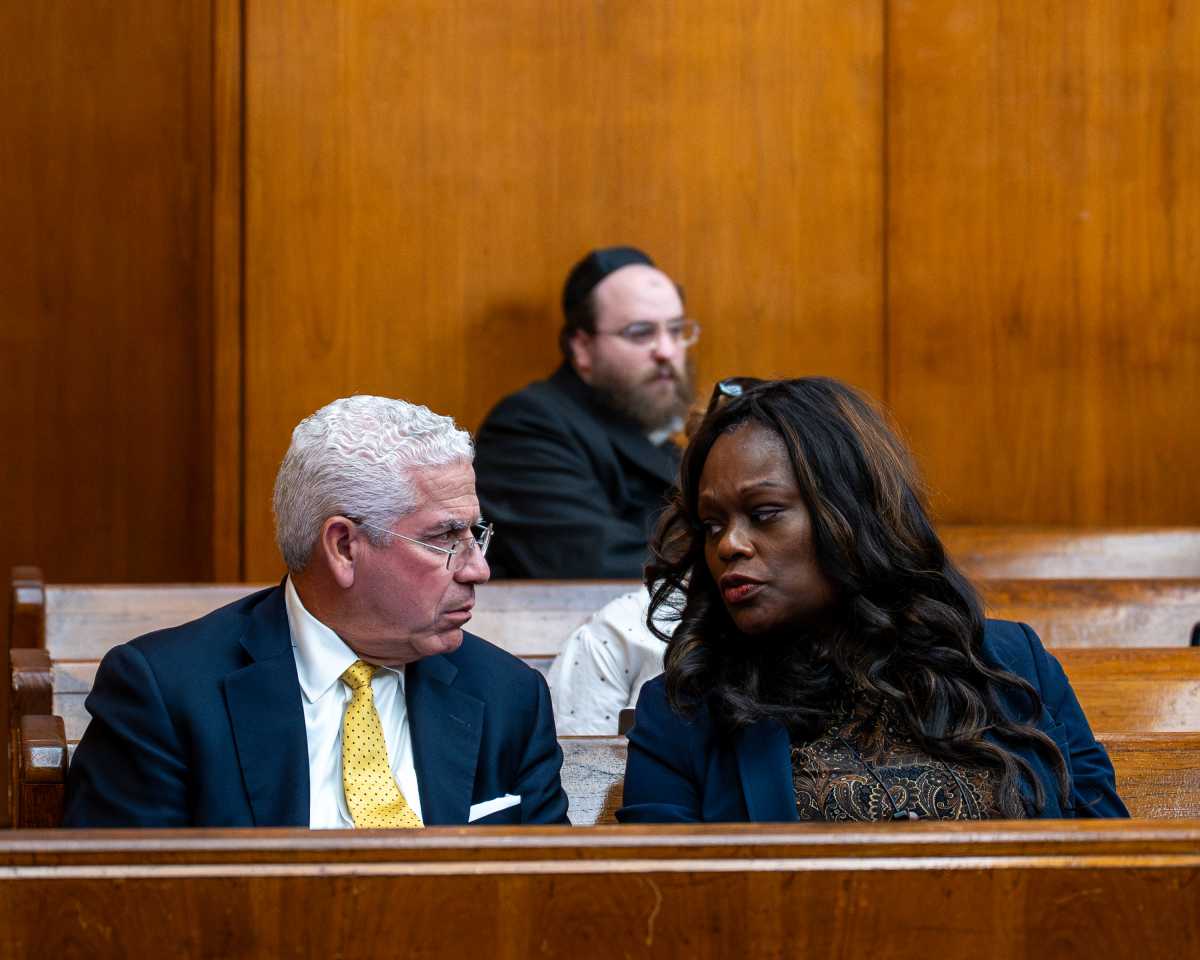
Velázquez and Bichotte Hermelyn — who has so far been absent from court proceedings surrounding the controversy — were both present in the courtroom. Velázquez’s original lawyers sat at the counsel table, before the judge, while Genovesi and Marion sat public gallery beside Bichotte Hermelyn.
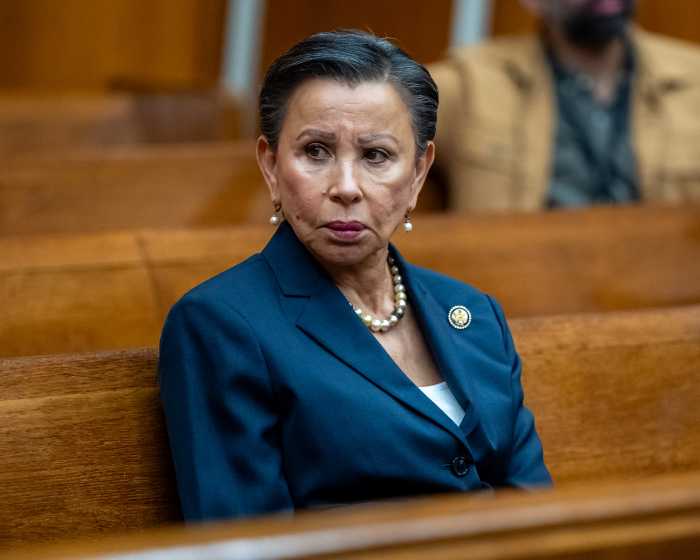 U.S. Rep. Nydia Velázquez is the county committee chair and interim head of the party, a judge declared last week. Photo by Gabriele Holtermann
Otanõ immediately asked to discuss the matter of who is legally authorized to represent Velázquez and the party. The Oct. 4 vote to elect Lucas, he said, was “in direct opposition” of a temporary restraining order handed down by Lewis last week, which is still in effect. As such, he added, the party “cannot be said to have elected a new chair.”
“We do not believe Lucas or Genovesi have the right to fire us,” Otanõ said, adding that Genovesi’s claim that he, Torres and Chachère do not represent Velázquez and the party “rests entirely in fiction.”
Bichotte Hermelyn and her allies had repeatedly claimed that the Oct. 4 meeting was a “meeting of members of the executive committee,” not a “meeting of the executive committee.” In court Tuesday, Genovesi claimed the TRO only applied to the executive committee — which is not yet organized, since there hasn’t been a meeting — not the “members of the unorganized committee,” seeming to imply that the meeting and Lucas’ election were allowed.
“We’re moving to disqualify them on the grounds that the chair of the executive committee has terminated their service,” he said.
Velázquez, in her position as county committee chair, does not have authority over anything outside county committee, Genovesi said, and cannot make decisions on the party’s legal counsel.
Sweeney ultimately opted to hear arguments on the reformers’ lawsuit and Bichotte Hermelyn’s request to intervene.
Reformers seek to officially nullify amended bylaws
Peña’s lawsuit, filed last week, seeks a declaratory judgement on the party’s recently-adopted (and more recently nullified) bylaws. The party’s executive committee, which is responsible for electing a party chair, is comprised of the 42 elected district leaders from across the borough. In the June primary, party reformers aligned with New Kings Democrats won enough district leader seats to oust Bichotte Hermelyn — the group’s longtime goal — and elect Peña.
Bichotte Hermelyn in August introduced a series of bylaw amendments that expanded the size of the executive committee significantly, and passed the amendments at a last-minute meeting of the outgoing executive committee, making the reformers’ majority irrelevant. The bylaws were passed in a last-minute meeting of the outgoing executive committee, including a number of members who had not won re-election.
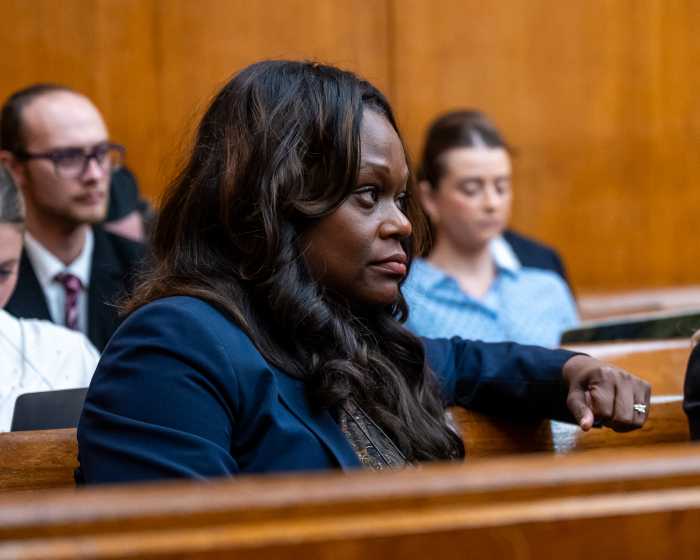 Bichotte Hermelyn introduced a series of bylaw amendments in August, sparking a string of legal battles. Photo by Gabriele Holtermann
Reformers sued, and a Brooklyn Supreme Court judge ruled the new rules “must be declared a nullity,” as the outgoing members of the committee no longer had authority to vote on significant changes, per election law and existing party bylaws. The party appealed, and an appellate judge issued a stay on the lower court’s ruling. In the meantime, the county committee organizational meeting on Sept. 23 went ahead under the amended bylaws, and dozens of new executive committee members were selected. During that meeting, the committee also voted to ratify the party’s rules. (At the hearing Tuesday, Sweeney said it was “silly” that the appellate court had allowed the Sept. 23 organizational meeting to go on under the August rules.)
Days later, the appellate court ruled against Bichotte Hermelyn, affirming the Supreme Court decision to toss the amended bylaws. The decision came hours before the executive committee meeting where a new party chair would be elected, and reformers immediately filed the new lawsuit to stop it.
“We’re afraid that the current party establishment may say, ‘Oh, well we passed those amendments again at the county committee meeting,’ and that’s not true,” New Kings Democrats president Tony Melone told Brooklyn Paper at the time.
The suit is seeking a declaratory judgement that the Sept. 23 meeting “did not validly independently ratify or adopt the specific amendments” passed in August and that actions taken regarding votes and rules at the meeting are “null and void.”
Last week, the court approved a temporary restraining order blocking the party or anyone “acting in concert” from electing a new chair until after a decision on the suit has been made.
“We can’t have an executive committee meeting without knowing who the members are,” said Mark Hanna, a lawyer for the reformers and a longtime district leader himself. “[We want to know] whether the vote of the county committee on rules adopted rules that are void, or if they have an effect, or if they were amendments, because it’s unclear. So we want to have surety before we move forward because unlike some folks we prefer to do things properly.”
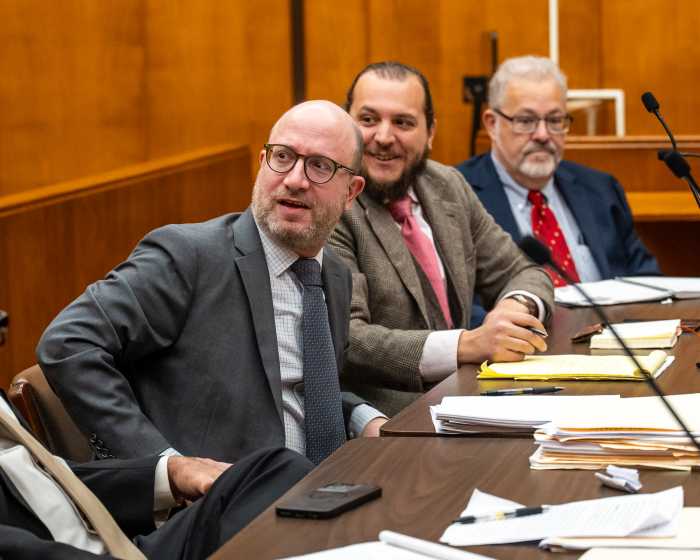 Lawyers Paul Newell, Mark Hanna, and Howard Graubard, who represent Peña and the reformers. Photo by Gabriele Holtermann
In court on Tuesday, Hanna argued that the party hadn’t followed the proper steps to approve the amended bylaws at the Sept. 23 meeting. They did not distribute the new rules to the county committee to be considered individually, he said, or show them on the screen before the vote. Most people never saw the rules at all, and those who did receive written notice about them received it in the mail after the meeting.
Velázquez’s lawyers, did not argue against the movement, and agreed the bylaws were not validly adopted.
But Genovesi — speaking from the gallery — said the county committee did not vote on the rule amendments, only to formally adopt rules already amended by the executive committee in August. As such, he contended that the party was not required to send written notice to the entire county committee or present them for individual consideration.
Genovesi also argued that the court orders had only voided the vote where the amended rules were adopted, not the rules themselves, and that they should be allowed to stay in place.
He accused Velázquez of “colluding” with Peña and the reformers, and acting against the will of the county committee. He and Bichotte Hermelyn filed the order to intervene after receiving the TRO and court order that said Velázquez was the interim head of the party, he explained. That was also why they moved forward with the vote to elect Lucas on Sunday, in apparent violation of the TRO.
Bichotte Hermelyn, Lucas seek to join lawsuit
“They’re all set — which is why became so important to have meeting on Sunday — they’re all set to collaborate with Nydia Velázquez and wipe out parts of [the county party] they don’t like,” he said.
Bichotte Hermelyn, Lucas and the other proposed invervenors have a right to join the case because they should have been named in the reformers’ lawsuit as individual members of the executive committee, Genovesi claimed. He had used a similar argument to justify the Oct. 4 meeting, claiming that since the participants were not individually named in the TRO, they were not bound by its restraints.
The contempt orders filed against Bichotte Hermelyn and her allies prove that they should have been named in the initial suit, Genovesi claimed.
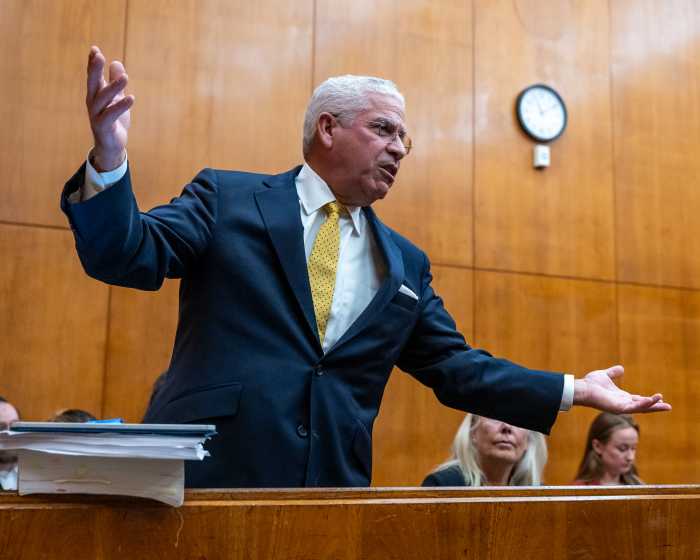 Genovesi argued that Bichotte Hermelyn should be able to intervene in the case. Photo by Gabriele Holtermann
Sweeney asked Hanna to explain why Genovesi should not be allowed to join the case.
“Certainly he represents an interest,” he said. “Maybe not county committee, but that’s beside the point.”
Hanna argued that prior case law requires the executive committee to be noticed, not its individual members. The executive committee is a “creature of” the county committee, he said, and is currently an “unincorporated assortment of people.” Velázquez is named in the suit because only she has the authority to convene the executive committee, he said.
Bichotte Hermelyn’s basis for intervening, Hanna added, is based on the Oct. 4 meeting, which violated the TRO. That presents a new question, he said, of whether the meeting was valid — especially because it was run under the voided rules, and dozens of non-district leaders took part in the vote.
Arguments stalled by question of legal representation
After more than an hour of arguments, Sweeney ended the hearing. He did not hear full arguments on the motion to dismiss Velázquez’s lawyers, and ordered the legal teams to return to court on Oct. 13 for a hearing on the issue.
Until that issue is decided, Hanna said, Sweeney is unlikely to take action on the arguments he heard Tuesday.
“They can’t do that because it’s not clear who has the right to even put in opposition to what we wrote,” he said. “We’re kind of stuck, now, for a week.”
Hanna asked if Sweeney could extend the TRO to prevent the new executive committee from taking further action, but Genovesi objected. As a result, Hanna said, they may file a new petition.
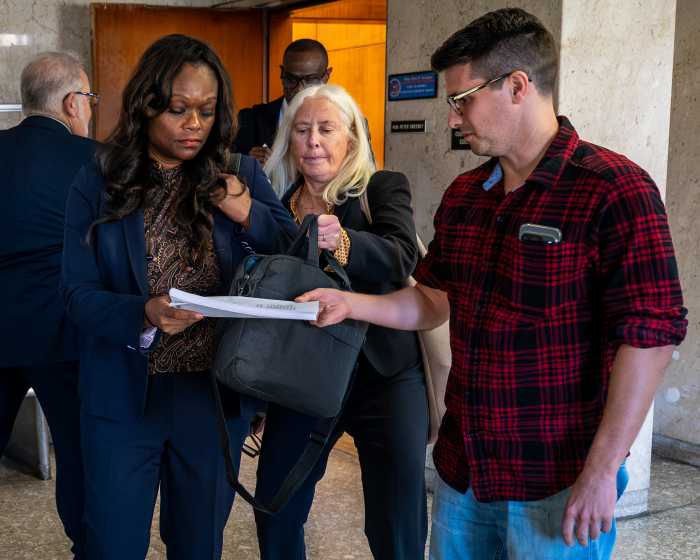 Adam Davis served Bichotte Hermelyn with a contempt order as she exited the hearing. Photo by Gabriele Holtermann
“At best, if they were not violating the court order, it means their meeting was a nullity, it was a meeting of members of the caucus of the executive committee and their friends to talk about what they would like to happen, but it had no legal effect,” explained his co-counsel, Howard Graubard. “In order for it to have any legal effect, they would have to be violating the temporary restraining order of which they are in contempt.”
Bichotte Hermelyn declined to comment as she exited the courtroom and was served with the contempt of court papers, directing questions to Marion.
Asked about the restraining order, Marion doubled down that it did not apply to her client, who she said had been denied entry to the courtroom during a brief hearing last week.
“We were denied the right to be heard, she wasn’t even allowed in … It’s not an argument, it’s the constitution, and it’s the due process upon which the democratic republic is based,” she said. “Judge Lewis already ruled, she’s not even entitled to get notice of a proceeding. So you can’t show up, you can’t get noticed, but then you can be prosecuted for contempt. It’s really incredible.”
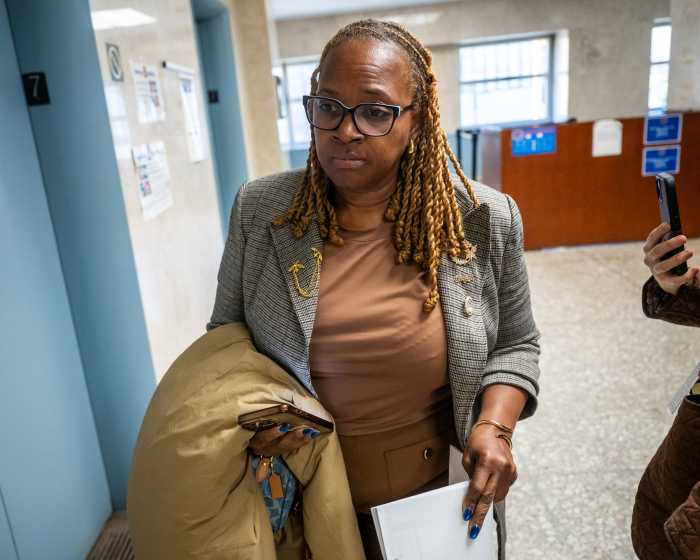 Assembly Member Nikki Lucas, who the party say is the new chair, arrived in the courthouse after the hearing had ended.Photo by Gabriele Holtermann
Lucas, who arrived in the courthouse after the hearing had concluded, also declined to comment, ignoring reporters’ questions about the case and the near future of the party. The midterm elections are less than a month away, and several Democrats in southern Brooklyn are trying to flip state Assembly and Senate seats currently held by Republicans. The county party is usually charged with supporting those candidates, but it’s unclear how the ongoing court cases and confusion over party leadership has impacted those efforts.
A hearing on the contempt of court order has been scheduled for Oct. 19.