
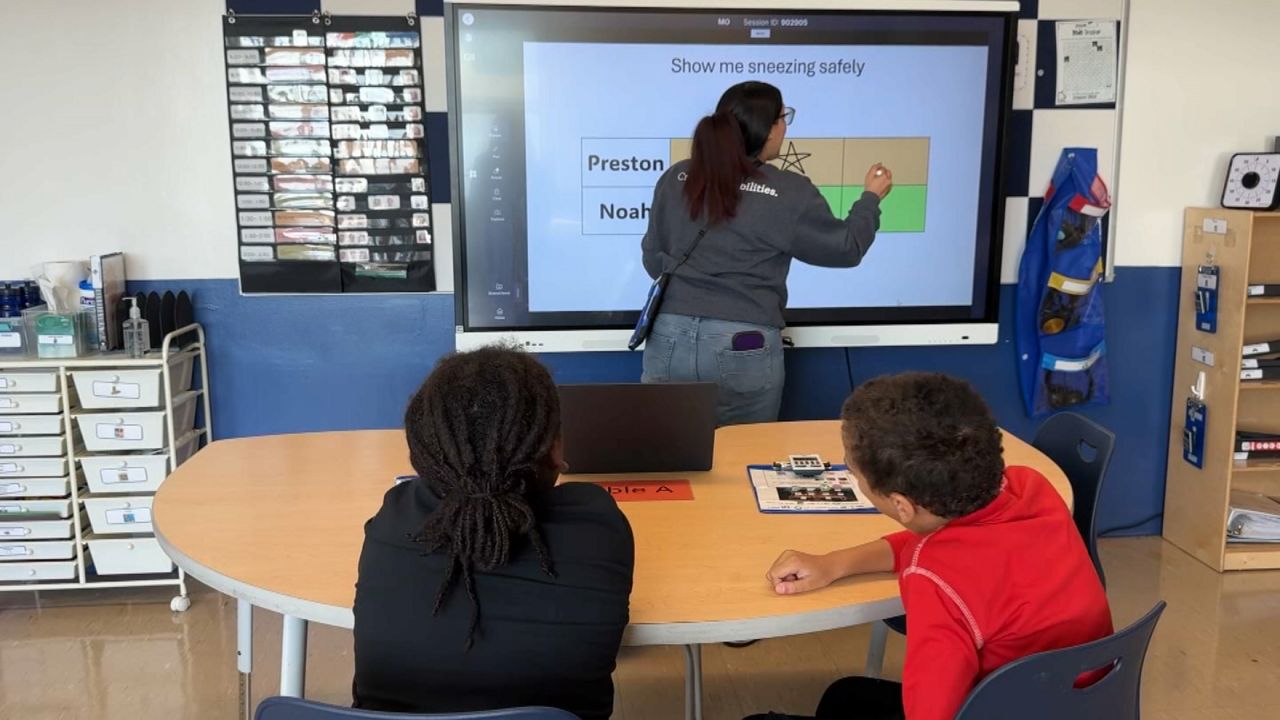
NYC Autism Charter Schools and DREAM Charter Schools both serve children in East Harlem and the South Bronx. Now, the two networks plan to merge.
“We will really be serving the entire range of the continuum, age wise, skill wise. It’s just, it’s such an exciting thing,” Julie Fisher, executive director for the NYC Autism Charter Schools, said.
The schools are different. NYC Autism Charter Schools serves 76 students from age 5 through 22, all of them with autism, many with profound needs. Fisher says they receive intensely individualized instruction, often with a one-to-one student to staff ratio.
“Every student has their own curriculum of skills that they’re working on, and that allows us to be super effective, super efficient in our teaching and provide it with a lot of intensity that we know our kids need,” she said.
They learn about self-care, like how to properly blow their nose and cough into their elbow. They practice spelling words, or identifying pictures. They play the piano, in preparation for a recital later this year.
The school has a waitlist, but Fisher says its small size and intense focus on its mission mean it sometimes struggles operationally and administratively.
“I started thinking about, what would it look like to be able to merge with an organization that has a lot of the infrastructure that we don’t?” Fisher said.
A few blocks away, in classrooms at DREAM East Harlem, students are debating themes in books they are reading. The network is much bigger, serving 2,800 children, with a focus on preparing students for college and continuing to support them through their college years.
The goals may seem different, but in many ways, the partnership was a natural one — DREAM Co-CEO Eve Colavito says the networks have worked together before.
“Teachers from NYC Autism Charter Schools would come to DREAM, to consult with us about students we had questions about and needed support with, and at the same time, students from NYC Autism would come to be integrated into classrooms at DREAM, you know, for music or art and including for our entire summer program,” Colavito said.
Colavito says DREAM is already focused on inclusion — the population of its students who have Individual education plans, or IEPS, hovers between 25% and 30%, though their needs are typically less profound than students at NYC Autism Charter Schools.
“We live in an incredibly diverse world, in a neurodivergent world, and that our belief at DREAM is that all kids — and we we put a lot of emphasis on that all — deserve an excellent education, and that that is the responsibility of public schools,” Colavito said.
The merger requires the approval of the State University of New York’s board of trustees. The schools will spend the next year working on an integration plan.