
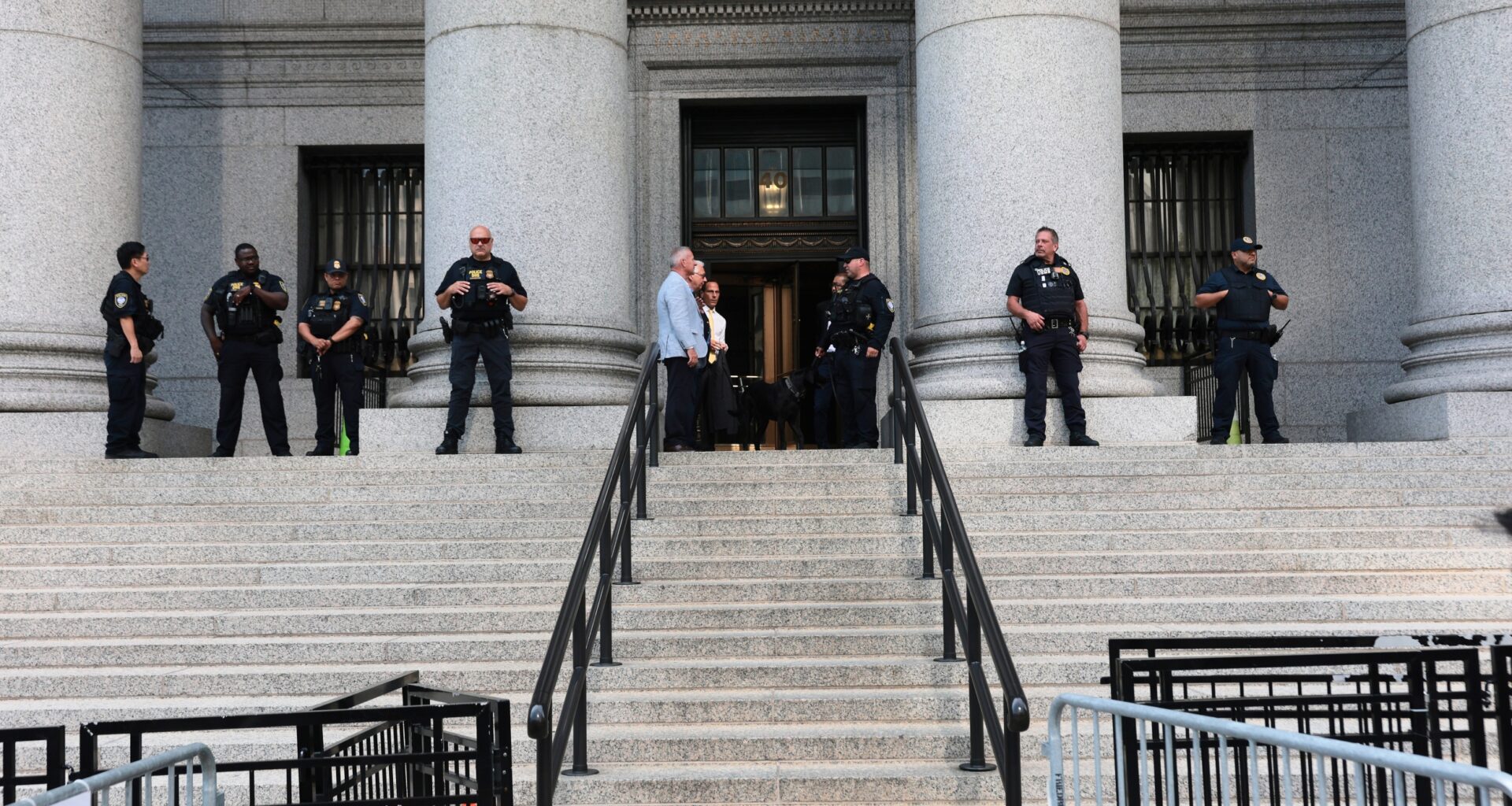
NEW YORK, NEW YORK – AUGUST 14: Department of Homeland Security agents stand guard at court hearing at Thurgood Marshall United States Courthouse ahead of a Luigi Mangione court hearing on August 14, 2026 in New York City. Mangione is set to appear in court for his federal case, where he is expected to plead guilty to two federal counts of stalking. He is accused of fatally shooting UnitedHealthcare CEO Brian Thompson on Dec. 4, 2024, in Midtown Manhattan. Mangione has pleaded not guilty to the state charges.
Photo by Michael M. Santiago/Getty Images
A Family That Never Made It Out of the Building
Jefferson Velazquez had done precisely what the U.S. immigration system required of him. The Honduran asylum-seeker showed up. In July 2025, he and his family appeared for a scheduled hearing at 26 Federal Plaza in Lower Manhattan, where an immigration judge reviewed their pending case and set a return date in October — granting additional time for the family to secure an attorney. A pastor who accompanied them confirmed no adverse ruling had been issued. Their asylum claim remained alive and active.
They never made it out. Before the family could reach the exit, masked ICE agents intercepted Velazquez in a corridor of the building. His wife was in tears. His 6-year-old daughter, Soye, stood nearby. Father Fabian Aries, the pastor who had accompanied the family into the hearing, found himself having to explain to a child what had just happened to her father. He told CBS News: “She was in shock, and Soye, who is 6 years old, asked, ‘Where is my father? Where is my daddy?’ It was very … it was a fiction movie.”
Not a Single Case — A Calculated Widening of Targets
The Velazquez arrest was not a one-off enforcement action. It marked a deliberate tactical expansion that elected officials who witnessed it described as a fundamental change in how immigration courts function: ICE was no longer limiting courthouse enforcement to migrants with final removal orders or criminal records. Families with active, judge-ordered proceedings — people who showed up at 26 Federal Plaza because the federal immigration system required them to — were now targets.
NYC Public Advocate Jumaane Williams, who was present at 26 Federal Plaza on the day Velazquez was taken, responded with visible emotion. He told reporters: “This little girl probably doesn’t even know what happened to her father yet. We have someone who’s waiting for her partner, not even knowing they are detained. These are human beings.”
Former City Comptroller Brad Lander, who also bore witness to the proceedings that morning alongside Rep. Dan Goldman, framed the arrests in categorical legal terms. He said: “This is an emergency for our democracy. As soon as they leave the courtroom, they are abducted by masked federal agents, many of them not wearing uniforms or badges, with, lets be clear, no legal basis for their abduction.”
The Number Behind the Stories: A 212% Surge
The Velazquez confrontation was a visible expression of a documented statistical surge. Federal court filings cited in ongoing litigation showed non-jail-based ICE arrests climbed 212% from the start of the second Trump administration, establishing New York City as the national epicenter of courthouse-based immigration enforcement. The people bearing most of that increase were not fugitives with outstanding warrants — they were immigrants attending mandatory hearings, doing what the legal system had specifically told them to do.
A Federal Injunction — and the Six Arrests That Followed It
On May 18, 2026, nearly a year after the Velazquez arrest, U.S. District Judge P. Kevin Castel of the Southern District of New York issued a 15-page order blocking ICE from conducting civil immigration arrests at Manhattan’s three immigration court facilities: 26 Federal Plaza, 290 Broadway, and 201 Varick Street.
The order followed an extraordinary concession: federal prosecutors acknowledged they had submitted incorrect legal justifications to the court to defend the arrest policy. Castel reversed a prior ruling and issued the injunction pending the outcome of the broader civil lawsuit — African Communities Together v. United States — finding that ICE had never held proper internal authorization for its mass courthouse detention operations.
The order did not stop the arrests. According to Courthouse News Service, ICE conducted at least six courthouse arrests in the months following the Castel ruling, defending each one by citing the detained person’s prior criminal history. One of those cases involved Matar Ndiaye, a Bronx resident detained on July 16, 2026, after appearing for a master calendar hearing at 290 Broadway on his active asylum claim. Court filings in his case stated he had never been convicted of a crime and had complied with every immigration directive issued to him.
In a June 2026 letter to Castel, attorney Katherine Rosenfeld, representing advocacy organizations party to the lawsuit, told the court that ICE had also maintained a near-daily courthouse presence that was generating fear even without resulting in arrests — precisely the “chilling effect” the injunction was meant to eliminate.
The Budget That Funds the Enforcement
Rep. Goldman, whose congressional district covers the Lower Manhattan courthouse complex, has directly connected the courthouse enforcement surge to the federal spending bill that made it possible. The One Big Beautiful Bill, signed into law by President Trump on July 4, 2025, committed $75 billion directly to ICE and approximately $170 billion across total immigration enforcement — funding new agents, expanded detention capacity, hiring bonuses, and accelerated deportation operations. Goldman has publicly characterized the combined immigration enforcement provisions as driving spending toward $175 billion, calling it “a horrific bill” that finances enforcement at the expense of healthcare and food assistance for ordinary Americans.
At a cabinet meeting on the day Velazquez was detained, Trump defended his administration’s immigration record, maintaining that enforcement actions target individuals with criminal histories.
The Question October 2026 Has Not Answered
The Velazquez case and the six documented arrests after the Castel order converge on a single, unresolved legal question: when a federal judge issues an injunction barring courthouse arrests, and ICE conducts them anyway, what mechanism actually enforces that order?
Legal advocacy organizations are pushing for judicial clarity on whether families appearing for mandatory continuance hearings — people whose cases remain actively pending, who have never received an adverse ruling, and who demonstrated good-faith compliance by walking through the courthouse door — fall within the Castel order’s protections against arrests “in or near” the designated court facilities.
Elected officials have confirmed they are tracking the Velazquez family’s case and connecting them with legal resources. The broader answer to that enforcement question, however, has not arrived. For now, the courthouse remains a place where showing up can still cost you everything.
© {{Year}} Latin Times. All rights reserved. Do not reproduce without permission.