

Scale Justice received a $5 million grant for its development team behind the legal artificial intelligence tool Reclamo.AI — a digital program meant to connect women, immigrant and non-English-speaking workers with legal resources who are facing harassment, underpayment, wage theft, and other violations on the job.
Conceived and developed by nonprofit Scale Justice’s Rodrigo Camarena, Reclamo is currently an AI-powered chatbot that receives questions in English and Spanish from workers about issues they’re having at their workplace and offers solutions to resolve them.
Users can ask the bot — which has been trained exclusively on material from legal assistance groups — various labor law questions and receive specific answers, along with information on how to contact an attorney, if needed.
Over the past 18 months, more than 5,000 people have used Reclamo; the system has helped people file more than $1.5 million in lost wages claims, Camarena said. He said the funding will allow him and his team to exponentially expand Reclamo’s impact and allow the tool to reach thousands more workers who otherwise wouldn’t get the legal help or support they need when experiencing labor law violations or poor working conditions.
“This funding is going to allow us to radically and dramatically expand the impact that we’ve had to date,” Camarena said. “It’s really a once-in-a-lifetime catalytic grant that will exponentially expand our impact and help more workers recover stolen wages. It will allow us to drive the impact deeper, help workers not only get information about their situation but compile cases and claims on their own and provide information to advocates more readily.”
With this $5 million grant, which Scale Justice won in the Workplace Innovation Now Challenge run by the Aspen Institute, Camarena and his partners at the New York Legal Assistance Group say they are going to be able to take Reclamo from a simple NYC-based chatbot to a sophisticated AI tool that will prompt and support workers nationwide in gathering evidence and building their own case against their employers, as well as walk them through filing a claim for stolen wages through a city agency, like the Department of Labor or Human Rights Commission.
“Right now, the program is primarily a chatbot that tries to empower workers by teaching them what some of their workers’ rights are,” said Mel González, director of NYLAG’s Employment Law Project. “That’s a tool that’s been tried many times, and in our space, we think there’s a lot more that we can do to help workers in ways that we think will help make lasting change and really build worker power.”
The idea, Camarena and González said, would be to use this funding to strengthen and streamline the process for workers to directly connect with the legal advocacy networks that exist to help them, as well as prompt workers to do the longer-term work of gathering all the necessary information on their own so that when they are connected with an attorney they can get help faster.
“The tool is being developed to empower workers to be the agents of their own change and of their own advocacy,” said González, who has been helping to develop Reclamo.AI for the past year. “In part, that’s by helping inform workers of their rights, and by helping them prepare to gather their own evidence, to know what evidence is important, and then to be able to sort of package that so that it’s ready to be presented to an advocate who can more thoroughly help them.”
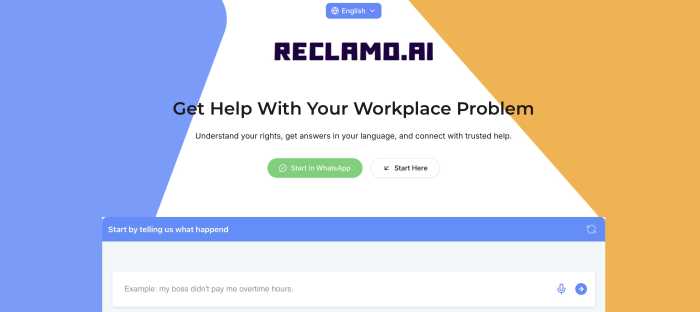 Reclamo.AI’s user interface.
The version of Reclamo that will exist after its developers use the new grant money will also provide information to workers on past workers’ rights struggles, offer guidance on how workers in their industries have pushed back against mistreatment before and guide them through processes of organizing their coworkers to create change instead of simply solving one-off problems someone is experiencing.
How Reclamo.AI came to be
Camarena said he was inspired to create Reclamo.AI after working at immigrant advocacy nonprofit Mixteca more than a decade ago. While there, he said he saw so many people come through their doors seeking help with workplace issues who weren’t able to get the legal help they needed, and he wanted to do something about it.
“Time and time again, I would hear stories of domestic workers, restaurant workers, day laborers being cheated out of their wages, and employees feeling the permission to do so because someone was undocumented or a woman, or didn’t speak English, and the most I could do at that time was refer them to a legal aid organization that was already oversaturated, or an agency that really didn’t give people the time of day,” Camarena said.
That wasn’t a problem unique to Mixteca. Immigrant, women and non-English-speaking workers are most likely to be taken advantage of in the workplace, harassed on the job, or be the victim of wage theft. They’re also the least likely to have access to an attorney or legal advocate, Camarena said.
“My experience there stayed with me and informed this project,” Camarena said. “I thought, ‘How can we give workers and worker advocates better tools to help vulnerable members of our society assert themselves at the workplace and have better tools to reclaim their wages?’”
The grant money will be used to hire more staff to carry out this development work and to conduct further outreach so more workers – particularly those in industries where wage theft and labor law violations are most prevalent, such as retail, food service, and home hospitality – know the resource exists.
Reclamo, which became an AI-powered tool available to the public over a year ago, is one of the latest – and now, one of the best-funded – examples of the legal profession deploying artificial intelligence to increase its capacity to serve clients.
The goal, Camarena said, is not to replace attorneys, but simply to ensure workers who historically have been legally disenfranchised are able to be more efficiently connected with lawyers and have easier access to information that will allow them to fix some of their workplace problems on their own.