
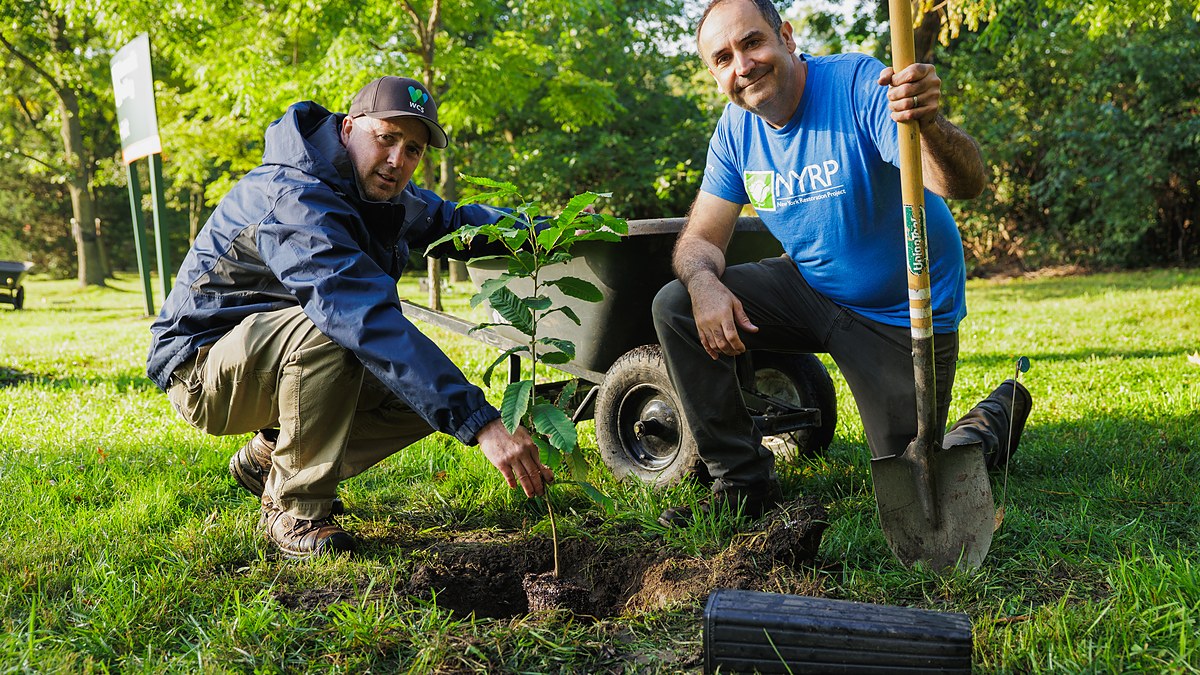
A tree once prized for its rot-resistant timber is taking root again in New York City, with 20 hybrid American chestnuts planted to help restore a species that lost nearly 4 billion trees to blight. It comes as New York Restoration Project (NYRP), the citywide nature conservancy founded by Bette Midler, donated the saplings to the Wildlife Conservation Society’s Bronx Zoo on Monday in partnership with The American Chestnut Foundation (TACF).
“For generations, this remarkable tree was a defining part of our forests, and its loss changed the landscape in profound ways,” said Lynn Bodnar Kelly, NYRP’s executive director. Working alongside the zoo’s horticulture team, NYRP’s restoration crews planted the saplings at three sites across the zoo, along the Bronx River’s east bank and beside a walking path just north of the Tiger Mountain exhibit.
 A New York Restoration Project team member and a crew member set a hybrid American chestnut sapling into the ground at the Bronx Zoo on Monday. (Photo Credit: New York Restoration Project)
“Our conservation work spans the globe, but also includes a commitment to our historic home and roots in the Bronx,” said Craig Piper, director of the Bronx Zoo. Hermann Merkel, then the zoo’s chief forester, became the first to document chestnut blight when he found it on the park’s chestnut trees in 1904.
The New York Zoological Society, which renamed itself the Wildlife Conservation Society (WCS) in 1993, published Merkel’s findings in its 1905 annual report. WCS says the zoo covers 265 acres of hardwood forest, and Piper said it has long worked to provide “critical habitat for local wildlife” across the campus.
Workers spray a tree infected with fungus after extensive pruning, in a plate from the New York Zoological Society’s annual report for 1905, the year after Hermann Merkel first documented chestnut blight at the zoo. (Photo Credit: Wildlife Conservation Society)
American chestnuts made up a quarter of the trees across their natural range in the eastern United States before the blight, with their hardwood timber going into log cabins, posts, poles, flooring, and railway sleepers. That is according to the State University of New York College of Environmental Science and Forestry (ESF), which says “essentially no chestnut lumber” has been sold in the United States for several decades.
Stumps across the tree’s range still push up new shoots, which ESF says thrive in harvested or disturbed ground before the blight inevitably kills them back. Citing the latest US Forest Service survey, the college says New York State may hold as many as 60 million of these sprout clumps, which it calls “a rich gene pool” for restoration.
“These trees do more than reconnect New Yorkers with a lost part of their natural history,” said Michael Goergen, president and chief executive of TACF, the Asheville, North Carolina-based foundation that breeds hybrid chestnuts. Goergen said the saplings now join “a living restoration network” that will help the foundation “learn which trees can survive, grow, and ultimately reclaim their place” in future forests.
TACF breeds hybrids of the American chestnut and the blight-resistant Chinese chestnut, then selects offspring that hold at least 70 per cent American ancestry. The foundation says it DNA-tested 6,878 trees this year to predict their resistance to disease, and planted 5,403 trees.
A hybrid American chestnut sapling inside a wire guard among the Bronx Zoo’s mature trees, at one of three planting sites across the zoo. (Photo Credit: New York Restoration Project)
Whilst the foundation hopes to breed populations that can survive blight and root rot in the wild within 20 years, it says it remains “on tree time,” with “decades of patient work” ahead. The top 10 per cent of offspring from its first round of selection will go into seed orchards, including at TACF’s Meadowview Research Farms in Virginia and at Pennsylvania State University.
Meanwhile, the US Department of Agriculture deregulated ESF’s genetically engineered Darling 54 chestnut in late August, saying the tree is “unlikely to pose a greater plant pest risk” than an unmodified one. TACF withdrew its support for the Darling trees nearly three years ago, citing poor performance and an “identity error” in the material it was supplied.
Sara Fern Fitzsimmons, then TACF’s chief conservation officer, said the Darling trees would “impair future deployment of disease-resistant American chestnut populations.” ESF says blight infections stayed smaller on Darling 54 trees than on their non-engineered siblings in its own trials, though the engineered trees also grew shorter.
As it stands, the zoo’s 20 saplings join more than 200 hybrids that NYRP has planted in Northern Manhattan’s Highbridge Park since 2017, the largest chestnut grove in New York City. NYRP’s 1,000 Chestnut Challenge, which asks New Yorkers to plant and monitor saplings to inform TACF’s restoration work, will reopen registration in 2027; this year’s intake is now closed.