
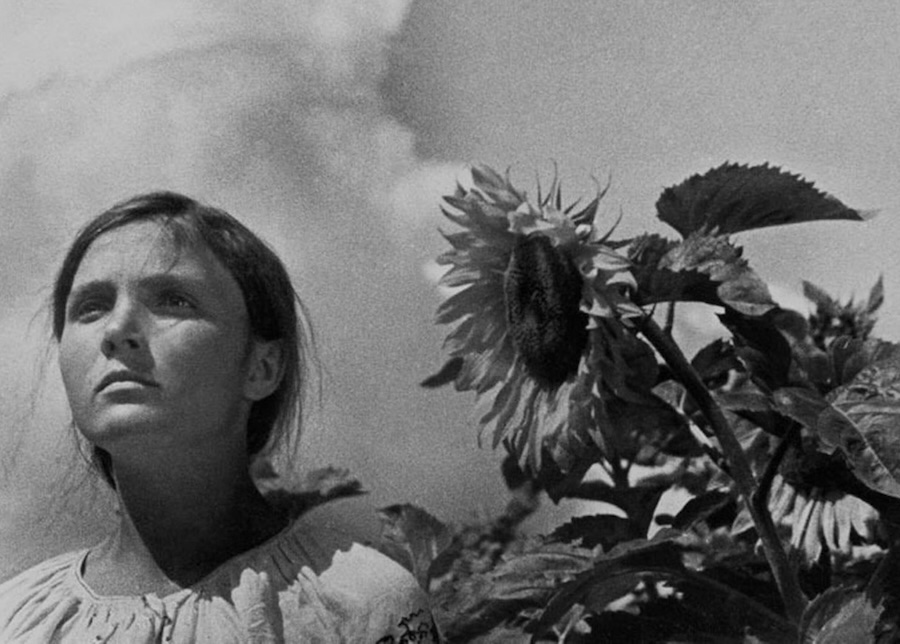
Oleksandr Dovzhenko was a connoisseur of clouds. In many of his shots, the big sky of Ukraine’s fields and steppe swallows the frame. When tiny human forms emerge upward into the heavens, they come as a surprise. As they grow they become monumental, often viewed from below. This is a fairly standard technique in Soviet visual art, which had a mandate to make workers look like heroes. But Dovzhenko goes a step further by making his characters look less like statues than like natural features, the wrinkles on their faces as noble as riverbeds.
Earth (1930), Dovzhenko’s silent masterpiece, is not only a celebration of agricultural collectivization—a predictable assignment for a filmmaker working at a Soviet studio—but an ode to the cycles of life, which resist the linear logic of Stalinist industrialization. In the opening scene, an old man eats a pear, smiles, and expires under a fruit tree; a beautiful death. His grandson Vasyl, a strapping young peasant, the hero of the collectivization effort, brings in the village’s first tractor to great fanfare, but it stalls on the road. He and his friends solve the problem of an overheated radiator by taking turns pissing into it. Dovzhenko films cows and horses as if they are people; with the rest of the villagers, they watch the march of progress with curiosity and trepidation. In real life millions of peasants were deported, executed, or starved during collectivization. Many animals died too, killed by owners who refused to see them confiscated by the state.
Vasyl is murdered by a “kulak” who doesn’t want to give up his land. The hero’s body is carried past an orchard whose branches brush his cheeks, past a field of sunflowers. His mother gives birth while he is being buried. Luminous rain pours over the village’s fruit trees and his girlfriend finds happiness in the arms of another man. Life goes on. The sunflowers that figure so prominently in Earth are now one of Ukraine’s national symbols; the flag is blue for the sky and gold for the fields.

Metrograph
Nikolai Nademsky as the dying grandfather in Oleksandr Dovzhenko’s Earth, 1930
Dovzhenko—subject of “Earth and Empire,” a new retrospective at Metrograph—is Ukraine’s most famous director, but he’s a complicated hero for a Ukraine at war with Russia. (The film studio named for him in Kyiv was hit by Russian strikes in June.) His films are mind-bogglingly beautiful paeans to Ukraine’s land and its people, animals, and plants, but he also played the Soviet game, his work vetted and reviewed by state organs and censors. He likely survived the 1930s only thanks to Stalin’s personal patronage and protection. Ukraine’s greatest director hid his youthful affiliation with Ukrainian nationalism, embraced Bolshevism, and created magnificent works exalting the October Revolution and the collectivization of agriculture, two of the most traumatic moments in Ukraine’s twentieth-century history. His films celebrate the Communist project, but at their best they depict human suffering and survival with a complexity that is alien to propaganda.
Born to Ukrainian peasants in a village in Chernigov region in 1894, Dovzhenko was the seventh of fourteen children. Rampant epidemics (typhoid, typhus) meant that by the time he was eleven, according to his biographer George Liber, he was the oldest living sibling in the family.1 Though his parents were illiterate, he went to school and trained as a teacher. He escaped enlistment in World War I, but he does seem to have served in the army of the nationalist leader Symon Petlyura’s short-lived Ukrainian People’s Republic during the tumultuous period between 1917 and 1919, when the Cheka arrested him at the border between Ukraine and Poland. His sentence for fighting under Petlyura was apparently reversed by the Borotbists, Ukrainian peasant communists, leading to his release; two years later he started working as a diplomat representing the Ukrainian Socialist Soviet Republic. The reversal of his fortunes remains a mystery. In his 1939 autobiography he simply claimed that he served as a Red Army schoolteacher from 1918 to 1920—the most appropriate lie, affirming his support for the Bolsheviks from the beginning and downplaying his history of association with the Ukrainian independence movement. He also spent a short period in Germany, where he befriended the painter George Grosz.
From then on Dovzhenko was an artist. He worked as a caricaturist before starting work as a film director at the Odesa Film Factory. After a few unexceptional films, in 1928 he completed Zvenygora. The magical-Bolshevik historical epic was recognized immediately as an extraordinary breakthrough, though it would soon fade from view, revived only after Khrushchev’s Thaw in the 1950s. “Zvenygora leaps!,” Sergei Eisenstein wrote after seeing an early screening in Moscow. Arsenal, about the revolution in Ukraine, followed in 1929, and Earth came the following year. Together the three films comprise Dovzhenko’s so-called “Ukrainian trilogy.” As the scholar Roman Rosliak has shown, Dovzhenko was under police surveillance beginning in the late 1920s, when he and a group of Ukrainians at the Odesa Film Factory tried to form their own professional association.2 The surveillance continued until his death in 1956. As he made his masterpieces, his colleagues and friends were coerced into informing the secret police about his complaints and aspirations. When the secret police called, it was almost impossible to refuse them.
Zvenygora takes its premise from an old folk tale in which a peasant discovers a treasure in a cave. When he takes only two coins, he prospers. But when he returns for more he finds the cave filled with snakes. The wind tells him to take only what he needs. In Dovzhenko’s hands the old story becomes a cinematic poem about Ukraine’s buried riches, updated with Soviet politics and avant-garde aesthetics. Cossacks gallop out of the forest in slow motion; they are hunting for liakhs, a name for western Slavs, who are searching for the buried treasure. We meet the “mossy old man” who has guarded the hoard for centuries; he leads the Cossacks to Zvenygora, the mountain where the treasure is hidden. The Cossacks shoot the liakhs out of the trees and laugh raucously as the bodies tumble to the ground, the foliage rustling. (“A liakh sat in an oak tree,” an intertitle tells us in the sardonic-folkloric register of the film. “And the liakh was no more.”) When a Cossack and the old man pounce on a silver goblet in the grass, it becomes a clouded, broken glass.

Metrograph
A scene from Oleksandr Dovzhenko’s Zvenigora, 1928
A better future is embodied here, as in all the films in Dovzhenko’s Ukrainian trilogy, by the robust, square-jawed young actor Semyon Svashenko, who plays Timosha, one of the old man’s two grandsons. (Offscreen, Svashenko’s brother was a writer killed in 1937, one of many Ukrainian-language writers purged under Stalin.) Rather than dreaming of gold, Timosha works hard in his village, fixing machinery. The other grandson finds work in Paris, earning money by tricking decadent theatergoers into believing he will shoot himself on stage. “Ladies and gentlemen! I am very grateful for your attention,” he tells them. “I know that you are not interested in either Ukraine or in the Bolsheviks…” He keeps talking, but we don’t know what he says. The onlookers pant with excitement. He raises the revolver, then pauses and keeps talking, buying time until a policeman, his accomplice, pulls him off stage.
He is, it turns out, raising funds to help him search for the buried treasure. Back in Ukraine he persuades his grandfather to sabotage the train that’s being built over the supposed cache. He is an enemy of progress, of the future. He has faith in neither the Bolsheviks nor Ukraine. But Timosha stops the sabotage and rescues his grandfather from being run over. The film’s last shot is of a train speeding forward: an easy metaphor for progress, but with a threatening undertone. What lay ahead for Ukraine, though Dovzhenko didn’t know it, were cataclysmic artificial famines and several more devastating wars, corrupt politicians using Ukraine’s survival as a bargaining chip, and long, fruitless rumors of hidden treasure.
Dovzhenko benefited from the “Ukrainianization” of the 1920s, part of a larger Soviet project to cultivate distinct cultural and linguistic identities in the non-Russian Soviet Socialist Republics and among recognized minorities. Ukrainian filmmakers were encouraged to pursue distinctly Ukrainian themes, an enticing prospect for Dovzhenko, with his passion for the Ukrainian countryside and his past flirtations with Ukrainian nationalism. Zvenygora doubles as a chronicle of Ukrainian history, from the days of the Scythians to the Cossacks to World War I, when village happiness is shattered by conscription. Men march off to the sound of accordions; women cry.
Timosha joins the Bolsheviks. His girlfriend begs him not to ride off, telling him to kill her if he won’t return to the village. He points his gun at her and we see her shadow crumple to the ground—but we don’t see her body. Dovzhenko consistently averts the gaze of the camera when it seems that someone is about to be killed. At first this seems like tact. Dovzhenko, after all, was finely attuned to suffering and death, something he had lived with since childhood and experienced on an ever-greater scale as he witnessed World War I, revolution, civil war, and collectivization. “Whenever I think of my childhood and of my home, in my mind I see crying and funerals,” he wrote. “I still cannot bear to look at funerals, and yet they pass through all my scripts and all my pictures, for the question of life and death affected my imagination when I was still a child and left its imprint on all my work.” After these scenes where the camera looks away, we sometimes learn that the person wasn’t killed at all. In Dovzhenko’s universe, suffering is near-constant, but death, like treasure, can be a metaphor or a matter of debate.
Arsenal, a darkly dazzling portrait of Ukraine after the October Revolution and during the civil war that followed, has a newly painful resonance at a time when central Kyiv is struck by Russian missiles almost daily. A painterly scene of peasant women with downturned faces is brought into motion by a one-legged man swinging across the street on crutches, a child following him. “There was a war,” the intertitles tell us tersely, and it is impossible not to think of the tens of thousands of Ukrainians, mostly men but women too, who have lost limbs to Russian weapons. The cruelty of bad rulers trickles down; a miserable mother beats her crying child in a rhythmic pulse, and a man with one arm beats a starving horse. Then Dovzhenko gives the horse—a descendent of the Christ-like horses of Tolstoy and Dostoevsky—an intertitle of its own, admonishing the man for beating it.

Metrograph
A scene from Oleksandr Dovzhenko’s Arsenal, 1929
We get lost in the intricacies of the civil war, but are rescued by Semyon Svashenko, again called Timosha. His travels allow Dovzhenko to create scenes evoking the many strains of nationalist thought in Ukraine at the time. Priests march before a painting of Taras Shevchenko, the poet and former serf who became Ukraine’s national bard, carrying it at a gathering of believers in front of St. Sophia Cathedral in central Kyiv. We see another painting of Shevchenko in a private home, where a man lights a candle and puts it under the icon. Suddenly Shevchenko moves his eyes and turns his head; the icon has come alive.3
Moments like these, along with all the other slants and caesuras in Dovzhenko’s work, not only advance his films into the realm of the sublime but give them a level of political and moral ambiguity that was rare in Soviet film, if not in the small subsection of Soviet masterpieces that are still watched and celebrated today. Timosha, when asked if he is Ukrainian, says “I am a worker,” frowns with deep thought, and then confirms, “Yes, a worker.” Like Dovzhenko, he seems torn between his identities as a Bolshevik worker-revolutionary and a Ukrainian peasant eager for liberation. Dovzhenko never stopped identifying as a Ukrainian. But there was an exceedingly fine, wavering line, for a Soviet Ukrainian director, between making politically palatable films about Ukraine and evincing a level of solidarity with other Ukrainians that could brand him as a nationalist—a charge that could mean death.
In Arsenal the revolution is represented not as a triumph but as a series of bereaved women, of grim executions. At the end of the film, Timosha is caught by Ukrainian nationalist soldiers who shout “Stop! Who are you?” “A Ukrainian worker,” he answers, finding the union of the two identities. “Shoot!” They fire at him, but he doesn’t fall. When they ask if he’s wearing armor, he bares his chest, miraculously unharmed. The film ends there, with the Ukrainian worker-revolutionary defiant, immortal but also vulnerable. As the critic Gilberto Perez wrote, “Arsenal is singular among Soviet films in the way it combines, without diluting either thesis or antithesis in this central contradiction, a militant advocacy of revolution and a dolorous sense of its tragedy.”
In Zvenygora, we come to understand that the treasure is not a cache of Cossack gold but Ukraine’s natural resources: its black earth, its mountains, its forests and rivers. But who does it belong to? Here, too, Dovzhenko’s films now suggest not only veiled criticisms of Stalinist policies that starved the Ukrainian countryside to feed the cities, but also premonitions of Hitler’s dream of using Ukraine’s black earth to feed German expansion, Russia’s attempt to reclaim Ukraine’s industrial east, and even Trump’s efforts to make deals for Ukraine’s mineral resources. We might think, also, of recent episodes when rivers, swamps, and forests have helped fend off Russian invasion.
Soviet debates about the appropriate use of natural resources often referred to nature’s “treasure,” from buried minerals to the rivers that powered the hydroelectric dams so central to Soviet industrialization and thus to Soviet art. Dovzhenko’s first sound film, Ivan (1932), is about a Ukrainian peasant transformed by participation in the construction of the Dnieper Hydroelectric Station, in what is now Zaporizhzhia. Destroyed during World War II to impede the German advance, the station was later rebuilt, but stopped generating power in 2024 after being hit by a Russian missile. In Ivan huge expanses of water, first serene and then tumultuous, match the expanses of sky. The stillness of the landscape is broken suddenly by the chaos and violence of construction. Ivan is a continuation of the projects of Arsenal and Earth, a formally inventive portrait of industrialization that shows at least some of the violence and death caused by the process, while also making clear the beauty not only of the Ukrainian landscape but also of the dream of modernization.

Metrograph
A scene from Oleksandr Dovzhenko’s Ivan, 1932
Ivan was intensely criticized in Ukraine for both ideological and artistic failures, at a time when bad reviews could mean ostracism, deportation, arrest, or even death. The hero was not heroic enough; the villain was too sympathetic; the Ukrainian landscape was portrayed with too much longing; the peasants seemed helpless in the face of the construction project. The Soviet Ukrainian Politburo denounced those involved with Ivan for “political blindness.” Dovzhenko and his wife Yuliya Solntseva, a Russian film star best known for playing the Martian queen Aelita, escaped to Moscow, where Dovzhenko met Stalin, an avid cinephile as well as a failed poet in his youth. Stalin liked Ivan very much, and soon Ukrainian critics did, too.
Dovzhenko’s next film was Aerograd (1935), about the construction of a new city in the far eastern Siberian taiga. (We never see the city.) The sea of trees matches the vastness of the sky, which is the poetic equivalent of the future; the aerial scenes are astonishing. The film is marred, however, by the cartoonish rivalry between the heroes and the Japanese warriors and Old Believers who try to stop them in their mission. Aerograd, despite its poetry, is the moment when Dovzhenko’s work began to slip into the realm of true propaganda.
Before long Stalin tapped Dovzhenko to make a biopic of Mykola Shchors, a Ukrainian Bolshevik military hero who had died in 1919 and therefore never had a chance to be purged. Despite Stalin’s patronage, the filming of Shchors was beset with difficulties both practical and ideological. The commander of Kharkiv Military District, a crucial character in the film, was arrested during filming, meaning that the scenes featuring him had to be thrown out and the script revised. Dovzhenko spent three months bedridden with coronary disease. Enemies seemed to surround him. In 1938, Rosliak notes, someone sabotaged his car and he almost died in a crash. A gun on the set of Shchors was found to be loaded with a real bullet.
Against all odds, this film was the greatest success—in a nonartistic sense—of Dovzhenko’s career; it won him a Stalin Prize. Perhaps Stalin had marked Dovzhenko for survival, as he sometimes did with favored artists. Dovzhenko’s luck seemed to run out in 1944, when Stalin read his screenplay for a World War II film, Ukraine in Flames, and accused him of nationalism, revisions of Leninism, and more: Dovzhenko had made a misstep by depicting the failures of the Soviet resistance to the Nazi invasion and by showing Ukrainians uniting in the struggle against Hitler. According to the prevailing line, Soviet citizens were all equivalent, whether Russian, Ukrainian, or Jewish. Dovzhenko’s rendering was taken as a dangerous sign of Ukrainian nationalism, an especially grave charge after Ukrainian nationalists’ wartime alliance with the Nazis. But Dovzhenko survived.
When Dovzhenko died in 1956—the year of Khrushchev’s “Secret Speech,” which prompted the de-Stalinization of the USSR—he was about to begin filming Poem of the Sea, about villagers saying good-bye to their home before it is submerged by the construction of the Kakhovka Hydroelectric Dam near Kherson, the final dam in the Dnieper reservoir cascade. Solntseva, his widow and frequent assistant director, agreed to direct the film in his stead. (She was assisted by Dovzhenko’s student Larisa Shepitko, soon to emerge as one of the USSR’s most brilliant filmmakers and an heir to Dovzhenko.) Poem of the Sea is touching, but it has a certain midcentury Soviet woodenness and feels shockingly conventional compared to Dovzhenko’s work. For years largely forgotten, it gained new currency after the Kakhovka Dam was blown up in 2023, presumably by Russian forces, flooding forty towns and villages, killing livestock, and washing huge quantities of toxins into the Black Sea. Residents of the region testify to their grief in poignant comments on the film posted on YouTube.
Solntseva directed two more films based on Dovzhenko’s scripts: The Tale of Fiery Years (1961), a revised version of Ukraine in Flames, and The Enchanted Desna (1964), based on Dovzhenko’s autobiographical “film tale” of the same name, a lyrical account of the landscapes, both internal and external, of his childhood. Jean-Luc Godard listed The Enchanted Desna as his favorite film of 1965; its child’s perspective and focus on consciousness rather than narrative give it an obvious nouvelle vague appeal. And with its folkloric modernism in brilliant color, its rustic dreamscapes pierced by sudden violence, The Enchanted Desna also has something in common with Sergei Paradjanov’s psychedelic poem of the Carpathians, Shadows of Forgotten Ancestors (1965). Solntseva made the most of the enormous progress in sound engineering since Dovzhenko began making talkies with Ivan; the film’s voluptuous surround sound embraces the viewer with the music of the Ukrainian countryside. In the voiceover we seem to hear Dovzhenko’s voice from beyond the grave. He recalls how, as a child, he felt that if he could harness just a thousandth of the sky’s clouds and arrange them in books or paintings, his life would not have been in vain.

Metrograph
A scene from Yulia Solntseva’s The Enchanted Desna, 1964
Solntseva at first received little credit for her work on the films, which were seen as posthumous Dovzhenko releases, but since then her reputation has been revived by film critics who see her as an important figure in her own right. In Ukraine some critics have denounced her, without much evidence, as an NKVD informant who surveilled and even manipulated Dovzhenko on the orders of her handler—according to one story, she reported that Dovzhenko spoke Ukrainian in his sleep—or as a Russian who sought to tear Dovzhenko away from Ukraine. The loving depictions of Ukraine in The Enchanted Desna make this latter charge seem rather ludicrous.
Dovzhenko liked to leave important dialogue to our imagination, omitting intertitles at moments that seem pivotal. His characters are often gazing at some mysterious object outside the frame. The ambiguity of his best films presents a complicated challenge for the composers who score them. Metrograph’s screenings of the Ukraine trilogy will be accompanied by new, live scores by musicians who are well aware of everything that has happened in Ukraine in the century since Dovzhenko began his career: the pianist Fima Chupakhin, the bandurist Julian Kystasty, and the band medukha, which describes its work as “Slavic folk songs steeped in psych-rock sensibilities.” Medukha’s score will include accordion, electric guitar, guzheng, and viola, a cosmopolitan blend of old and new, folkloric and avant-garde, that suits Dovzhenko well.
It will be fascinating to see how Dovzhenko’s films, with their wide-open spaces, reinvent themselves in the company of these new songs. That said, I watched Arsenal on a screener that had no musical accompaniment, and I appreciated the silence; it made me feel the interstices and ambiguities of the film even more intensely. The iconography of heroism is nourished by music, and looks more unstable and thus more interesting without it.