
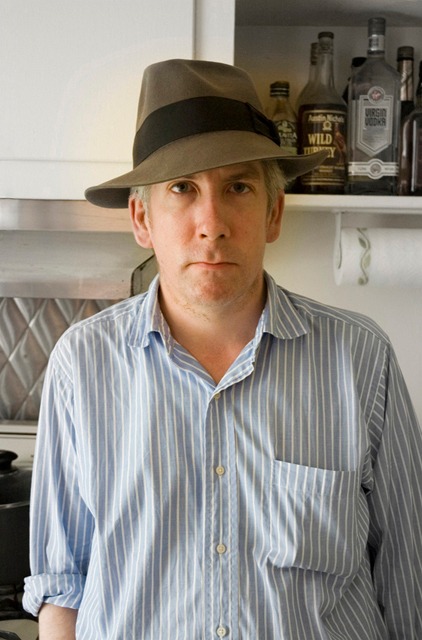
Obituaries, he often complained, rarely did justice to the people they were meant to honour, so for years he wrote his own annual round-up of the notable dead, with all the wit and bite he felt they deserved. Jim Knipfel, the fiercely funny memoirist, novelist and longtime “Slackjaw” columnist who turned his slow descent into blindness into some of the most original writing of his generation, died on October 7, 2026, after more than a year with bile duct cancer. He was 61.
Knipfel was born on June 2, 1965, at the U.S. Air Force base in Grand Forks, North Dakota, where his father was stationed, and before his first birthday the family moved to Green Bay, Wisconsin. As a teenager, he was diagnosed with retinitis pigmentosa, a rare genetic condition that would gradually take his sight, and he also struggled with severe depression through his teens and early twenties, an experience he later wrote about with remarkable candour. After a six-month stay in a psychiatric ward in Minneapolis, he went on to find what he described as a deep and lasting interest in life.
He studied physics briefly at the University of Chicago before transferring to the University of Wisconsin–Madison to major in philosophy. With a friend nicknamed Grinch, he launched the tongue-in-cheek Nihilist Workers Party, whose prank flier promoting “telephone terrorism” landed in the student paper The Daily Cardinal and earned a mention in Time magazine in 1987. He later wrote of youthful misadventures that included an ill-fated scheme involving the grave of notorious killer Ed Gein. On October 25, 1987, his “Slackjaw” column debuted in Philadelphia’s Welcomat, later the Philadelphia Weekly, where he also reviewed restaurants and art.
In 1990, Knipfel moved to Brooklyn with his then-wife, Laura, continuing to file “Slackjaw” for the Welcomat out of loyalty to his editor, Derek Davis, while contributing articles and music reviews to the New York Press under editor John Strausbaugh. When Davis was pushed out in 1993, Knipfel brought his column to the Press, starting out as the paper’s receptionist before becoming a full-time columnist and staff writer covering news, film, music, features and the crime blotter.
Initially reluctant to write a memoir, he accepted a book deal from Penguin Putnam editor David Groff in 1997, reasoning that it might be worth leaving something more solid behind than newspaper pages. His first draft ran to 500 pages, and after Groff pointed out the thread of his journey toward blindness running through it, Knipfel reshaped the material into ‘Slackjaw’, published in 1999. He toured 10 cities to promote it, reading from large-print pages under a bright lamp with a magnifying glass. The book became a critical and popular success, praised by the famously reclusive Thomas Pynchon as “an extraordinary emotional ride, through the lives and times of reader and writer alike, maniacally aglow with a born storyteller’s gifts of observation,” while The Boston Globe called it “a disease book with an attitude.”
He followed with ‘Quitting the Nairobi Trio’ in 2000, chronicling his months in the Minneapolis psychiatric ward, and ‘Ruining It for Everybody’ in 2004. By 2007, he told Leonard Lopate that he was done with memoirs: “I had three of them out before I was forty, and I think that’s just asinine.”
Turning to fiction, Knipfel embraced his love of pulp storytelling with ‘The Buzzing’ in 2003, the tale of Roscoe Baragon, a veteran reporter stuck on the kook beat who uncovers an elaborate conspiracy. “Roscoe, to put it simply, represents what I would like to be,” he admitted. ‘Noogie’s Time to Shine’ followed in 2007, then ‘Unplugging Philco’ from Simon & Schuster in April 2009, the story collection ‘These Children Who Come at You with Knives, and Other Fairy Tales’ in 2010 and ‘The Blow-Off’ in 2011. He also contributed to ‘Crimes of the Beats’, ‘Legal Action Comics’ and ‘New York Calling: From Blackout to Bloomberg’, wrote about Louis-Ferdinand Céline and penned the introduction to the centennial edition of Helen Keller’s ‘The Story of My Life’.
After the New York Press let him go in June 2006, ending a 13-year run, “Slackjaw” continued online at Electron Press, where his memorable pieces included a tribute to David Paterson’s inauguration as New York’s first legally blind and first Black governor and a 2008 rant about Park Slope’s sidewalk-clogging strollers that set Brooklyn buzzing. From 2023, he wrote columns and cultural criticism for Truthdig, and in 2025 he won first place for online current-events columns at the Los Angeles Press Club’s Southern California Journalism Awards.
Death, in all its strangeness, was one of his great subjects. He wrote about the coverage of Heath Ledger’s passing and Charlton Heston’s obituary, and for years produced his own year-end tributes to the departed, alongside affectionate essays about his Green Bay childhood and the fading of his vision.
Jim Knipfel leaves behind a body of work that refused to soften hard truths, finding dark humour, curiosity and defiance in places most writers would avoid. Few people thought more about how the dead should be remembered, and his own legacy is fittingly unsentimental and unforgettable: a writer who lost his sight and gained an unflinching vision, sharing it with readers one wickedly funny column at a time.