

The nationwide Sexual Health and Reproductive Rights Bar Association exists because New York City-based attorney Natalie Birnbaum saw a need for it after spending years fighting against the past decade’s attacks on abortion rights and decided to build it.
“I really feel strongly that, particularly in such uncertain times, when we don’t have as much confidence in how our laws are being upheld, the one thing that can never be taken away from us are our relationships,” Birnbaum said of why developing a bar association specific to reproductive rights law is important. “I was really inspired to create more infrastructure to build out our relationships.”
Birnbaum, who’s the founder of reproductive rights firm Repro Solutions, has been one of the most prominent attorneys pushing to protect abortion rights for nearly a decade. She came out swinging during her first major foray into the field in 2017 when she helped work on some of the first buffer zone laws preventing anti-abortion protestors from harassing abortion seekers walking into clinics.
Shortly after, in 2018, she helped litigate against the anti-abortion advocates bringing Dobbs v. Jackson Women’s Health Organization, the case that ultimately resulted in Roe v. Wade’s reversal in 2022, when it was at the district court level.
“In that moment, I just understood that the fight around abortion and reproductive rights was … about our bodily autonomy, our choice, our roles in the world, how a woman’s body is treated as property,” Birnbaum said of her time working on those matters for firm Stroock & Stroock & Lavan LLP. “It’s very interesting to be at a forefront area of the law. I was just so fired up. I decided, ‘This is what I’m focusing on.’”
Since then, she’s been an integral part of the push for the passage of state-level Shield Laws – which permit healthcare providers in states where abortion is legal to provide telehealth care and ship abortion pills to people in states where it isn’t – across the nation.
“It was so inspiring and interesting to be in the rooms with these legal scholars, people from all corners of the law, getting their feedback,” Birnbaum said of what the early days of working on Shield Laws looked like. “All of these people were weaving together all these different areas of knowledge to get a sound basis of, ‘Is this constitutional? What are the holes in the arguments? Where will this make sense? What are the protections? How can we make sure that the max amount of protections are passed? How do we build this thing?’”
 Natalie Birnbaum, an attorney who’s been working on reproductive rights lawerying for nearly a decade.Photo provided by Natalie Birnbaum
That work, she said, is ongoing and critical as she and her team await a decision on whether those laws will be challenged in front of the U.S. Supreme Court and is informed by her work on telemedicine matters at healthcare firms like Nixon Law Group and Nelson Hardiman LLP.
It also intersects with her work advising telehealth providers across the country on how to comply with those laws when providing abortion care to people within the legal lines in a fraught landscape, something she’s been doing at her firm Repro Solutions and others, like the Reproductive Health Institute for Telehealth Equity Solutions, where she’s working in a more policy-centered space on the issue.
The motivation behind Repro Solutions
Birnbaum said she was motivated to open Repro Solutions to advise reproductive health providers on offering telehealth care and mailed abortion pills to patients under Shield Laws because, as an attorney deeply involved in the fight to get them passed, she was one of the only lawyers familiar enough with the law to provide the legal service to clinics on how to actually comply with and use them to get people care who needed it.
“It was the August after Dobbs, and I started working on the New York Shield Law and then got connected with the providers that were really championing getting these Shield Laws passed, and then I started working with California providers,” Birnbaum said. “Then these laws passed, and there were providers who said, ‘Okay, now we want to structure our clinics in a legally compliant way under the Shield Law.”
“There weren’t a lot of lawyers that were familiar enough with the Shield Law to feel comfortable advising clients and say, ‘In the state of California it is legal, and it is protected for you to mail [abortion] pills through a telehealth visit into another state,’” Birnbaum said. “It was this new thing, and there weren’t a lot of lawyers in the space. One of my clients I did policy advocacy with in California was like, Hey, will you help us build out our structure?’ I said, “Yeah, I can do that.’”
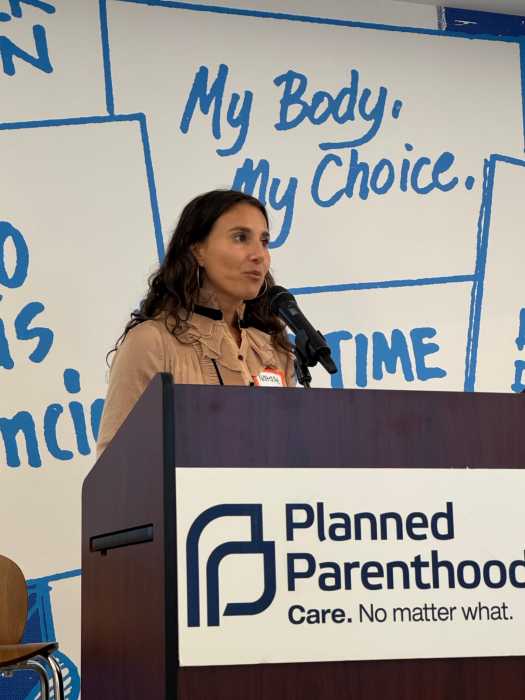 Birnbaum speaking at a Planned Parenthood event.Photo provided by Natalie Birnbaum
Advising clinics on complying with telemedicine laws was something she’d been doing at other healthcare firms; she just hadn’t necessarily applied that skill in the same way in the reproductive space, Birnbaum.
“I started that work for that clinic, and then like other folks came to me that had Shield Law questions, or telehealth practices, or clinics that wanted to integrate telehealth, and I just started doing that,” Birnbaum said.
Her decision to form the Sexual Health and Reproductive Rights Bar Association was also born from a similar sense that there was a gap that needed filling. After Donald Trump was elected president for the second time in 2020, Birnbaum said she was contacted by a clinic that wanted to close its doors due to the combative landscape they anticipated experiencing. She was upset and feeling alone, she said, and wanted a way to bounce ideas off of and seek support with her colleagues
“I was really craving that in that moment. I was thinking, ‘I know that there are other healthcare attorneys that are not at the big places, like Planned Parenthood, that are local healthcare attorneys and clients are going to them right now and being like, ‘What should we do?’” Birnbaum said. “And I was like, ‘I want to talk to them. Why can’t I talk to them? I know that they want to talk to me too. Where are they?’”
“I decided, I’m just going to do it. I’m going to create a way for us to be communicating with each other,” Birnbaum said.
She reached out to fellow attorneys in the space, received a positive response and launched the bar association in 2025. It’s been incredibly necessary, she said, and has given attorneys a space to share information with each other.
“We have in one of our communication platforms, where one lawyer said, ‘I need to connect with somebody over here in this state about this. Does anybody know anyone? And then someone answers, and it’s just building those networks because finding a repro-friendly lawyer in a certain state and a certain issue area can be hard.”
“Having people in real time answer each other or share information is great, and we’ve seen it play out through greater ease and efficiency and collaboration,” Birnbaum said, “Another thing we’ve been doing is policy programming to raise awareness about different issue areas. From that, some folks have gone on to do collaborations with other organizations they didn’t know about before.”
 Birnbaum stands with her Sexual Health and Reproductive Rights Bar Association co-founder, Melissa Torres-Montoya.Photo provided by Natalie Birnbaum
Her decision to pour her time into growing the organization is representative of her persistence in working in both the advocacy and more direct lawyering space of reproductive rights. It’s an intentional choice to work on both sides of things, Birnbaum said, because it gives her efforts to push abortion rights forward the advantage of being incredibly informed.
“It makes for effective lawyering when you’re working in an issue area to do both sides – to do the policy side and to do the direct lawyering side,” Birnbaum said. “When litigation does come up, having the knowledge and the breadth of knowledge of who supported the law that you then have to defend your client under and what the process of developing it looked like is helpful because you’ve already explored and exhausted to an extent the holes or flaws in a law.”
“And, in my direct client work, when I can see what a provider is experiencing on the ground in terms of their challenges or what they need, then I’m a better advocate on the legislative policy level because I’m like, ‘If we word the law like this, it’s not actually getting to the root of the problem of the population we’re seeking to protect or support,’” Birnbaum said. “Whereas if you’re more removed from that person and what’s happening on the ground, things may sound really good, but you may not be able to have that same understanding of the practical impact.”
That deep knowledge is also critical to success when you’re working at the forefront of an actively developing legal landscape, Birnbaum said.
“It’s very exciting, and it’s challenging, and there’s a lot of balancing that needs to happen when you’re working in such a high-risk area of law,” Birnbaum said. “Being at a new frontier of an area of law requires balancing between, ‘Okay, this is what I think, and here’s where I’m going to push it. And here’s where there’s legal precedent.’”
Birnbaum says she now sees her role as an attorney in this fight as one of a person who can offer level judgment on exactly how and where to push advocacy efforts while supporting clinics in complying with ever-contested state laws to legally provide abortion care and supporting other attorneys in doing the same. She also sees it as aligning with her initial reason for wanting to seek out a career in law.
“I was drawn to law because I had an orientation towards wanting to make the world a better place,” Birnbaum said. “I wanted to use tools in order to improve people’s lives and circumstances.”
“Today, I find, particularly being in an area of law that’s on the frontier, in a moment where historically we’re on the precipice of a whole new world, it feels like our sound judgment, our balanced judgment is so important,” Birnbaum added.