
SODUS BAY, N.Y. — Fall is here and literally hundreds of millions of birds across the United States are flying south. On waterways across New York, there are increasing numbers of a certain type of bird, which many people living near their nesting areas can only hope will soon head south for the winter as well.
On the choppy waters of Sodus Bay, Huron Town Supervisor Dave Fantuzzo shows black birds leaving their mark on an old dock off Newark Island. And that’s a problem.
“We’ve been getting a lot of complaints,” said Fantuzzo.
Huron includes some islands and a large portion of the land on the south and east sides of the bay.
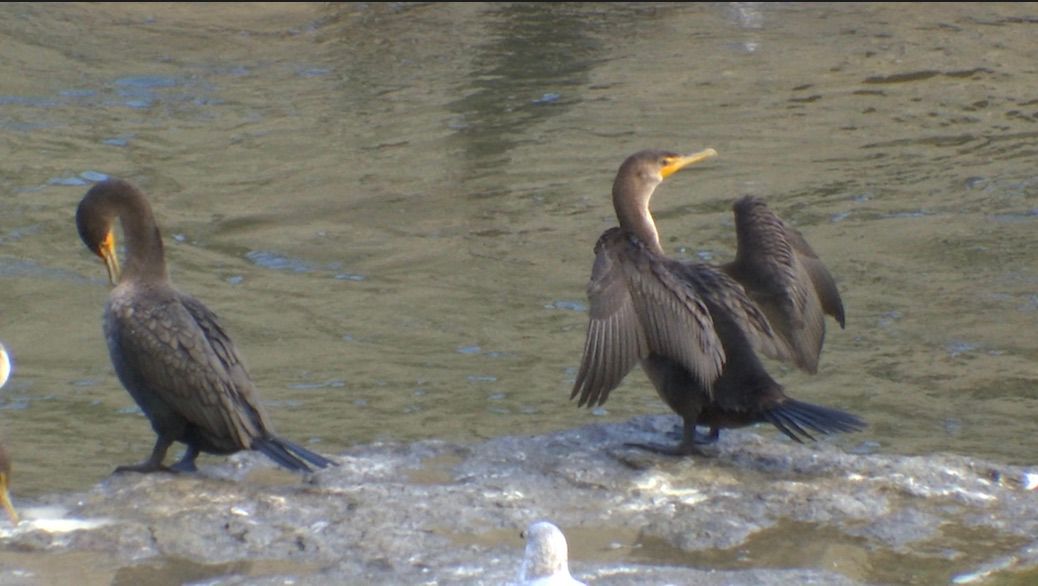
The birds in question are double-crested cormorants. They are migratory birds — somewhat gangly and not very graceful. They eat large amounts of fish and leave large amounts of waste.
“They have been creating quite a mess,” said Fantuzzo. “They are killing a lot of the trees. Their poop leaves a terrible odor.”
“They’re very unique,” said Stacy Furgal, Great Lakes fisheries and ecosystem health specialist with New York Sea Grant. “Once you learn how to identify them, there’s not really anything else that looks quite like them.”
Over the summer, New York Sea Grant began tracking large and growing groups of the double-crested cormorants. Not only are they voracious eaters, but their waste can cause quite a bit of damage.
“Their excrement is quite acidic, so it can cause habitat damage,” said Furgal. “So it can kill trees and vegetation around where they’re nesting.”
Fantuzzo says he has spent much of his summer taking calls from people who live along Sodus Bay — a summer haven for fishing, boating and tourism. It’s also home to several large flocks of double-crested cormorants.
“People are concerned about how they were killing the trees and leaves,” he said. “And they just want to know if there’s anything that could be done.”
For those annoyed by the birds, there’s another issue. Double-crested cormorants are a federally protected bird species. They’ve been spotted near waterways all over the state.
“There’s no simple way to get rid of them,” said Fantuzzo.
“It’s pretty widespread across the state,” said Wayne County Geographic Information Systems Manager Zakk Hess. “Anywhere there’s water, there’s cormorants.”
Hess created an app, initially geared toward just Wayne County residents, where people could report cormorant sightings and damage. The reporting tool has expanded, through a partnership with New York Sea Grant, into a statewide reporting site.
“These people want someone to do something because the issue has gotten so bad,” said Hess. “A lot of people are pretty upset about this and some of the things said are pretty concerning. They know that they’re being heard and something hopefully can happen.”
That solution remains tricky. Since cormorants are a protected bird, that means nests, eggs and habitats can’t be disrupted.
“It’s a balancing act,” said Furgal. “This situation is very nuanced. We do have a federally protected bird species, but we have a bunch of these impacts.”
While there is no hunting of cormorants allowed, lawmakers in St. Lawrence County recently passed a resolution supporting a congressional bill, introduced this year, which would allow a migratory hunting season for double-crested cormorants.
Data collected this year and next through the app will be shared with impacted towns and with environmental agencies like the New York Department of Environmental Conservation.
“So we’re trying to come up with some sort of solution,” said Hess. “Or at least give them a voice to pass it on to those higher up, who might be able to do something about it.”
That’s something which, at this point, appears easier said than done.
“You worry about, ‘well, if you get rid of them or where are they going to go?’ ” said Fantuzzo. “They’re going to go down to the next island. And it’s not what we want. It’s concerning.”