
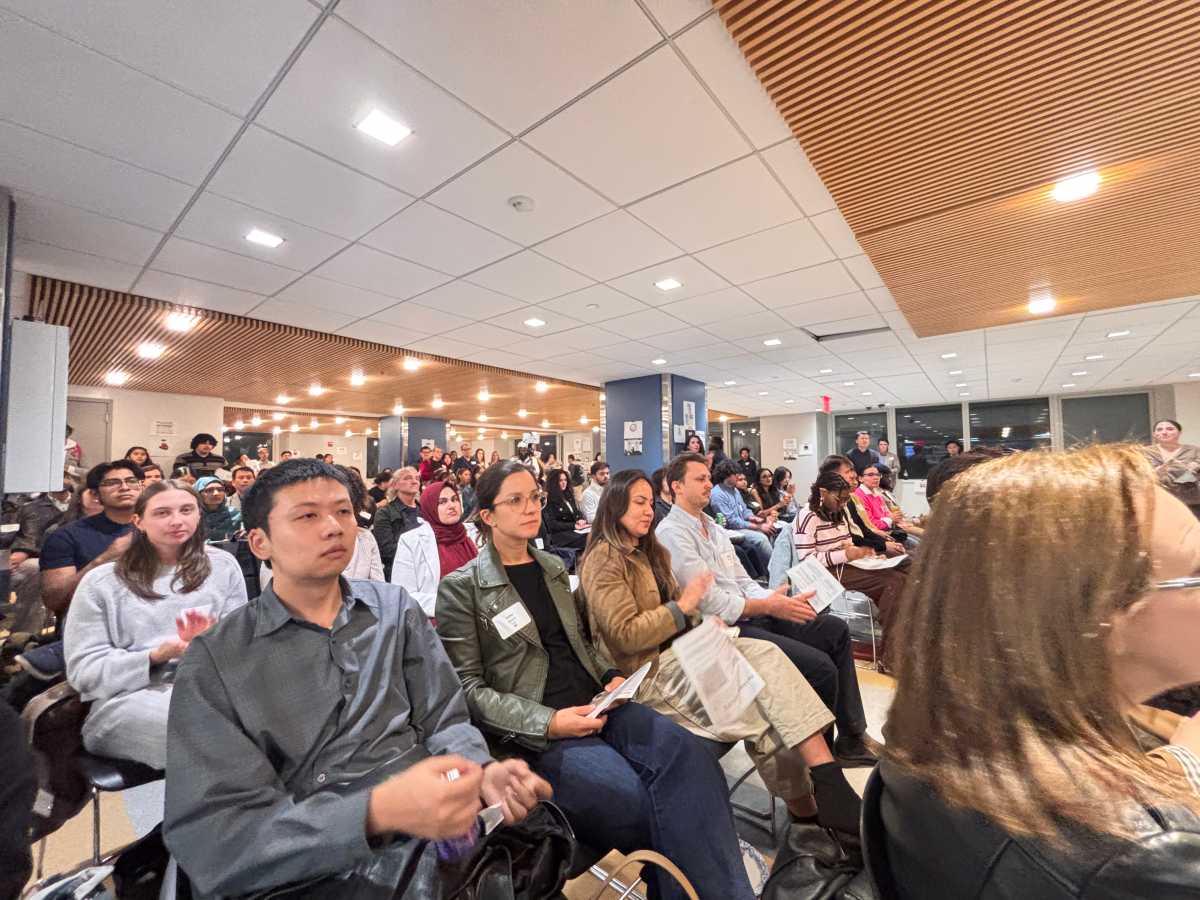
It all started when a student raised his hand after being asked what he thought were issues in architecture. “Loneliness,” he said. On Oct. 6, students crowded into a large space in Downtown Brooklyn, finding community, connection and career guidance.
Nearly 100 architecture students recently met their mentors through a nine-year-old program designed to help them build a career and a life, finding inspiration as well as education from people in the profession.
Architecture students from four schools and their mentors united last week at New York City College of Technology’s Voorhees Hall, at 186 Jay St., forming relationships and finding resources.
The program, launched by the Architectural League of New York, is one of New York City’s more notable examples of expanding the boundaries of education.
Students came from City Tech, Kean University’s Michael Graves College of Architectural Design, City College’s Spitzer School of Architecture and the New Jersey Institute of Technology’s Hillier College of Architecture and Design.
The Architectural League of New York includes designers, landscape architects, architects, artists and academics.
There are 12 architecture programs in New York City, including two public schools, City College and City Tech, both of which participate in the program.
“Mentors come from all over the place,” Architectural League Executive Director Jacob Moore said. “People who are seniors at big firms, who run their own offices, people just out of school who want to pay it forward, young architects who have been mentees.”
Mentors with diverse backgrounds, experiences and ethnicities are matched with a diverse group of students who find role models, resources and relationships.
“Our students are from all over the world,” said Ting Chin, who leads City Tech’s architecture school. “I think we reflect the demographics of New York City.”
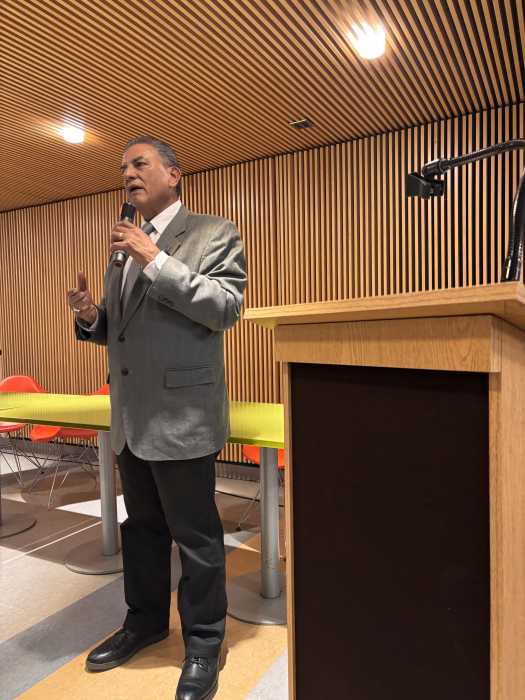 City Tech Interim President Milton Santiago spoke about the college’s growing architecture program and its emphasis on preparing students to make an impact on their communities.Photo by Claude Solnik
City Tech Interim President Milton Santiago said the school’s architecture program attracts people who want to build a life, a career and a city.
“It’s growing,” he said of the 900-person program. “Most of our students live in urban environments. They want to contribute to the environment where they live and work and make an impact on their communities.”
The mentoring mandate
Outgoing City Tech architecture Chair Sanjive Vaidya said the program was born out of one raised hand and a realization that followed a question about students’ concerns.
“A student raised his hand and said, ‘We feel really lonely,’” Vaidya said. “Studying architecture is a lonely enterprise. All of us have been late night in studios, headphones plugged in, working on a project.”
When he surveyed students, Vaidya found that few, if any, knew architects, had architects in their families or had visited an architecture firm.
“When I asked if they knew someone in the building industry, then I got some positives,” Vaidya said. “Some had family in construction.”
When asked about famous architects in film and television who might inspire students, Vaidya said the media offers few examples.
Aside from the father in “The Brady Bunch” and a Simon and Garfunkel song about Frank Lloyd Wright, architects may build the world, but they are largely absent from television and film. Inspiration seems to flow instead from what students see around them.
“You’re looking at it,” Chin said of buildings inspiring students, “seeing it, using it every day.”
Zoe Fruchter, senior program manager at the Architectural League, said “each pair represents its own opportunity for connection and enrichment.”
“The mentees are learning not only in school, but the norms of professional non- academic communication,” Fruchter said. “A lot of them have jobs, families, duties. Begin with kindness. Begin with understanding.”
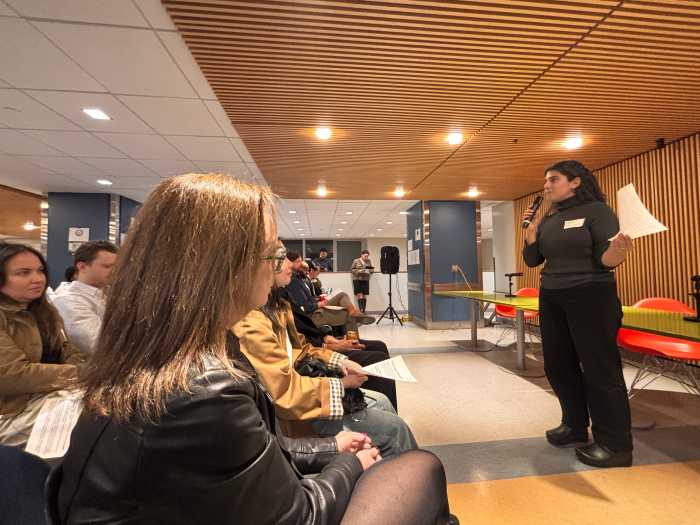 Marianela D’Aprile, the Architectural League of New York’s mentoring director, spoke about the organization’s nearly decade-long program connecting architecture students with professionals in the field.Photo by Claude Solnik
Mentors said it is easy for students to disappear into their studies, losing sight of the need to socialize and build bonds with the community.
“It’s easy to go into a rabbit hole. I tend to focus on the journey students are having now,” Tom Chou, a mentor, said. “We both have things to learn from each other.”
Marianela D’Aprile, the league’s mentoring director, said the organization views these connections as a key part of its mission.
“The League has been doing this for almost a decade,” D’Aprile said. “It’s a really important program for us.”
Building relationships
Chou said electronic communication makes it easier to stay in touch between in-person meetings.
“We texted each other a lot,” Chou said. “That’s the primary mode of communication. It felt like a friendship more than mentorship.”
Others said it is important to get over the fear of embarrassment to create opportunities to learn.
“I was hesitant at first to ask those silly questions. Once we set up weekly Zoom meetings … I got comfortable,” said Isus Marsho, an undergraduate student at Michael Graves College of Architectural Design. “Ask those silly questions. They’re not silly, things you’re learning the first time. Just find the joy in being into architecture and designing.”
Flaminia Cedeno, a third-year City Tech student, spoke with her mentor, Evelyn Hinojosa, who works in store design for Dior.
“I came into architecture, because I’m mostly interested in art and I’m really good at math,” Cedeno said. “I’m really good at designing and creating. Why not go into architecture?”
Hinojosa said they met virtually before meeting in person, as she hoped to provide Cedeno with a sounding board and support.
“I invited her to a [remote] meeting before orientation to meet and have good one and one time,” Hinojosa said.
 Flaminia Cedeno, a third-year City Tech architecture student, stands with her mentor, Evelyn Hinojosa, who works in store design for Dior. The two connected through the Architectural League of New York’s mentorship program, which pairs students with industry professionals to offer career guidance and support.Photo by Claude Solnik
Hinojosa told Cedeno about her job, and Cedeno appeared encouraged by her mentor’s enthusiasm.
“It is a really cool job. You’re in between art and architecture and fashion,” Hinojosa said of her work, which illustrates the variety of career paths available to architecture students. “I came back to New York. I’m from New York. I was recruited to work for them.”
If the program is designed to build relationships, it is not designed to build résumés through internships with mentors.
“I think the job market is difficult, especially for entry level jobs,” Chin said, noting that the challenges make mentoring even more important. “We’re probably affected to some degree by AI.”
She said artificial intelligence can help with rendering and image-making, but jobs remain available at small and large companies, as well as in related fields.
“It’s a long process. You need level of education, hours working for another architect, and you have to pass multiple exams,” Chin said of becoming a licensed architect. “You can be a designer at a firm. There are all these related professions you can enter.”
She said façade design, sustainability, building information modeling and many other specialties can provide career opportunities.
“You don’t know what you’ll end up doing. I never dreamed I would end up doing the amount of detailing I’m doing,” said Alicia Niebrzydowski, a mentor who works at WDP Consulting Engineers. “I was a strictly theoretical girl in school.”
Founded in 1881, the league has changed as the world has changed, but some things remain the same.
“One thing that has remained consistent is a commitment to creating space where designers and architects can learn from one another,” D’Aprile said. “Think big, dream big, so we can shape the way you work today, but also the future of the profession.”