
New York has played an extraordinary role in American history, from the battles that helped secure independence to the industries and immigrant communities that transformed the young nation. Its waterways opened routes into the interior, while its cities became centers of commerce and manufacturing that helped drive cultural change. Yet the Empire State’s story begins long before European settlement, with Indigenous nations whose histories and traditions remain essential to New York today.
John Mix Stanley, The Trial of Red Jacket, 1869, oil on canvas. The painting depicts Red Jacket (1758–1830), a prominent Seneca leader of the Haudenosaunee Confederacy, defending himself against an accusation of witchcraft. Public domain. Courtesy of Wikimedia Commons. A Brief History of the Empire State
Long before European settlement, the region that became New York was home to Indigenous peoples whose communities flourished amid its extensive forests and along its rivers, lakes, and coastal waterways. Woodlands provided game, nuts, medicinal plants, and materials for shelter and tools, while the waterways supported fishing and transportation. The Haudenosaunee Confederacy originally consisted of five nations: the Mohawk, Oneida, Onondaga, Cayuga, and Seneca. The Tuscarora later joined as the sixth nation. Their political alliance became one of the most influential Indigenous confederacies in North America. Along the Hudson Valley, Long Island, and the lower reaches of the state, the Lenape and other Algonquian-speaking peoples maintained their own communities and extensive networks of trade and exchange. These Native nations remain part of New York’s cultural and political life today.
European colonization began in the early 17th century when the Dutch established New Netherland, with New Amsterdam developing into a trading settlement at the southern tip of Manhattan. The English seized the colony in 1664 and renamed it New York in honor of the Duke of York. Under English rule, the colony’s ports, farms, and trading communities expanded, although that growth came at the expense of Indigenous lands and relied in part on enslaved African labor. By the eve of the American Revolution, New York had become a commercially important and politically divided colony.
New York occupied a strategic position during the Revolutionary War. British forces captured New York City in 1776 and held it for the remainder of the conflict, while fighting continued throughout the Hudson Valley and upstate regions. The American victory at Saratoga in 1777 proved a turning point, helping persuade France to enter the war as an American ally. The conflict also divided the Haudenosaunee nations, whose communities suffered devastating destruction and displacement. Following independence, New York became the 11th state to ratify the Constitution in 1788, and New York City briefly served as the nation’s first capital under the Constitution, where George Washington was inaugurated in 1789.
The opening of the Erie Canal in 1825 transformed New York’s economy and the nation’s westward development. Connecting the Hudson River to Lake Erie, the canal dramatically reduced transportation costs and opened new markets for agricultural products and manufactured goods. Buffalo, Rochester, Syracuse, and other communities grew as trade and industry followed the waterway. New York City, already an important port, became an even more powerful center of American commerce. The canal’s influence extended far beyond the state, helping connect the Atlantic coast with the rapidly expanding interior.
During the 19th and early 20th centuries, millions of immigrants entered the United States through New York Harbor, first through Castle Garden and later Ellis Island. Many settled in New York City, while others moved into communities across the state or traveled farther west. At the same time, New York became a center of reform. The 1848 women’s rights convention at Seneca Falls helped launch the organized women’s suffrage movement, while abolitionists and Underground Railroad networks challenged slavery. These movements, along with the labor activism that accompanied industrial expansion, helped shape national debates over citizenship and equality.
New York’s industrial and cultural influence continued to grow through the 20th century. Rochester became known for photography and optical manufacturing, Buffalo for steel and transportation, and Corning for glassmaking, while New York City emerged as a global center of finance, publishing, fashion, and the arts. From Manhattan’s skyscrapers to upstate New York’s factories and workshops, the state produced innovations and objects that became part of America’s material culture. Its history is reflected not only in monuments and museums, but also in the everyday things people made, used, and preserved.
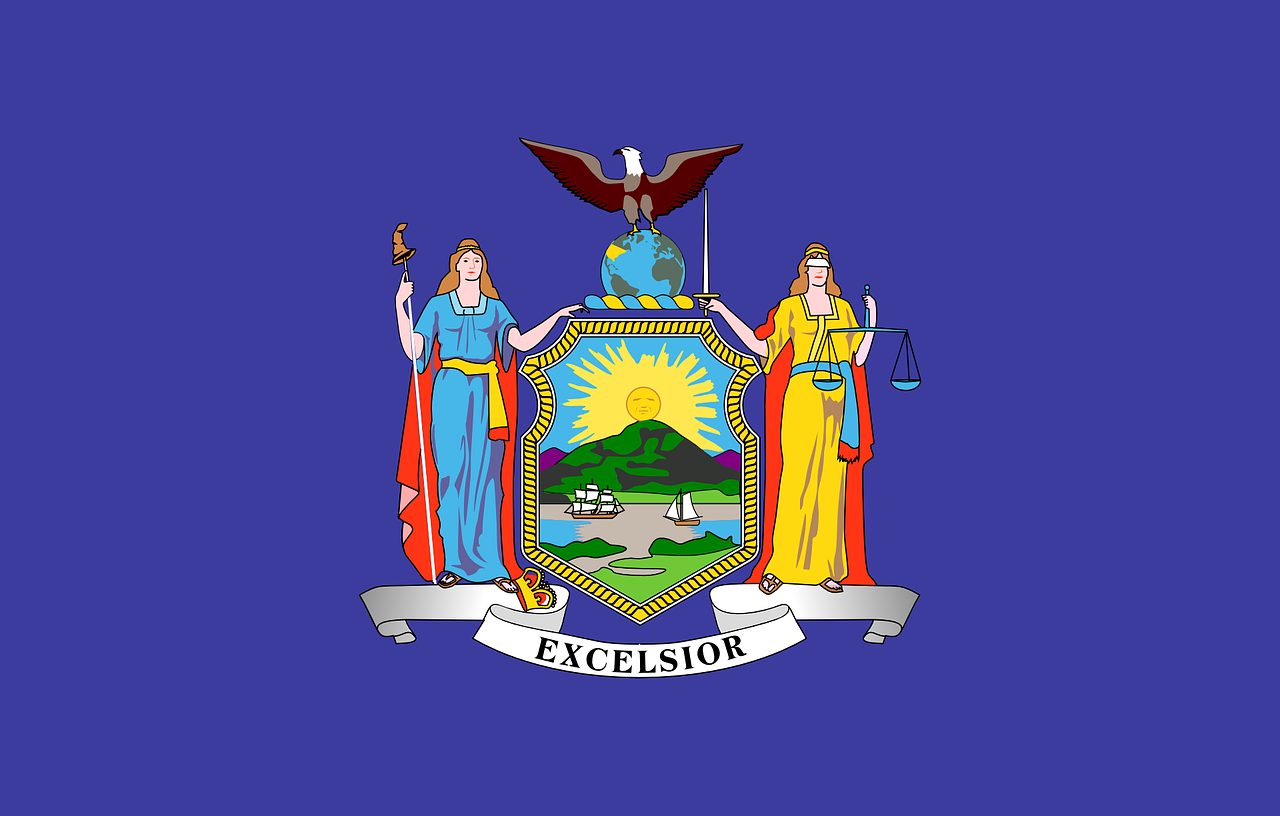
The New York State Flag features the state coat of arms—showing the Hudson River, mountains, Liberty, Justice, an eagle, and the motto “Excelsior”—centered on a dark blue field, officially adopted on April 2, 1901, and standardized in 2020. Image: 50states.com. Honoring the 250th
New York is commemorating America’s 250th anniversary with exhibitions, historical programs, and events examining the state’s central role in the Revolution and its influence on the nation that followed. The New York State 250th Commemoration Commission is coordinating efforts to explore both the founding period and the continuing struggle to fulfill the ideals expressed in the Declaration of Independence. The statewide initiative includes museums, historic sites, educational institutions, and local communities.
At the New York State Museum in Albany, Revolutionary New York explores the state’s Revolutionary history through artifacts, images, and interactive displays. The exhibition extends beyond the War for Independence to consider later movements for equality, including women’s suffrage and the Stonewall Uprising. It remains on view through July 8, 2029.
New York City’s contributions are also receiving special attention. The Museum of the City of New York presents The Occupied City: New York and the American Revolution, an exhibition examining the city during British occupation through historical objects, documents, and multimedia presentations. Elsewhere, museums and historical organizations across the state are revisiting the Revolutionary era through exhibitions and public programs that continue beyond the July 4 anniversary.
Collecting New York
New York’s collecting heritage reflects its long history as a center of American manufacturing, artistic innovation, and commerce. From New York City’s decorative arts studios to Corning’s glasshouses and Rochester’s factories, the state produced objects that remain highly sought after by collectors. Others, including World’s Fair memorabilia and vintage tourist souvenirs, offer more affordable ways to explore its history.
Tiffany Studios Tel El Amarna Favrile Vase. This blue iridescent Favrile glass vase features an Egyptian-inspired decorative band around its neck and bears the signature “LCT Tiffany Favrile.” 9” H. Sold for $6,250 at Jaremos on October 1, 2026. Courtesy of WorthPoint.
Among New York’s most celebrated decorative arts firms was Tiffany Studios, whose iridescent Favrile glass became a hallmark of American Art Nouveau design. A striking blue Tel El Amarna Favrile vase, featuring Egyptian-inspired decoration around its neck and signed “LCT Tiffany Favrile,” sold for $6,250 at Jaremos on October 1, 2026. The 9-inch-tall vase reflects the firm’s interest in ancient decorative traditions and the luminous surfaces that made Tiffany glass famous.
Steuben Gold Aurene Cabinet Pieces. This group of four blown-glass pieces features the luminous iridescent finish associated with Frederick Carder’s Steuben glass. Each is inscribed “Aurene” and bears an individual model number. The tallest measures 7½” H. From the collection of Ruth deLorraine, Campbell, New York. The group sold for $540 at Cottone Auctions on September 24, 2026. Courtesy of WorthPoint.
Farther upstate, Steuben Glass was founded in Corning in 1903 by Frederick Carder and Thomas G. Hawkes. Carder’s richly colored art glass included Aurene, an iridescent finish that became one of Steuben’s most recognizable creations. A group of four Gold Aurene cabinet pieces, each signed and numbered, sold for $540 at Cottone Auctions on September 24, 2026. From the Ruth deLorraine collection of Campbell, New York, the pieces demonstrate the varied forms and shimmering surfaces that continue to attract Steuben collectors.
Thomas W. Commeraw Stoneware Jug. This early 19th-century three-gallon jug by New York potter Thomas W. Commeraw features cobalt-highlighted clamshell decoration and a five-line maker’s mark identifying his pottery at Corlears Hook, New York. One of the largest documented examples bearing this elaborate mark, the 16½”-tall jug sold for $11,000 at Crocker Farm’s July 31, 2026, auction. Courtesy of Crocker Farm.
New York stoneware offers another collecting tradition, one rooted in the practical wares produced for homes and businesses during the 19th century. Among its notable makers was Thomas W. Commeraw, a free Black potter who operated a stoneware manufactory at Corlears Hook in Manhattan. His distinctive cobalt-decorated vessels are particularly prized today. An exceptional three-gallon stoneware jug, featuring his clamshell decoration and elaborate five-line maker’s mark, sold for $11,000 at Crocker Farm on July 31, 2026. The jug offers a tangible connection to an important early American craftsman whose achievements are receiving greater recognition.
1964–65 New York World’s Fair Souvenirs. Two colorful souvenir plates featuring the fair’s iconic Unisphere accompany a 1965 official souvenir book. Held in Flushing Meadows–Corona Park in Queens, the World’s Fair celebrated technological innovation and visions of the future. The three-piece group is offered for $36.54. Courtesy of eBay seller Toyz Store and More. 1964–65 New York World’s Fair Souvenirs. Two colorful souvenir plates featuring the fair’s iconic Unisphere accompany a 1965 official souvenir book. Held in Flushing Meadows–Corona Park in Queens, the World’s Fair celebrated technological innovation and visions of the future. The three-piece group is offered for $36.54. Courtesy of eBay seller Toyz Store and More.
New York hosted two of the 20th century’s most memorable World’s Fairs, both held at Flushing Meadows in Queens. The 1939–40 fair embraced the theme “Building the World of Tomorrow,” with its futuristic Trylon and Perisphere becoming instantly recognizable symbols. A vintage tin bank depicting the two structures sold for $75 at Absolute Auction Gallery on April 22, 2026, despite a $200–$300 estimate. A generation later, the 1964–65 fair introduced the Unisphere, a monumental steel globe that remains a Queens landmark. A group of two souvenir plates and a 1965 official souvenir book featuring the Unisphere and other fair imagery is currently offered on eBay for $36.54.
Kodak Six-20 Flash Brownie Camera. Introduced in 1940, the Kodak Six-20 Flash Brownie box camera features a distinctive circular flash reflector mounted above its compact black body. Manufactured by Eastman Kodak of Rochester, New York, the camera helped bring flash photography within reach of amateur photographers. This vintage example sold for $24.85 on eBay on October 8, 2026. Courtesy of WorthPoint.
Rochester’s Eastman Kodak Company helped make photography accessible to millions of Americans, and its cameras remain popular collectibles. The familiar Brownie line introduced generations of amateur photographers to picture-taking, while later models incorporated features such as flash attachments. A vintage Kodak Six-20 Flash Brownie, produced beginning in 1940 and fitted with a large circular flash reflector, sold for $24.85 on eBay on October 8, 2026. Its distinctive design makes it an appealing example of the everyday technology that transformed family photography.
Vintage New York City Skyline Souvenir. This bronze-colored souvenir depicts the Statue of Liberty surrounded by familiar New York landmarks, including the Empire State Building, Chrysler Building, and original World Trade Center towers. A nostalgic reminder of the city’s changing skyline, the miniature is offered for $14. Courtesy of Poshmark seller jdhorse22.
New York City’s tourist trade has also produced generations of inexpensive souvenirs. A bronze-colored miniature skyline featuring the Statue of Liberty, Empire State Building, Chrysler Building, and original World Trade Center towers is offered on Poshmark for $14. Another nostalgic example is a colorful circa-1960s souvenir plate depicting the Statue of Liberty surrounded by Times Square, Rockefeller Center, Coney Island, and other familiar attractions. Bearing the slogan “City of Wonders,” the plate is offered for $24 on Etsy. Such souvenirs preserve changing views of New York and remind collectors that history can be found in the most ordinary objects.
Vintage New York City Souvenir Plate. Colorful illustrations of the Statue of Liberty, Empire State Building, Times Square, Rockefeller Center, Coney Island, and other landmarks decorate this circa-1960s souvenir plate bearing the slogan “City of Wonders.” Offered for $24. Courtesy of Etsy seller PineyWoodsCorner. Looking Ahead: New York’s America 250 Calendar Highlights
Communities across New York are commemorating the nation’s 250th anniversary with exhibitions, educational programs, historical reenactments, and opportunities to explore the people and places that shaped the Empire State. New programs and events continue to be added throughout the anniversary period.
The Battle of White Plains comes to life through a large-scale Revolutionary War reenactment at Ward Pound Ridge Reservation. The free weekend event features living-history activities and presentations exploring the struggle for independence in the Hudson Valley.
This exhibition examines how residents of the Oneonta region experienced the American Revolution. Through local stories, it explores the lives of people who participated in the conflict and those whose communities were transformed by it.
Haudenosaunee artists offer perspectives on the nation’s founding and its consequences for Indigenous peoples. Featuring sculpture, beadwork, paintings, and contemporary artwork, the exhibition considers the anniversary through the experiences and cultural traditions of Native communities.
This major exhibition examines New York City’s experience during the Revolutionary War, when British forces occupied the city for much of the conflict. Historical artifacts, manuscripts, and interactive displays explore the decisions and experiences of New Yorkers during the struggle for independence.
The New York State Museum examines the state’s pivotal role in the Revolution and the continuing pursuit of the nation’s founding ideals. Artifacts, historical images, and interactive displays connect Revolutionary-era events with later movements for civil rights and equality.
Explore More America at 250: