
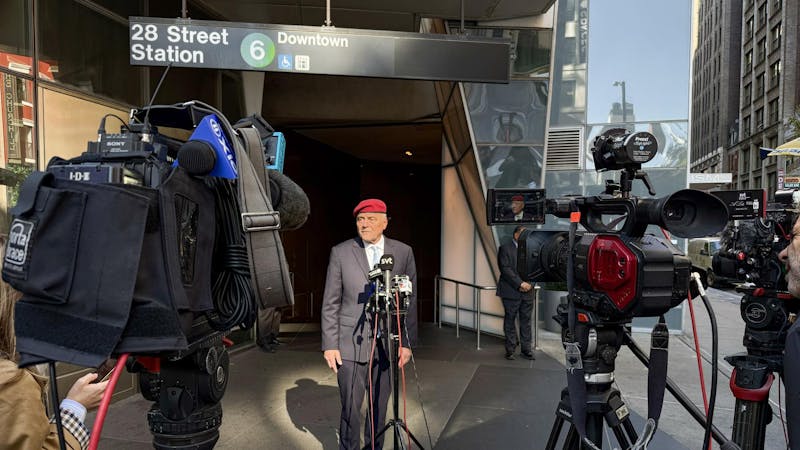
Every election cycle, we are introduced to new candidates. This year, New York City’s mayoral candidates have had their fair share of colorful personalities running. One of them was Curtis Sliwa, known for his bright red beret, constant stream of one-liners and street-corner speeches. Now, once again, Sliwa has caught the attention of the public with a campaign that was more show than substance.
As the votes were counted and his defeat was confirmed, we can look back and clearly see this outcome coming. Though his energy and visibility were unmatched, Sliwa’s effort to run a leadership campaign felt more like a citywide stage act. In the grand scheme of things, he played his role incredibly well, not as New York City’s mayor, but instead as its most recognizable jester.
Sliwa first gained popularity in the late 1970s as the founder of Guardian Angels, a volunteer anti-crime patrol group that became a fixture in New York’s subways. His striking public image and willingness to confront danger earned him admiration early on. Nevertheless, his career was never truly free from controversy.
Sliwa once admitted in the 1990s to having staged fake crime rescues to attract publicity for the Guardian Angels. This pattern of showmanship ended up defining his political style. This flair, which made him famous in the streets many years ago, returned when he ran for mayor. But this time, his speeches were filled with jokes and exaggerated claims.
During this past campaigning period, Sliwa relied heavily on his charisma and humor to win over the public. Instead of actually debating during debates, he turned them into stage performances— treating serious discussions and topics as an opportunity to make punchlines and quick comebacks against the other candidates.
Voters found it difficult to see him as a credible leader due to the proposals he laid out to the public. His ideas for crime and housing were not strong, and he had a habit of reducing complex issues into just punchy sound bites.
Within his own party, enthusiasm was limited. It was reported that he polled at only 15 percent among voters, far behind the eventual winner, New York City Mayor-elect Zohran Mamdani. Many Republicans were urging Sliwa to drop out of the race. The lack of support he had during his candidacy was a sign that his campaign was more a spectacle than a strategy. Sliwa continued to show up for talk shows and rallies, but it was quite clear that he was not going to win this election.
Even Sliwa’s rallies, which were lively, reinforced the idea that he treated politics like they were a theater show. Though the imagery was quite memorable, it distracted people from his actual campaign policies. President Donald J. Trump, who is also known to be quite theatrical, mocked Sliwa’s act by calling him “not exactly prime time.” Now, when one showman calls another showman unserious, the critique is quite heavy.
Nevertheless, Sliwa put an incredible amount of effort into his campaign. He traveled through all five boroughs and met New Yorkers everywhere in public. His enthusiasm for this race was unattached and genuine. He clearly loves the city of New York, which he had hoped to lead. Many people admired his persistence and motivation for this campaign. This is probably not the last time that he will run for mayor, but his campaigning efforts do not mask how his politics were more rooted in personality than policy.
In hindsight, Sliwa’s 2025 run for mayor will most likely be remembered less as a serious political effort but more as a symbol of New York’s love for spectacle. Sliwa was able to fill the role of a loud New Yorker with a heavy accent, who could turn a press conference into a comedy show and a political debate into a theatrical performance. This persona he created made him into a beloved media figure, but failed to convince voters that he could handle the pressure of being New York’s next mayor.
Overall, Sliwa’s performance gave the city entertainment when it needed leadership and nostalgia when it needed new ideas. But his loss does not take away from the lasting impression he made. Instead, it confirmed what many were thinking all along: Sliwa was never truly meant to be mayor but was instead meant to be a performer, the jester who made people laugh even when they cast their votes for someone else.
Zaariya Bajwa is a third-year in the School of Arts and Sciences majoring in criminal justice and sociology. Bajwa’s column, “Scarlet Takes,” runs on alternate Wednesdays.
*Columns, cartoons, letters and commentaries do not necessarily reflect the views of the Targum Publishing Company or its staff.
YOUR VOICE| The Daily Targum welcomes submissions from all readers. Letters to the editor must be between 350 and 600 words. Commentaries must be between 600 and 900 words. All authors must include their name, phone number, class year and college affiliation or department to be considered for publication. Please submit via email to oped@dailytargum.com and eic@dailytargum.com to be considered for publication.