
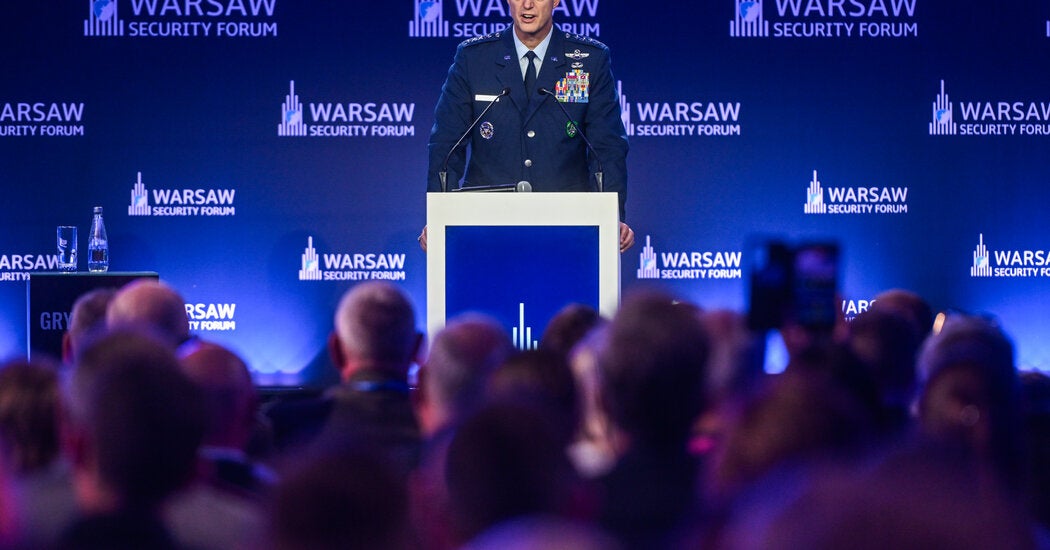
Specifically, he said, the blueprint pairs precision weapons with what he described as “affordable mass” — large numbers of autonomous systems, drones, and electronic warfare assets designed to sustain a protracted war of attrition.
The “block, blunt, and break” strategy he outlined is designed to stop an invasion in its tracks without trying to conquer the enemy’s homeland.
First, he said, allied forces immediately “block” an attack at the border to prevent the enemy from seizing territory, a change in strategy since Russia’s invasion of Ukraine. Next, they “blunt” the offensive by hitting advancing troops from the air, sea and land to strip their momentum. Finally, if the attack continues, they “break” the enemy by targeting the supplies, communication links and command networks that keep their frontline forces fighting, weakening the aggressor to the point of collapse.
General Grynkewich stressed that NATO is not interested in taking an adversary’s land. By limiting the objective strictly to the tactical and operational neutralization of the adversary, NATO intends to deny the enemy any pretext for escalation, he said, placing the moral and strategic burden of expanding the war squarely on the aggressor.
“Implementing the theory of victory I’ve described today would require me to issue orders that I hope to never give,” he said. “But let there be no doubt, should war come, we will block, blunt any attack, and then if it does not cease, we will break the forces conducting aggression against us.”
Kremlin officials have routinely dismissed the alarms being raised across Europe.
“We have no intention to fight Europe, to engage in warfare with Europe; that is utter nonsense,” Sergey V. Lavrov, the Russian foreign minister, said during a meeting of the United Nations General Assembly in September. “But Europe is preparing for war with us,” he said. “This could become a self-fulfilling prophecy.”
Adam Goldman contributed reporting from London.