
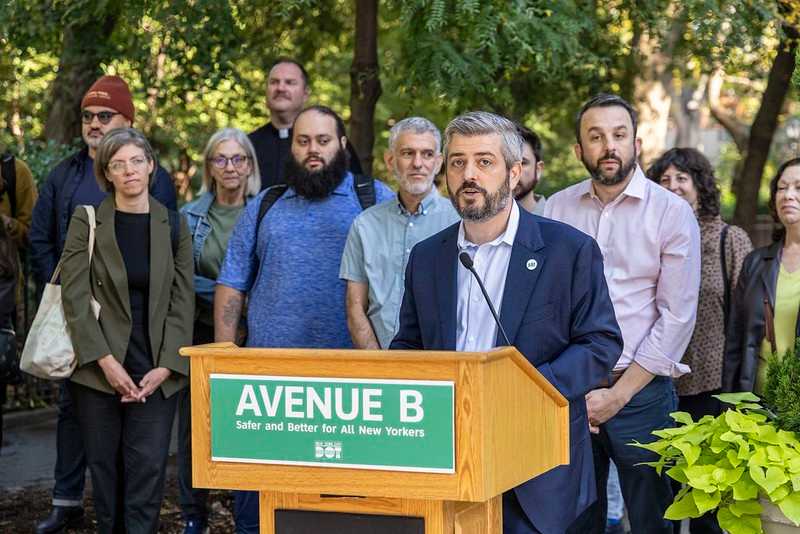
The city Department of Transportation (DOT) celebrated on Tuesday the completion of numerous upgrades to the Avenue B Open Street, running several blocks through the heart of Manhattan’s Alphabet City.
The redesign, which DOT started in late June, included making the street one-way for vehicular traffic along three blocks of Avenue B, allowing for two-way bike traffic on that stretch, and adding safety elements to several of the road’s intersections.
Together, the upgrades are meant to make the narrow street safer for pedestrians and cyclists alike by slowing and reducing vehicle traffic, DOT Commissioner Mike Flynn said.
“These improvements mean less traffic, safer crossings, and more space for people to walk, bike, and truly enjoy their neighborhood,” Flynn said during an Oct. 13 ribbon-cutting ceremony.
“Our streets are more than just for the movement and storage of cars; our streets are public spaces for everyone to share,” he added.
Under the redesign, the agency transformed the road abutting the eastern side of Thompkins Square Park from two traffic lanes into one from East 7th to East 10th Streets. The three-block span already functions as an open street every day between 8 a.m. and 8 p.m.
Now only northbound vehicle traffic is allowed along those blocks, with southbound drivers getting diverted onto East 10th Street.
Cutting the street to one lane is aimed at lowering vehicle traffic volumes to just the drivers of local vehicles, weeding out those who use the street to pass through the neighborhood. At the same time, it maintains access for emergency and sanitation vehicles as well as deliveries.
“We want Avenue B to be a place residents come to enjoy, not just a shortcut for drivers looking to get elsewhere,” Flynn said. “That’s why we reverse the direction of vehicle traffic in the middle of the open street, discouraging through traffic while maintaining local access for residents and deliveries.”
Under the project, DOT also reconfigured every intersection between East 4th and East 14 Streets by painting curb extensions to shorten pedestrian crossing distances. The agency reinforced the curb extensions with hard elements, such as planters, bike parking, and granite blocks.
The sidewalk extensions also provide space for placing the foldable tables and chairs that are common at many open streets through the city.
Furthermore, to reduce truck traffic on Avenue B, DOT installed loading zones at the start and end of every side street.
The redesign builds upon and enshrines work the open street had already begun.
Cecil Scheib, a volunteer with the Loisaida Open Streets Community Coalition, one of the groups behind the Avenue B Open Street, said that since launching the public space during the COVID-19 pandemic in 2020, car traffic has dropped considerably. He said that in 2019, before the open street, car drivers outnumbered bike riders and users of other transportation modes on the stretch two to one.
“For every person biking on the street, there were double the number of cars,” Scheib said. “Since the open street, we have flipped that ratio to where there are many more bikes than cars on the street, and during any given hour, you can see more than 100 bike users coming down this now safer street.”
When asked if DOT had considered fully pedestrianizing the street, Flynn said they went with a plan that prioritizes pedestrians, but did not close the door to that possibility in the future.
“I think what you see right now is a toolbox that is reducing through traffic, it’s slowing traffic, it‘s prioritizing pedestrians in many ways,” Flynn said. “In terms of longer-term ideas, we’re always listening; we’re always open to them.”