
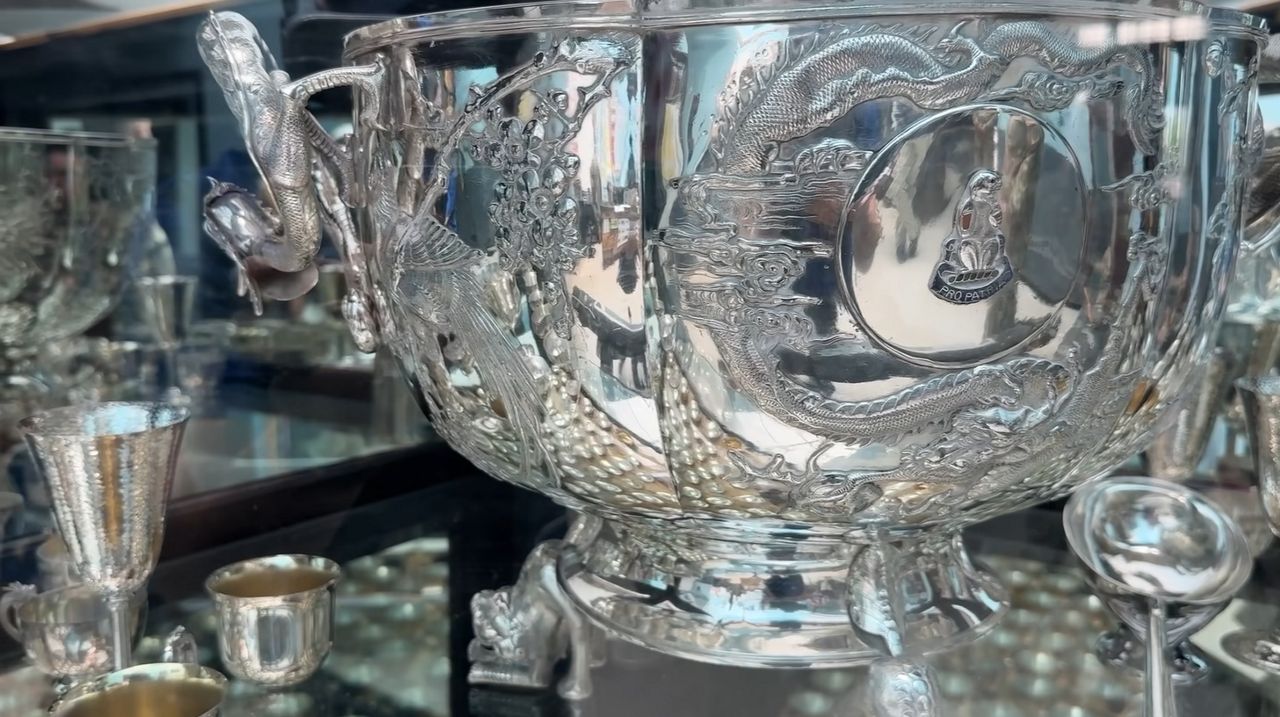
Over the last few years, Fort Drum and the 10th Mountain Division have put an emphasis on history. But often times that history is shared through stories or photographs.
However, there’s one piece that is alive and well for the division to see, except it’s so important, it only comes out for very special occasions and it is heavily secured.
Most of us of a certain age remember — back in the day — a big dinner, Thanksgiving, Christmas, our parents, maybe our grandparents going to the cabinet and bringing out the good China.
Well, here on Fort Drum, believe it or not, there’s a unit that does that as well. The difference is our China growing up probably wasn’t worth some $5 million.
“We went over to protect the international settlement in Shanghai at the time,” Sgt. Major Brody Hall said.
It sits in this display inside the headquarters of a 10th Mountain Division unit known as the Polar Bears. And that case, by the way, is not only locked, there’s pressure sensors.
A handful of Chinese silversmiths in the community there took about $1,500 worth of U.S. trade silver coins from the officers of the regiment,” Sgt. Maj. Hall said.
They took that silver and melted it down, creating this, the Shanghai Bowl.
“So, if you were to tap that glass vigorously, it would ping over it. Our Department of Emergency Services and the MPs would be dispatched out here to see what is going on with it,” Sgt. Maj. Hall said.
That silver, now a bowl and cup set, is worth millions.
“Both handles are essentially dragons, such as are the the the feet at the bottom of it,” Sgt. Maj. Hall said.
But its history, its journey to get here. Well, that’s priceless.
“It was buried to keep it out of the hands of the Japanese,” Sgt. Maj. Hall said.
1942. World War II. The polar bears in the Philippines. They were in trouble.
Captain Earl Short buried the bowl and cup on a hillside in. Four days later, he and his unit were taken prisoners of war.
“This could still be sitting in a remote corner of Corregidor Island in Manila Bay in the Philippines right now,” Sgt. Maj. Hall said.
Captain Short was held captive for four years until the end of the war.
“When most people were thinking about going home, seeing family, I mean, he immediately started petitioning the chief of staff of the Army to be able to go back during his convalescence to retrieve,” Sgt. Maj. Hall said.
“It would take two months of digging — with heavy equipment — before Captain Short and his team found the bowl. However, it and the cups though, would stay in Korea with the polar bears for another 50 years.
“All of the cups throughout the years have been engraved with, you know, you know, officer organization within the 31st Infantry Regiment,” Sgt. Maj. Hall said.
The bowl finally made its way to the U.S. and Fort Drum a little more than 30 years ago. And yes, every once in a while, maybe once or twice a year, it does come out for special occasions.
“This is the link to our past. You think of all of the hundreds of officers, noncommissioned officers, soldiers since, you know, it was created in 1932 that have touched this.”
About a month before the bowl was buried, a number of Polar Bear prisoners of war, were forced to march 100 miles to a Japanese Camp — where its believed some 18-thousand Filipino and American soldiers died from a lack of food & water, conditions and executions.
That event was known as the Bataan Death March.