
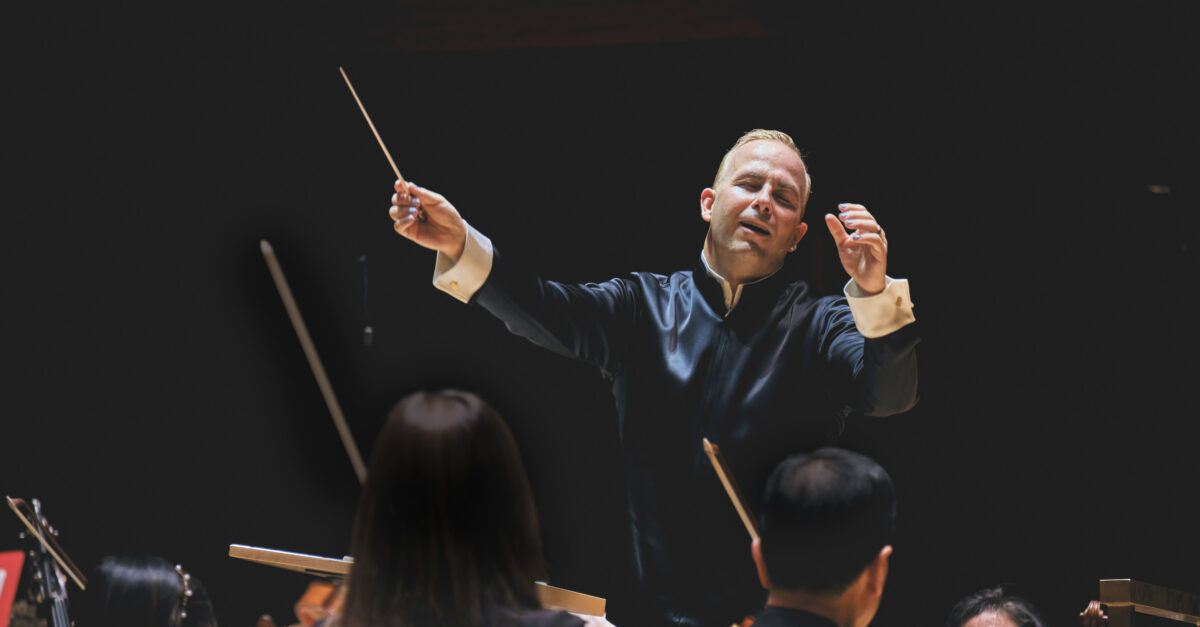
In his lifetime, Gustav Mahler was celebrated both as a composer of vast, visionary symphonies and as a formidably exacting conductor of opera companies and orchestras from Vienna to New York. His ability to conceive music on a cosmic scale while executing it with microscopic precision has made him an inspirational figure for legions of musicians.
One of his greatest modern-day champions is Yannick Nézet-Séguin, who leads a cycle of the Austrian master’s nine completed symphonies with The Met Orchestra, The Philadelphia Orchestra, and the Vienna Philharmonic throughout Carnegie Hall’s 2026–2027 season. “I think the mix and the juxtaposition of the three different sounds of these three orchestras is going to make for a fascinating journey,” he says.
“As a conductor, there is nothing more exhilarating than conducting a Mahler symphony,” he continues. “There’s also nothing more exhausting emotionally and physically. But there is just no other way to conduct Mahler than to embrace … the entire world in each symphony.”
The epic scale of Mahler’s symphonic landscapes—the shortest of the nine completed works clocks in at just under an hour, while the six-movement Third Symphony takes roughly twice as long to perform—mirrors the scope of his ambition. As he told his confidante Natalie Bauer-Lechner, the first two symphonies contain the inner aspect of my whole life; I have written into them everything that I have experienced and endured.” Bolder still is his often-quoted declaration that “creating a symphony means to construct a world with all manner of techniques available.”
Mahler’s imaginative world was defined, in large part, by his experience as a Jew coming of age in the cosmopolitan capital of the Austro-Hungarian Empire, a sprawling multicultural polity that was gradually falling apart in the late 1800s. (Mahler’s midlife conversion to Catholicism in 1897 was probably a tactical move intended to pave the way for his appointment as director of the Vienna Court Opera.) Deeply personal—even confessional—in tone, and highly innovative in their structures and sonorities, his symphonies bridged the divide between late Romantic and early modernist sensibilities: Both Richard Strauss and Arnold Schoenberg were among his admirers.
“I think it’s helpful to be reminded that Mahler’s music was coming rom a very vulnerable place for him … almost like an eternal child looking at the big world,” Nézet-Séguin says. Nowhere is this disarming blend of innocence and worldliness more evident than in Mahler’s popular and perhaps most accessible symphony, the Fourth—from the earthy humor of the first movement, with its recurring sleigh-bell motif, to the macabre dance of death led by an “out-of-tune” solo violin, and the winsome vocal finale that describes a child’s beatific vision of the afterlife. Mahler reveled in such jarring juxtapositions, even if audiences and critics often deplored them. Elements of “high” and “low” culture mingle promiscuously in the sound worlds of his symphonies, as they did on the streets of Vienna. In No. 1, for example, Mahler transforms the jaunty nursery tune “Frère Jacques” into a slow, ironic funeral march and leavens it with reminiscences of Bohemian musicians he heard in his youth. The central three movements of the Seventh Symphony—an almost cartoonishly spooky scherzo flanked by a pair of dream-like “Night Music” episodes—have a schizophrenic, stream-of-consciousness character that borders on the surreal.
Mahler, whose busy conducting and administrative career monopolized his time during the concert season, wrote most of his music during summer vacations in “composing huts” tucked away in rural retreats far from the city’s frenzied crowds.
Not surprisingly, nature imagery is a recurring motif in his symphonies, from the primal, spring-like idyll of the First to the bleaker emotional landscapes of the Sixth and Ninth. What the composer called nature’s “polyphony”—manifest in “the singing of thousands of birds, in the howling of the storm, the lapping of the waves, or the crackling of the fire”—was a lifelong source of thematic material. “Through his music, the human being is surrounded by every level of nature,” Nézet-Séguin explains, “from the rocks to the plants to the animals to other humans.”
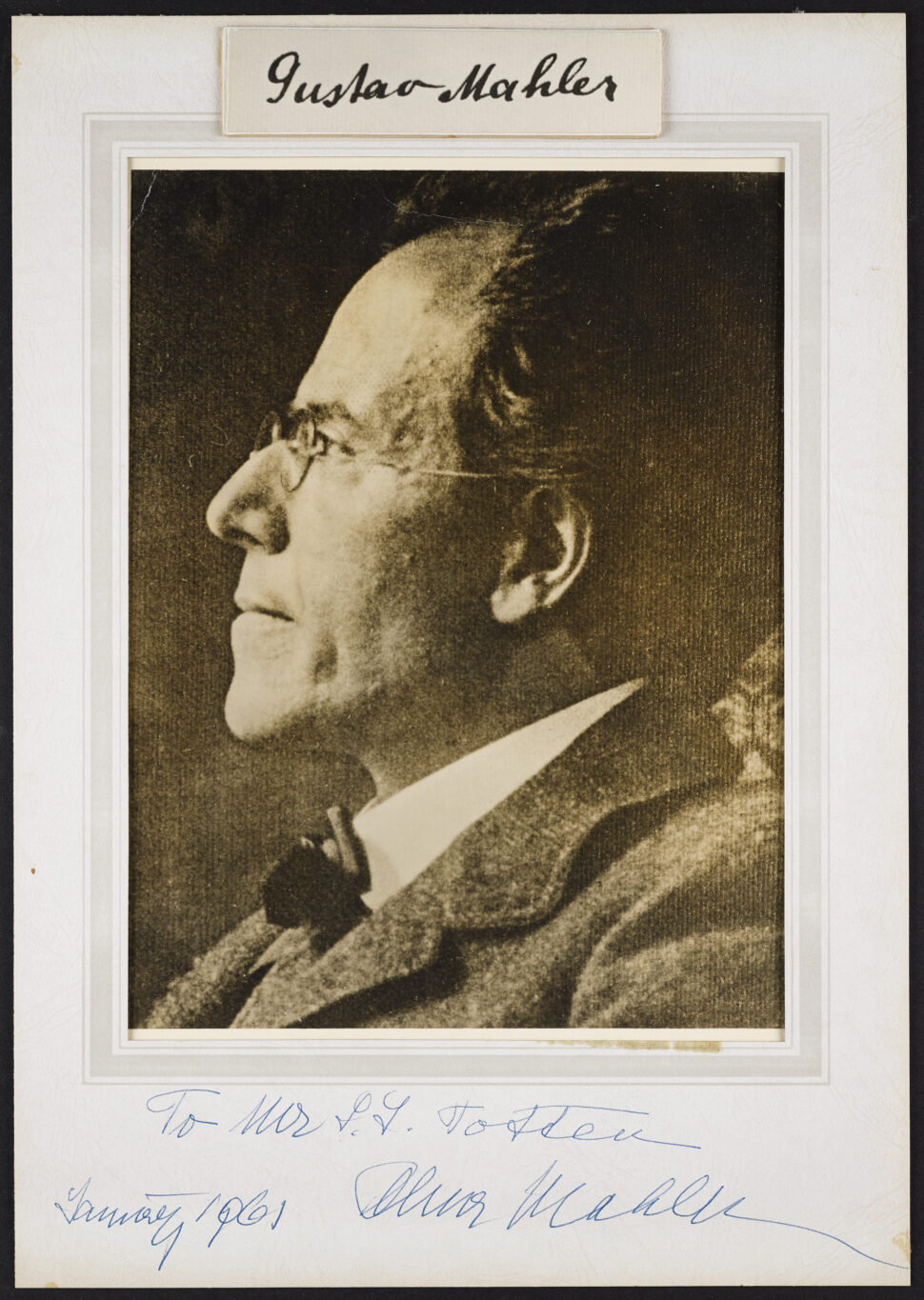
Gustav Mahler, signed by Alma Mahler
For Mahler, the natural world offered not only a refuge from the daily grind, but also a window onto the subconscious. Of his monumental Third Symphony, he wrote: “All of nature speaks in it, telling deep secrets that one might guess only in a dream!” On a more cosmic level, nature served as a conduit for the rich vein of spirituality that Mahler tapped in the Second, or “Resurrection,” Symphony. “People still think that nature stands only on the surface,” he wrote, “but those who, in front of nature, are not impressed by its infinite mystery, by its divinity that we can only sense but not understand or penetrate—they cannot approach it! A trace of this infinity, which is in nature, must be found in every work of art, like are flection.”
Perhaps the most overtly spiritual of Mahler’s symphonies is the Eighth, the so-called “Symphony of a Thousand.” (The nickname was coined by the promoter of the 1910 Munich premiere; Mahler detested it but recognized that it was a brilliant marketing ploy.) In this massive symphonic cantata—scored for double chorus, boys’ choir, soloists, and supersized orchestra—the composer returned to the choral forces he employed in the Second, Third, and Fourth symphonies in the hallowed tradition of Beethoven’s Ninth. The Eighth’s unorthodox format—with two parts, as it were “acts,” in place of movements—highlights the operatic strain that runs throughout all of his orchestral music. (Mahler never wrote an opera himself, although he seems to have abandoned a number of operatic projects.)
But there is no question that Mahler’s conception of the symphonic form was essentially dramatic. According to Bauer-Lechner, as a child he enjoyed inventing stories for his favorite pieces, which he recited to his parents and their friends while playing the piano. Each of his first four symphonies was initially accompanied by a literary program outlining the “plot” of the musical drama. Although he later repudiated such extra musical listening aids, he continued to provide detailed—and often contradictory—scenarios for his works in private letters and conversations.
“His imagery is so beautiful, yet painful—it encompasses all of these emotions that allows the audience to create their own personal stories as they listen,” Nézet-Séguin says. “In many ways, film music of today is indebted to composers like Mahler.”
In 1907, shortly after being diagnosed with the chronic heart condition that led to his death four years later, Mahler came to the United States to guest conduct the Metropolitan Opera. By the time he was appointed principal conductor of the New York Philharmonic in 1909, the intimations of mortality that had long been present in his music were becoming increasingly explicit.
In his 2020 novella The Last Movement, Austrian novelist Robert Seethaler movingly imagines the ailing maestro sailing into New York harbor: “Sitting on the sundeck, Mahler contemplated the meaninglessness of life with a twinge of baleful recognition. Life was little more than a brief exhalation, a breath in the storm of the world, yet he loved it so much that his sadness at the futility of this love almost broke his heart.”
For Nézet-Séguin, it is this dual awareness that is at the heart of Mahler’s enduring appeal. His music speaks “to everyone’s contradictions, dualities, struggles. You know, nobody is certain of anything. If we’re really true to ourselves, we know that as humans we are full of contradictions. And so as we listen to his music, we feel that we’re understood by someone who doesn’t try to pretend that there is only one way to think.”
Visit CarnegieHall.org.