
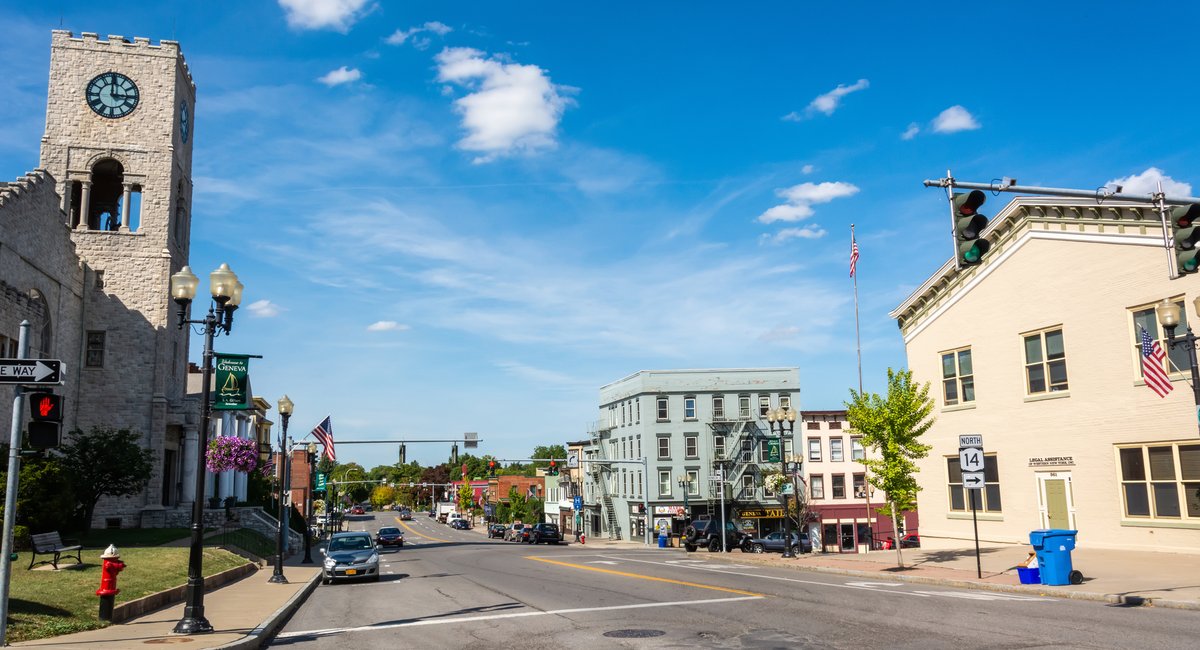
As measles cases continue to tick up on the New York State Department of Health dashboard, public health officials in Otsego and Seneca counties said they believe the outbreak is even bigger than the state’s count shows.
The county officials told Gothamist they think many more cases are going unreported in their upstate counties, where the disease is spreading rapidly through unvaccinated communities.
The state has confirmed 126 measles cases through Oct. 10, including eight new cases confirmed last week, according to the state Department of Health website.
The data comes from cases reported by local health departments. The disease’s spread in rural upstate communities prompted Gov. Kathy Hochul to declare a disaster emergency last week to expand measles testing and vaccination efforts.
But “looking at case counts can be a little deceiving,” said Scott King, the public health director in Seneca County, in the Finger Lakes region, where the state dashboard has logged 22 measles cases this year.
“Cases can jump at a moment’s notice if you get one official case and then you interview that person and he or she says, ‘Oh, yeah, my spouse and my four kids all had the rash,’” King said.
King said finding entire households that have gotten sick is a common occurrence in enclaves where vaccination rates are low. King said county health workers are working to confirm additional cases by interviewing patients who test positive, but not all households are cooperative.
“ We’re dealing with some situations as we speak of likely cases and lots of people exposed, and it’s continuing to spread,” King said.
Measles is highly contagious and is characterized by a rash, often accompanied by cold-like symptoms such as a high fever, watery eyes and runny nose, according to the U.S. Centers for Disease Control and Prevention. In severe cases, it can result in a swelling of the brain known as encephalitis, hospitalization or death.
The state Department of Health has declined to provide demographic data on the outbreak. But state Health Commissioner James McDonald said at a public health meeting last month that about two-thirds of the cases confirmed at the time were in unvaccinated adults.
Heidi Bond, the public health director for Otsego County in central New York, said the state dashboard logged 21 measles cases there. She said all cases were in unvaccinated individuals, and most were adults.
She said the county’s assistant director of public health has been going door to door offering the measles, mumps and rubella vaccine in areas where measles is spreading.
But, she said, “The majority of the people that we have spoken to, measles has already affected them or their families, so they are thinking, ‘We don’t need the vaccine because we’ve been ill.’”
Bond said the goal now is to find those who are unvaccinated and have not yet been exposed to measles, while also trying to convince those who have already gotten sick that they should still take the MMR shot to get immunized against mumps and rubella.
The state health department said it has administered more than 1,200 MMR shots across rural parts of the state since July.
Reaching under-vaccinated communities, including the Amish
Amish residents in upstate New York are among those who are getting sick, said Torah Bontrager, the executive director of the Amish Heritage Foundation, which works with Amish communities in the state. She said upstate Mennonites and other Anabaptist groups that may be hesitant to get vaccinated are also at risk.
Measles has been spreading through Amish communities that are under-vaccinated in Pennsylvania and Ohio, and some of the counties that have logged cases in New York also have significant Amish settlements, including Seneca and Otsego.
Bontrager said attitudes toward vaccination vary widely among Amish people. She said she grew up in a strict Amish community in the Miidwest and didn’t have hot running water or an indoor bathroom as a child, but did get vaccinated. In recent years, some Amish New Yorkers have adamantly resisted vaccines, incurring thousands of dollars in fines from the state Department of Health for violating school vaccine mandates.
But state and local health officials in New York have declined to say whether Amish New Yorkers are bearing the brunt of the state’s measles outbreak.
“We’re not naming the community, just really saying it is an under-immunized community,” said Bond.
King was similarly circumspect.
“We don’t want to marginalize or stigmatize any particular community, Amish or any other,” King said. “But there is a pool of folks in our county who are the ones getting sick, by and large, and so we are targeting that community for this information [about the disease] as best we can.”
King said his office launched an at-home vaccine program in Seneca County last year and ramped up when “ the first rumblings of measles” came to the county early in the summer.
The program has distributed 139 doses of the MMR vaccine this year, all but eight of them administered since June, King said. That’s five or six times what was administered last year, he said.
He added that some of those in the affected community came to the county seeking the shots themselves when people started getting sick.
In addition to giving shots on people’s porches, King said the effort to contain the virus includes sharing information about how to stay safe from measles — such as isolating if you feel sick — through flyers posted in local businesses and at community events such as auctions. He said midwives who work with the affected community also share information about the disease.
Without explicitly linking Amish residents to the current measles outbreak, King added that those residents are an integral part of Seneca County.
“ They’re our friends and neighbors,” King said. “We want them to be healthy. They want to be healthy. We all have the same goals.”
Bontrager said she’s conflicted about health officials’ determination not to say that measles is spreading in Amish communities.
“ If you’re going to go to an Amish farm or Amish business, you should know that the risk is higher there,” Bontrager said. That information could be useful to someone who has a baby who has yet to be vaccinated, she noted.
Ellen Hey, the chief clinical officer for Finger Lakes Community Health, said the population upstate that’s at high risk for contracting measles includes Amish and Mennonite residents as well as unvaccinated people outside those communities. She added that there’s a lot of integration, creating the opportunity for the virus to spread.
The measles outbreak comes as some Amish New Yorkers are actively seeking to scale back New York’s strict school vaccine requirements.
While city and state data show the MMR vaccination rate among 2-year-olds varies widely across different counties, the rate jumps to over 97% for kindergarteners once the school vaccine requirements kick in, federal data show.
Shortly before Hochul declared the current measles outbreak a state disaster emergency, a group of Amish New Yorkers petitioned the Supreme Court for the second time to hear their case challenging the state’s school vaccine policy, which doesn’t allow religious exemptions.
In a handwritten letter signed by several representatives for Amish New Yorkers, a plaintiff in the case stated, “Our Almighty God wants us to fully put our faith and trust in Him. Which is in conflict to put our trust in vaccines.”
The letter added that, “We, as a peace loving religious group, are sincerely sorry that we are causing the state a prob [sic].”
Lower courts have previously upheld New York’s elimination of the religious exemption.
This story was updated with additional comment.