
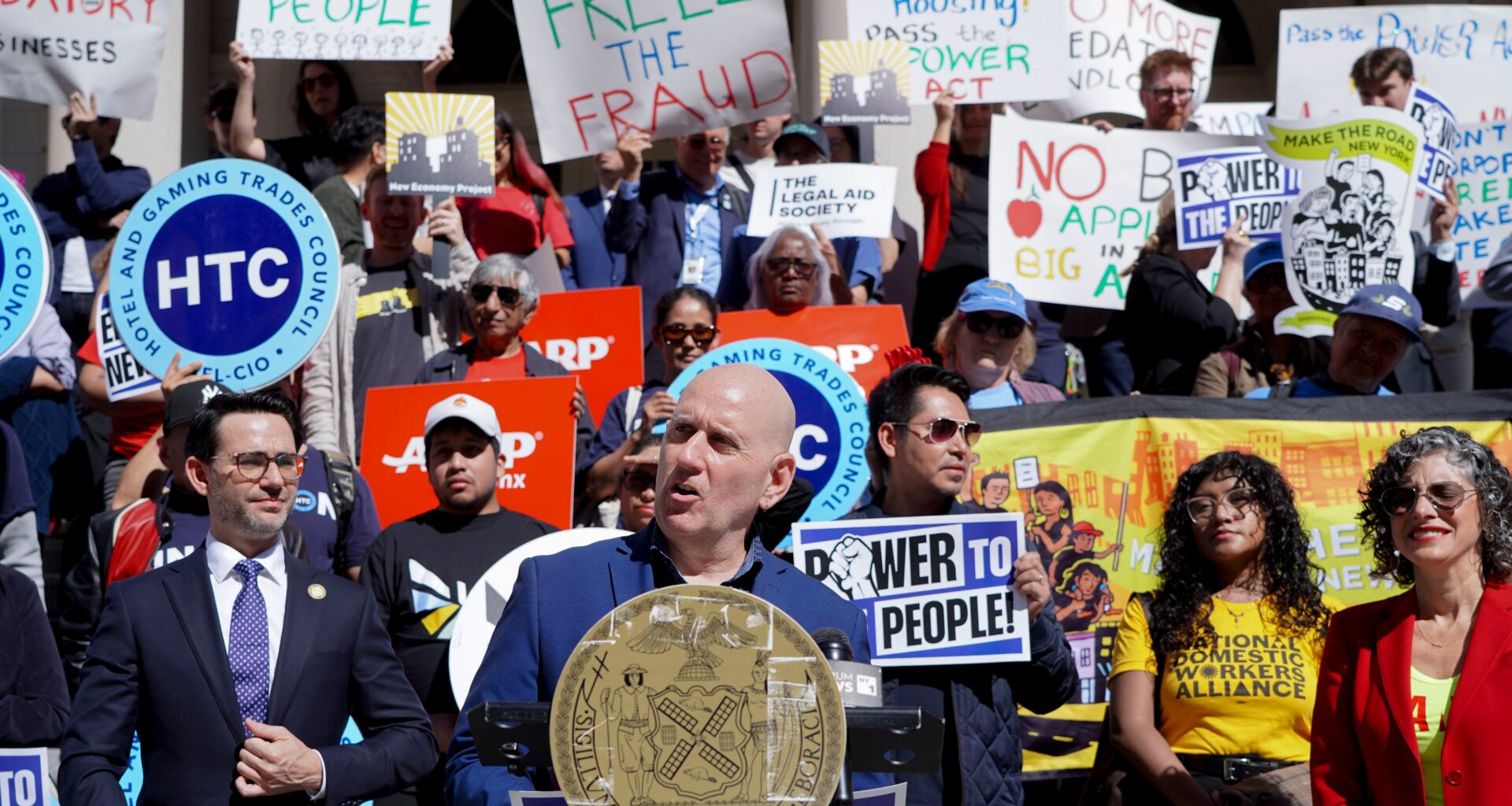
Corporations have taken advantage of working people for too long: sometimes nickel-and-diming them, sometimes taking a bigger bite. The Trump administration won’t help, so cities and states must create guardrails protecting people from fraud. A new NYC bill would do that.
Introduced last week with the mayor’s support, the People and Organizations Winning Economic Relief (POWER) Act would take standard protections in 43 other states and D.C. — but not yet in NYC — and turbocharge them. It would adopt the gold standard in consumer protection so that people can navigate the marketplace without getting ripped off.
Current New York State laws allow people to sue businesses over “deceptive” practices, but not “unfair” or “abusive” ones. The bill, sponsored by Councilman Harvey Epstein, would close that loophole, allowing consumers, tenants, small businesses, nonprofits, and others to stop predatory conduct.
This bill would also help workers, in several ways. First, workers and consumers are the same people. Affordability is about what goes both out of and into our wallets. Household debt is rising faster than household income: 52 cents of every dollar goes to debt payments. Wage increases, when and if they happen, are increasingly consumed this way.
Affordability doesn’t distinguish between consumer or worker activity; why should the law? Unfortunately, sometimes workers fall between the cracks of statutes. Many laws draw arbitrary lines, depending not on what activity a person is doing, but on why they’re doing it.
If you take out a loan to pay for a car to drive your kid to school, that’s a personal loan covered by consumer protection laws. But if you use a loan to pay for the same car to work as a rideshare driver driving someone else’s kid to school, you’re generally legally not treated as a “consumer.”
Since people deserve fair treatment in any context, the POWER Act would throw these distinctions out the window. Some examples:
First, rideshare drivers. When they take out a loan or an advance on their earnings, these debt products often fall through the cracks of consumer and employment law. Gig corporations have long treated workers as independent contractors and not as employees, fiercely resisting enforcement and policy to the contrary. As a result, drivers fall into a legal netherworld, vulnerable to usurious loans that may or may not be covered by traditional consumer laws. The POWER Act would close that gap.
Or consider gig delivery workers whose tips have been stolen by delivery platforms. This violates employment laws, but again, because corporations treat these workers as independent contractors, such workers would benefit from other kinds of lawsuits.
The POWER Act would also allow workers to challenge employer policies limiting job mobility: health care workers with “stay-or-pay” contracts requiring thousands of dollars payment to leave a job early, or everyday workers with non-compete provisions preventing them from working for their employer’s competition.
When a corporation surveils workers, or uses their data for training artificial intelligence, this, too, could be a basis to sue.
Current law lacks clear redress for some of the above examples. Others have potential remedies under existing state law, but not at the City level. In other situations, protections currently exist, but scant agency resources limit enforcement.
Accordingly, the POWER Act would allow nonprofits, including labor unions, to act as whistleblowers bringing cases for the public good, force-multiplying government’s efforts.
More cities and states should pass laws like the POWER Act, to deliver more justice to hardworking people.
Gerstein is the director of the NYU Wagner Labor Initiative. Salas is a senior fellow with the Century Foundation and is a former commissioner of the NYC Department of Consumer and Worker Protection.