
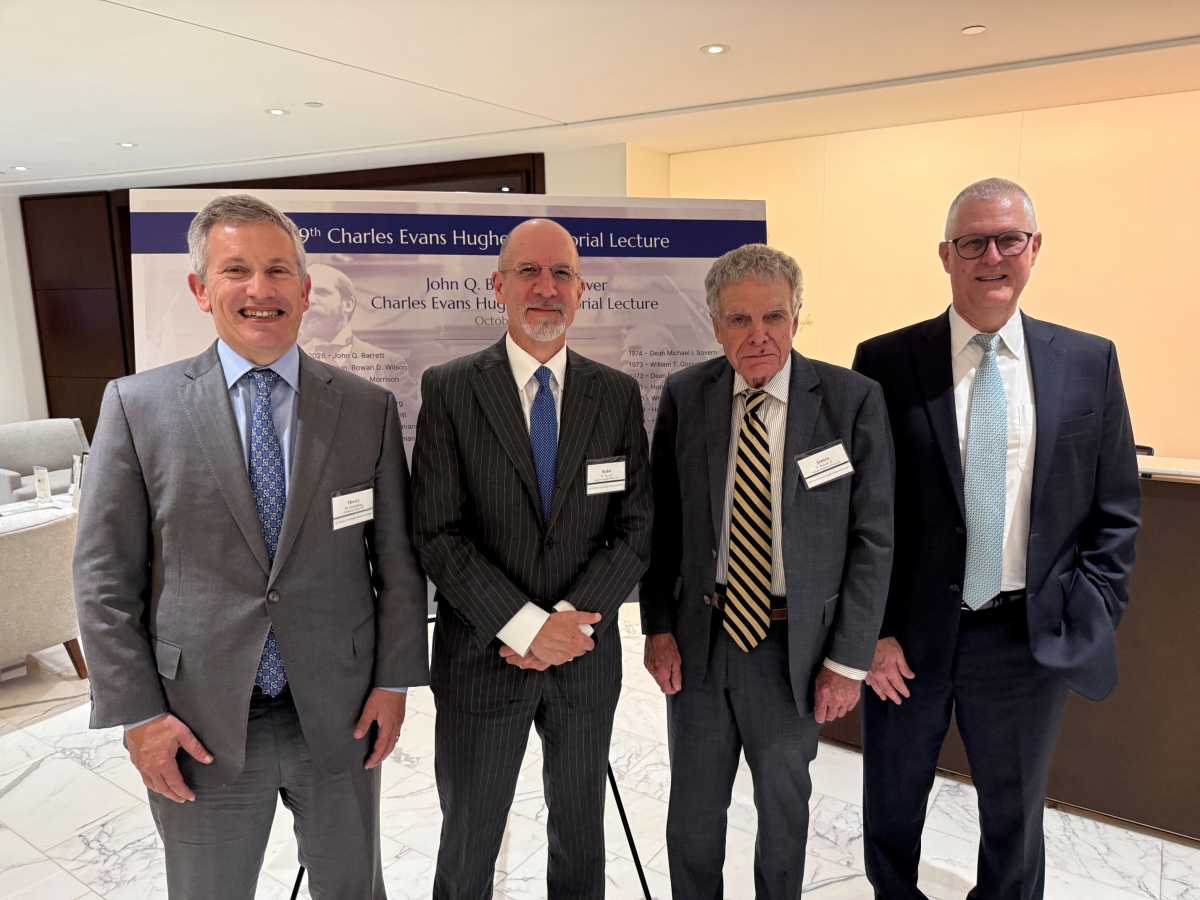
While many may think nothing could be further apart than elected government officials and those appointed to wear Supreme Court robes, leaders in the legal profession recently said government officials might make good justices.
St. John’s University law professor John Q. Barrett made the case for practical, as well as legal, experience for these justices at the New York County Lawyers Association Hughes Memorial Lecture Association’s 59th Charles Evans Hughes Memorial Lecture.
Barrett, in his Oct. 15 speech titled “‘Presidential Material’ Should Be ‘Supreme Court Material,’ and Vice Versa,” said it’s possible, sometimes preferable, for officials with government experience to make good justices.
He said Charles Evans Hughes, a founder of Hughes Hubbard & Reed, served as secretary of state and presidential candidate before serving with distinction as Chief Justice of the U.S. Supreme Court.
Barrett, at the lecture in the Hughes Hubbard & Reed offices at One Battery Park Plaza, said Franklin Delano Roosevelt and Hughes, who both served as New York State governor, “greeted each other and referred to each other as governor.”
“The Hughes model is statesmanship. It is governing,” Barrett said. “We need people who are both, in all of our top offices. At various times, in one person, we might find that.”
 Opening remarks from NYCLA President-Elect Henry M. “Hank” GreenbergPhoto courtesy of Hughes Hubbard & Reed LLP
For many years, Supreme Court chief justices had served in elected political office before serving on the court.
“Are we pretending in our time that judging is apolitical, being an umpire, apart from the realm of politics?” Barrett asked. “While we at the same time fight hard for judicial appointments who will get us judges, especially justices, who will give us policies we want intensely.”
Instead of being ideologues, Barrett said, many great judges held elected office in the past. Prior to serving as Chief Justice, Earl Warren, for instance, served as the governor of California and its Attorney General.
“The Hughes model is an occasion for us to notice presidential and Supreme Court material in one person. As a general matter, that is a better way to think,” Barrett said. “Presidential material should be Supreme Court material and vice versa.”
Hughes opposed many of FDR’s New Deal measures, but supported some, resisting FDR’s desire to pack the court with additional justices.
“Sometimes they upheld New Deal measures. Many times, the majority is invalidating, and there are strong dissents,” Barrett said. “That doesn’t destroy the comity of the court on Hughes’ watch.”
Rather than simply advancing an ideology, Barrett said Hughes seemed to look at humanity, making decisions he believed benefited the nation.
“The Depression is an emergency,” Barrett said of government’s changing role. “People can’t pay their mortgages in this emergency situation; the power of the state grows to address human need.”
Hughes took a pass on running for president again in 1928, placing the nation’s interests over his own, Barrett added.
 John Q. Barrett, Professor of Law at St. John_s University in New York City, speaking.Photo by Claude Solnik
“He could well have been his party’s man. Hughes in a noble way says my arc is cresting. I’m not the young man I used to be. Law practice is fine,” Barrett said. “He gives his seat to the other party, the court packing proponents he had publicly lanced four years earlier.”
NYCLA President Henry M. Greenberg said the model of Charles Evan Hughes and Earl Warren and other chief justices “previously with elected experience tended to bring to the job and role of a judge the sort of pragmatic wisdom and shrewdness that is different from the current model.”
“I think Hughes is the greatest public servant in American history who never became president of the United States,” Greenberg said. “He went to sleep on election night 1920 thinking he was the next president of the United States.”
Hughes fell short by a few thousand votes in California, which sent him back to private practice instead of the presidency.
“Hughes came ever so close to being president. His career is one of the most extraordinary careers in American legal history. He did everything,” Greenberg added. “In all of these positions, he’s widely regarded as one of the greatest who ever held that post. He was brilliant, wise, experienced. He had enormous charisma.”
James Kobak, Jr., Senior Ethics Counsel at Hughes, Hubbard, also saw Hughes as a prime example of how someone can serve the country and the court.
“When he was chief justice of the Supreme Court, he’d been secretary of state, he’d been a presidential candidate. He’d been governor of New York, a practicing lawyer. He had all this experience, Kobak said. “I think a little broader experience of government and life are good.”
 Charles Evan Hughes presiding over Supreme Court in surreptitiously taken photographPhoto by Claude Solnik
Barrett said Barack Obama, “vigorous, smart and under-employed,” would be a “fabulous Supreme Court justice,” and Bill and Hillary Clinton, Mitt Romney, Mike Bloomberg, Al Gore, Corey Booker and Liz Cheney also could fit the bill.
Meanwhile, justices like Sandra Day O’Connor and Elena Kagan could provide presidential material.
“Former justices becoming presidents might change how the executive branch regards and works with the courts,” Barrett said. “My conclusion is we should think, re-label and re-energize what we do when we see people as material for this or that top office, judicial, otherwise appointed or elected. We should seek for any such spot to identify our next Hughes.”
He sees Hughes as serving and abstaining from service, not simply as suits him, but based on his belief on what benefits the nation.
“I think that Hughes was more or less this virtuous selfless servant responding to the call,” Barrett said.
The attorneys said a lack of experience in dealing directly with people can lead to ideological tests that disregard practical experience regarding impact on humanity.
“The current confirmation process puts a greater premium on ideology,” Greenberg said. “We heard, ‘Let’s go back to the future.’”