
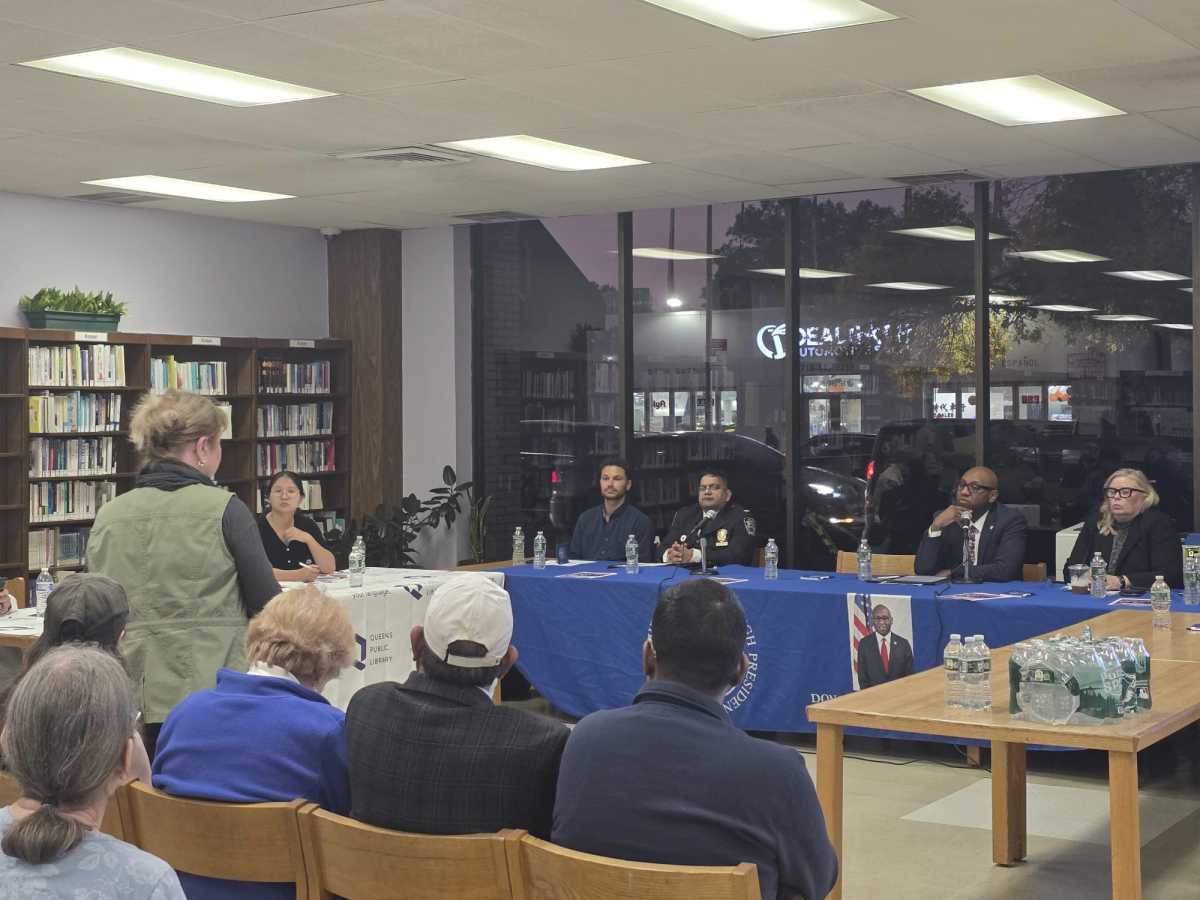
Queens Borough President Donovan Richards sought to reassure northeastern Queens residents at a recent Flushing town hall about the city’s plan to include several neighborhoods on the Affordable Housing Fast Track, which aims to aims to streamline the city’s review process and accelerate the construction of affordable housing in districts that have produced the lowest amounts of affordable housing.
The Affordable Housing Fast Track, approved by New York City voters in a City Charter amendment in November 2025, takes effect in January 2027 and targets the 12 community districts that have historically produced the lowest amounts of affordable housing.
The city has announced the 12 districts with the lowest production of affordable housing, including Community Districts 4, 5, 10, 11 and 13 in Queens.
Community District 11 residents gathered in East Flusing Library on Oct. 13 for a town hall with Richards, with some residents raising concerns about the impact that the fast track would have on the neighborhood during a Q&A session at the end of the event.
Speakers expressed fears that the district, which includes parts of Auburndale, Bayside and Douglaston, would lose its power to reject major housing developments.
As a result of City Charter amendments approved by voters last year, eligible rezoning proposals that create affordable housing in the 12 designated districts will use a streamlined 90-day public review process beginning in January 2027. The streamlined process will cut roughly four months from the traditional Uniform Land Use Review Procedure (ULURP), which takes seven months and includes review from impacted community boards, borough presidents, the City Planning Commission and the City Council.
The Affordable Housing Fast Track retains review from community boards and borough presidents – but holds them concurrently. It also retains review from the City Planning Commission but bypasses the City Council completely. The fast track does not change environmental review requirements or landmark protections.
At Richards’ town hall, local residents expressed concern over the removal of the City Council, noting that it removes the power of council members who represent impacted neighborhoods to veto unpopular projects. They also noted that a significant number of City Planning Commission representatives are mayoral appointees, which they said would remove local voices.
Richards, however, noted that he retains an appointee on the planning commission, stating that he has recently appointed Variety Boys and Girls Club CEO Costa Constantinides as the borough’s representative. He added that his office will remain in “close contact” with Constantinides over any developments earmarked for Queens as part of the Affordable Housing Fast Track.
He also asserted that his office still holds the power to hold public hearings and raise concerns about any proposed developments before they reach the City Planning Commission.
“Just as we do with any affordable housing proposals that come before us, we want to be thoughtful,” Richards said, adding that his office has done a “good job” in ensuring that proposed developments have delivered a public good for the neighborhood.
“I can tell you right now, if we see a proposal, we‘ll be very transparent with the community board, and we will do what we do on a regular basis if an application comes up.”
Richards also noted that there are certain districts across the city that have not pulled their weight in terms of affordable housing development. The 12 districts announced for the new initiative represent roughly one-fifth of New York City’s 59 community districts but produced just 883 of 63,870 new affordable homes over the past five years, equaling 1.1% of the citywide total.
“There are districts in Queens that have done little to none on affordable housing, and obviously CB11 falls into that category,” Richards said. “I want us all to be cognizant that we are in a housing crisis.”
Mayor Zohran Mamdani said earlier in October that the streamlined process will help ensure that every neighborhood in the city plays a role in addressing the housing crisis, ensuring that certain neighborhoods are not tasked with shouldering the bulk of affordable housing production.
“New York’s housing crisis is not going to be solved by asking the same neighborhoods to do all the building,” Mamdani said in a statement. “Every New Yorker deserves a home they can afford, and every neighborhood must be part of delivering it. The Affordable Housing Fast Track gives us a new tool to cut through red tape and make sure our housing growth is shared more fairly across all five boroughs.”