
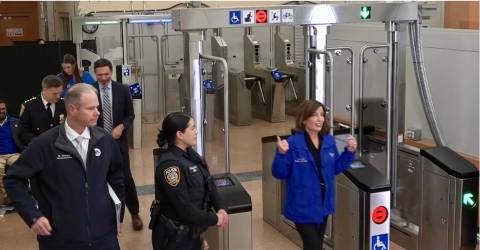
The MTA is rolling out phase two of its new fare beating subway gates designed to thwart fare evaders and six of the 20 new stations to be added will be in Manhattan.
But the rollout will be slow. Three vendors, Cubic, Conduent and STraffic, paid for the gates to be installed at high-volume subway stations last year, including Times Square, to demonstrate their capabilities.
Under the next phase, the vendors will be getting paid for the gates. Twenty of the new fare arrays, in addition to the twenty already placed within the subway system, will be bid on by the end of this year.
The bids call for six additional Manhattan stations to be equipped. Phase two includes: 14 St-Union Sq—encompassing the 4,5,6,L,N,Q,R and W lines; West 72nd and Chambers Streets for the 1, 2 and 3 lines; East 86th and 125th Streets for the 4,5 and 6, lines and Spring Street for the C and E trains.
The first phase of the program introduced last year has been a success, MTA Chairman Janno Lieber and Gov. Kathy Hochul said at an Oct. 7 press conference in Queens. “Across our 20 pilot stations, fare evasion is down an average of 35 percent,” said.Hochul “In fact, at two of those stations, it’s down 72 percent. So when something works, we double down. Today, I’m announcing the next 20 stations that’ll be getting these high-grade fare gates.”
Subway fare evasion has been a persisten problem in recent years. From a high of 14% of riders in 2024, the MTA said that number has gone down to just below 10%. Many of the non-payers have been using emergency gates. Others duck under or over the gates. The new gates are said to be particularly good at thwarting leapers and divers.
In one example cited at the press conference, the Nostrand Avenue C&E station, the pilot fare gates helped to record a drop in ridership fare evasion from 11.6 % to 3.8%, with no appreciable larger uptick in evasion at other close-by stations.
Within the next three years, more than $1 billion is planned to be spent by the MTA to outfit 150 stations with at least one of the new device systems where about 70% of the current subway ridership currently travels.
The new subway gates, however, will do nothing to combat the problem with fare evasion on NYC Transit buses, which sees almost one out of every two bus riders not paying their fares, a $562 million fare loss in 2025. So far, the Eagle Teams, fare agents that check for on-board bus fare payments, have been largely ineffectual in a system that saw 440 million rides last year, a total of almost 1.5 million riders a day. Fare evasion on buses is still estimated to be 49 percent.