
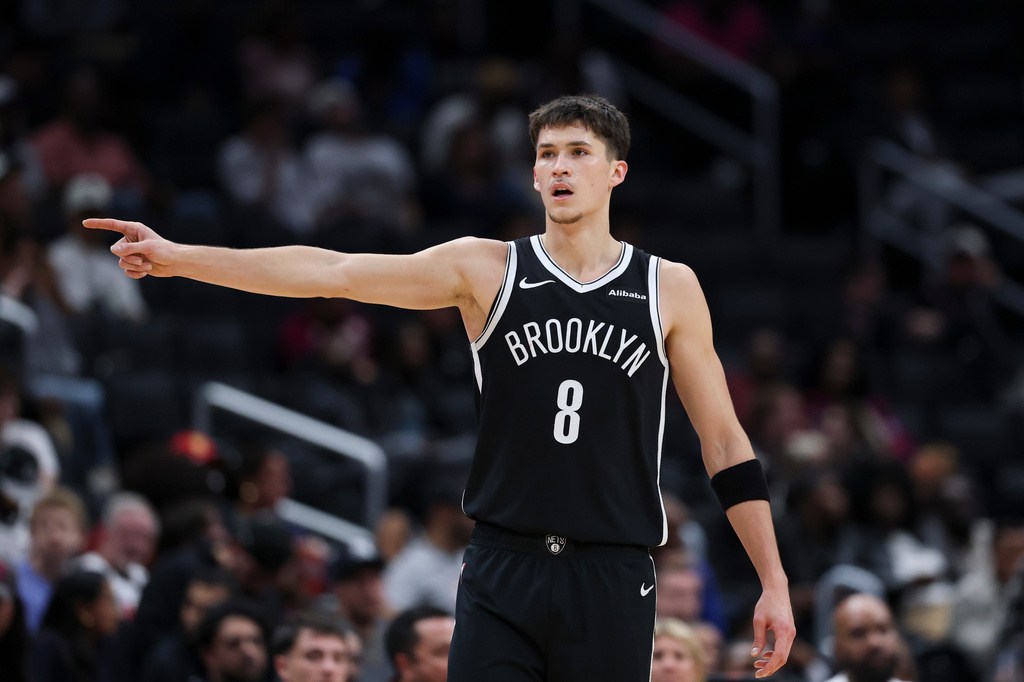
The Nets gave their five first-round picks plenty of opportunity last season.
In Year 2, they need more reasons to keep giving it.
Brooklyn led the NBA in rookie minutes and finished 20-62. None of its five first-rounders made an All-Rookie team. Egor Dëmin received two second-team votes; Nolan Traoré, Drake Powell, Danny Wolf and Ben Saraf received none.
The continued development of the Flatbush Five remains central to the Nets’ rebuild, but they return to a roster with more offensive talent, another young lead guard in Mikel Brown Jr. and more players competing for the same touches. Improving individually is only part of the assignment. They also have to help the players around them.
For third-year head coach Jordi Fernández, the choices will get far more specific. Which guard can keep the offense moving? Which wings can defend without compromising spacing? Which bigs can function together?
The five sophomores enter camp with different ways to earn his trust.
These are the questions each needs to answer.
Can Dëmin become a consistent threat inside the arc?
Dëmin gave defenders a reason to chase him off the 3-point line. He made 124 3-pointers at a 38.5% clip and set an NBA rookie record by hitting at least one in 34 consecutive games. Now he has to make defenses pay for getting so close.
A jumper once viewed as a question became one of Brooklyn’s most encouraging developments. Dëmin averaged 10.3 points and 3.3 assists in 52 games before plantar fasciitis ended his season.
Consistently getting past defenders off the bounce would unlock more of his game. His size and vision already help him find teammates. Reaching the paint at a higher frequency would force more help, giving him more opportunities to create an open shot instead of waiting for one to develop. Finishing through contact would make the defense account for his own scoring, too.
The summer work has fit those needs, with attention to his handle, shot making and physicality. Dëmin averaged 21 points and 4.3 assists in three Las Vegas games and earned All-Summer League second-team honors. Against the Sacramento Kings, he had 22 points, eight assists, four steals and no turnovers.
The production was encouraging. The Year 2 test will be whether he can keep creating when a defender crowds his jumper or stops his first drive. Brooklyn has plenty of reason to trust the shot. A more complete offensive game would give Dëmin more control over which shots the team gets.
Can Traoré challenge for Brooklyn’s lead-guard job?
Brown may enter camp as the presumed lead guard, but Traoré played well enough down the stretch to deserve a chance to challenge him. His rookie season took him through 13 games with Long Island, where he averaged 18.8 points and 6.5 assists, and eventually into 31 NBA starts. Across February and March, Traoré averaged 10.9 points and 4.8 assists in 27 games. He scored 23 points, handed out seven assists and made five 3-pointers against the Washington Wizards.
Traoré’s speed gives Brooklyn something that can’t be easily replicated. He gets paint touches with ease, but the openings he creates are valuable only if he consistently takes advantage of them. His 38% shooting from the field, 31.8% from 3-point range and 2.3 turnovers per game show how much work remains.
Right knee surgery kept him out of Summer League, interrupting his chance to build on his strong finish. His return will bring a different backcourt to navigate, but a dependable second-unit creator remains a need for Brooklyn. Traoré can push for more minutes by turning his paint touches into better shots and fewer turnovers.
With Brown’s arrival, Traoré has to make himself too good to ignore.
Can Powell make enough shots?
The Nets know where Powell’s strengths are. His length and athleticism translated on defense, and his 63 appearances were the most among Brooklyn’s five first-round rookies.
However, keeping him on the floor gets harder when opponents can use his defender elsewhere.
Powell averaged 6.5 points and shot 28% from 3-point range. He made 36.4% in November, then finished the season by going 2-for-19 over his final five games. Las Vegas brought more offensive struggles, with Powell shooting 25.9% from the field and 25% from deep.
But performance against Sacramento in Summer League showed how versatile he can be when the shots fall. He scored 18 points, made four of seven treys, added two steals and blocked a shot.
When Powell’s defender has to stay near him, there’s one fewer body available to crowd a teammate’s drive. Making open shots and finishing around the basket would give Fernández more freedom to use his defense.
Powell needs to stop giving the defense a place to rest. The more consistent his shot becomes, the higher his ceiling rises.
Can Wolf turn his versatility into a dependable role?
Step-back 3-pointers, crafty drives, a sky hook. Wolf’s game hasn’t lacked variety.
At 6-foot-11, his handle and passing give Brooklyn several ways to use him. He averaged 8.9 points, 4.9 rebounds and 2.2 assists as a rookie. A 23-point, nine-rebound, five-assist game against the Cleveland Cavaliers showcased what it can look like when everything clicks on offense.
Now, that production has to become more consistent — a common theme across the Nets’ 2025 class. Wolf shot 40.5% from the field and 32.2% from 3-point range. He can stretch defenses when dialed in, but shots have to fall more often.
Wolf, 22, averaged 11.8 points and 5.8 rebounds across four games in Las Vegas, including 20 points on 9-for-16 shooting against the Atlanta Hawks. Brooklyn can keep experimenting with how to use him, but the frontcourt competition puts a premium on fitting alongside other bigs.
More dependable shooting would help. So would his work on initiating contact and maintaining his dribble through it. If a defender can’t stop Wolf’s drive with a bump, he can keep looking for a finish or an open teammate. Preserving those choices under pressure would make his versatility more valuable in whichever lineup Fernández deploys.
Can Saraf become an efficient NBA scorer?
There was noteworthy progress with Saraf. Over his final 16 games, he averaged 12.1 points, 4.1 assists and 3.2 rebounds. His ability to get downhill and create for teammates gave Brooklyn a reason to keep exploring what he could do with the ball.
But Saraf’s inefficiency extended well beyond his jumper. He shot 21.1% from deep for the season. Inside the arc, he made 35.1% of his shots in the paint outside the restricted area, compared with the league’s 44%. In the restricted area, he shot 57.4% against a league average of 66%.
And Summer League offered mixed results. Saraf had 15 points, seven assists and three 3-pointers against Golden State Warriors Blue in the California Classic. In Las Vegas, he averaged 8.8 points and three assists while shooting 31% from the field and 22.2% from 3-point range.
With Brown, Dëmin and Traoré also able to handle the ball, Saraf will need to learn to contribute off the ball. His passing has value, but sharing the floor with another creator requires him to convert the open shots he’s given. Finishing reliably and making 3-pointers would let him contribute without needing to have the ball in his hands.
The Nets have spent a season learning where these five can help. Year 2 should begin determining how much Brooklyn can count on them as it tries to build a team capable of winning.