
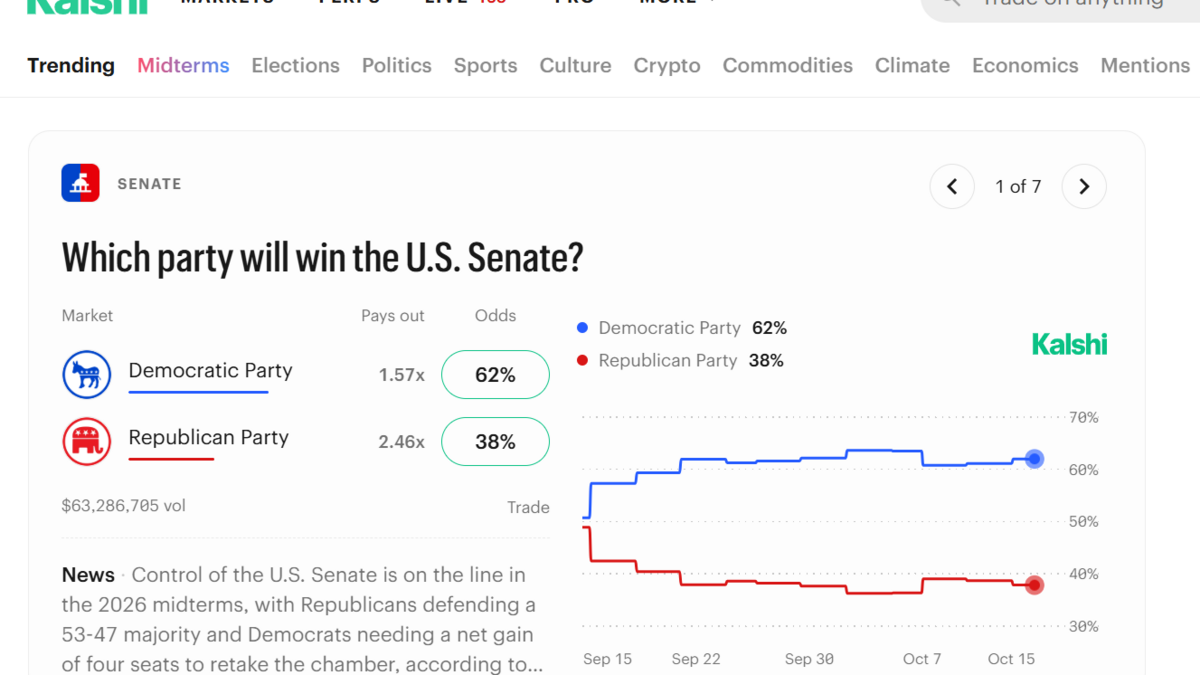
The homepage of Kalshi, an online “prediction market,” on Oct. 15. In late September, Kalshi began donating to several Idaho lawmakers’ and state officials’ campaigns.
Kalshi
Screenshot of Kalshi.com
Will gas prices drop? Will Gavin Newsom be the 2028 Democratic presidential nominee? Will the Seahawks beat the Broncos?
On Kalshi, an online “prediction market,” users can buy a “yes” or a “no” vote on seemingly any question, based on the outcome they expect. If they guess right, they earn money.
Betting sites like this have increasingly found themselves at the center of controversy — over whether their “trades” constitute gambling, whether they should be subject to states’ laws around sports betting, and whether they should be banned outright amid allegations of insider trading and other wrongdoing.
Kalshi, a market leader in the space, has argued that it should be regulated at the federal level, not by states. But in 2026, it ramped up its lobbying at the state level, OpenSecrets reported — and in recent weeks, has added Idaho to that list.
Starting in late September, Kalshi began to donate to candidates for the Idaho Legislature, including $1,000 to House Speaker Mike Moyle, R-Star, and $500 to Senate Majority Leader Lori Den Hartog, R-Meridian. It gave $5,000 to Attorney General Raúl Labrador, $5,000 to the Idaho House Republican Caucus and $5,000 to the Idaho Democratic Legislative Campaign Committee.
Kalshi did not respond to an emailed request for comment from the Idaho Statesman, though a spokesperson for the company in September told OpenSecrets: “Like many U.S.-regulated companies, we support candidates on both sides of the aisle.”
Moyle — who also heads the House Republican Caucus — told the Statesman he didn’t know that Kalshi had donated to his campaign, though he emphasized that the contribution “does not buy my vote.”
Labrador’s campaign told the Statesman by email that he did not solicit the donation from Kalshi — and that before accepting it, “he made clear that it would have no effect on his position on prediction markets.”
Labrador was among 44 state attorneys general who in July signed a letter calling platforms like Kalshi a “new form of casino” that is preying on young people, The New York Times reported. They argued that markets like Kalshi should be paying state taxes and following more stringent regulations — even as President Donald Trump has sought to limit that state oversight.
“Attorney General Labrador’s position is clear: He believes prediction markets are gambling, and the states should set gambling policy, and federal bureaucrats should not override state law,” his campaign told the Statesman by email. “No campaign donation will change his position on any issue, nor his zeal to defend Idaho’s laws and sovereignty.”
Gambling is illegal in Idaho with a few exceptions, including the state lottery. Prediction markets are available in Idaho and are regulated only by the federal Commodity Futures Trading Commission.
Donations may not buy votes — but they often buy ‘attention’
States are just starting to regulate online betting sites, Boise State University political science professor Jaclyn Kettler said. So it makes sense, she said, that Kalshi is “viewing it in their interest to start spending money at the state level.”
Is it fair for a company like Kalshi to assume it’ll get the outcome it wants by donating to particular candidates?
Not necessarily, Kettler said. It’s more nuanced than that: Campaign donations often get donors “a foot in the door.”
“Those that contribute to candidates are more likely to get meetings with office holders. They may be buying time or attention,” she said. “It may be that you’re developing some sort of relationship.”
Kettler emphasized that these are aggregate trends. “Of course, some office holders prioritize their constituents over everyone else,” she said, and officials are subject to many competing interests.
Kalshi also donated $500 to several incumbent Republican state lawmakers, including Rep. Rob Beiswenger, of Horseshoe Bend; Sen. Chris Bruce, of Kuna; and Rep. Josh Keyser, of Meridian. As of Thursday, Polymarket, another well known prediction market, had not donated to any Idaho campaigns.
Idaho Statesman
Sarah covers the legislative session and state government with an interest in political polarization, government accountability and the intersection of religion and politics. Please reach out with feedback, tips or ideas. If you like seeing stories like hers, please consider supporting her work with a digital subscription.
Support my work with a digital subscription