
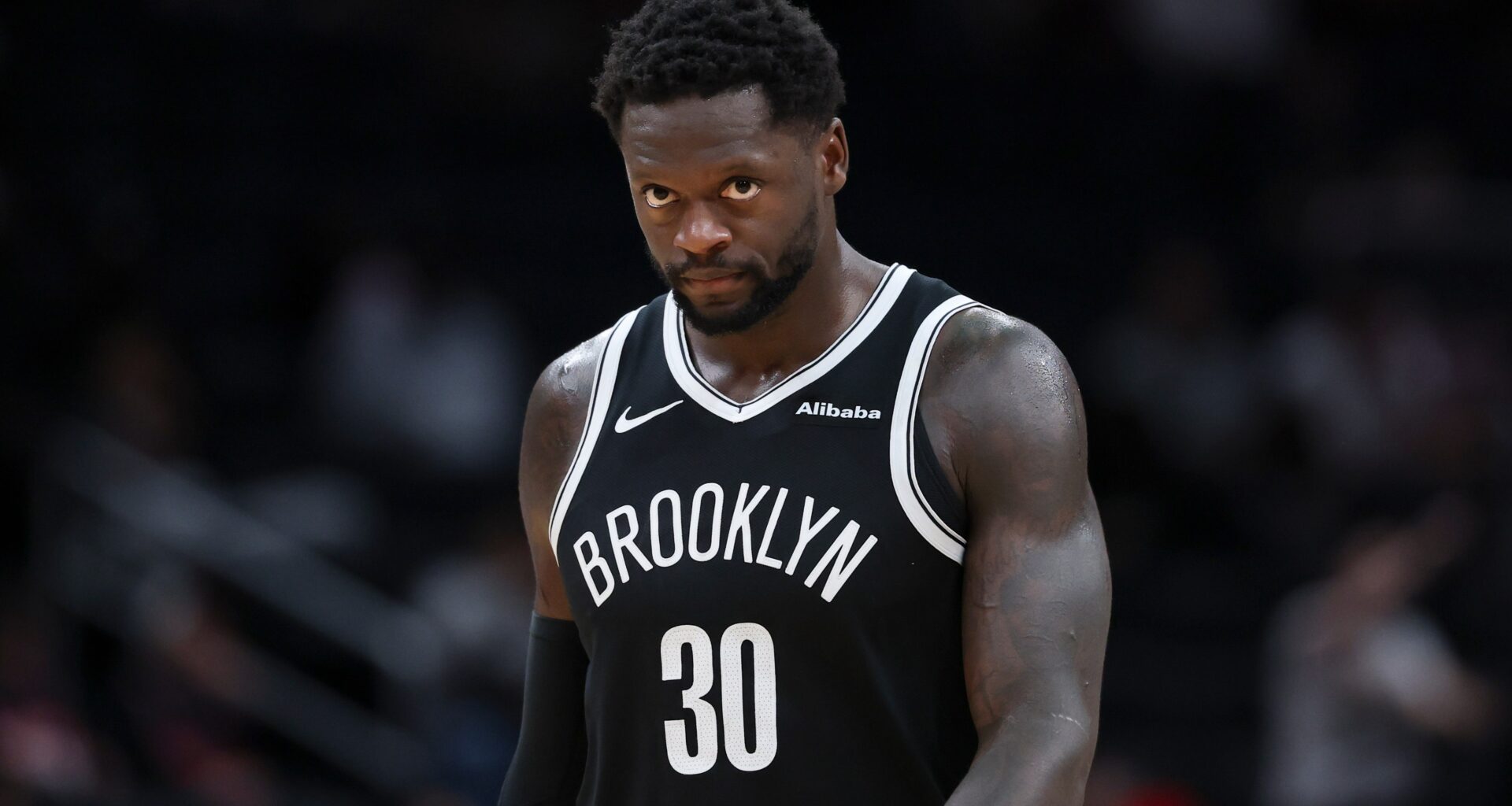
Michael Porter Jr. talked through a look he already sees in Brooklyn. Julius Randle drives. Help rotates over. Porter is waiting beyond the arc, both feet planted, ready to fire.
Then, during a recent appearance on N3on’s stream, came a question about a much bigger number: Could the Nets win 50 games this season?
“Yeah, I do,” Porter said.
Brooklyn won 20 last season. Reaching 50 would require 30 more victories, matching the Detroit Pistons’ 2024-25 increase, the sixth-largest one-season improvement in NBA history. The Nets haven’t hit 50 wins since the 2001-02 New Jersey team went 52-30 and reached the NBA Finals.
BetMGM has set Brooklyn’s win total at 24.5.
The gap between those numbers is enormous. The case for a better Nets team starts with the type of sequence Porter described.
Randle has been making a promise of his own. He told rookie Mikel Brown Jr. the Nets were going to “shock the world,” then stood by it Sept. 12 at the Brooklyn Basketball Training Center.
“Exactly that,” Randle said when reporters asked what he meant. “Whatever your expectations are, whatever expectations that are put upon us, we’re going to exceed them and we’re going to do things at a very high level.”
Brown had given the phrase a more specific meaning after the draft, when Brooklyn introduced him alongside Joshua Jefferson and Tyler Bilodeau.
“We’re going to shock the world with our competitiveness,” Brown said, describing his conversation with Randle. “Trying to bring back that winning culture that Brooklyn Nets once had, this Nets organization once had.”
Brown chose competitiveness, something Brooklyn can show well before anyone knows its final record. Porter put a number on where he believes the work can lead.
For either version to show up in the standings, Brooklyn’s offense has to improve. The Nets finished last in the NBA in paint shooting and 3-point percentage last season and 28th from midrange. No other team ranked in the bottom five from all three areas. Brooklyn’s offense ranked 30th.
Randle and Porter give it two established scorers whose games could help each other. Randle averaged 21.1 points, 6.7 rebounds and five assists in 79 games for the Minnesota Timberwolves last season. Porter averaged a career-high 24.2 points, 7.1 rebounds and three assists in an expanded role for Brooklyn.
ESPN ranked Randle 54th and Porter 60th in its preseason NBA Top 100.
Porter’s career season still came within the league’s lowest-ranked offense. Randle offers more than another 20 points a night. His drives can pull a defender away from Porter and give Brooklyn’s best shooter better looks.
More telling, though, are the numbers that show how they might complement each other.
Over the past seven seasons, Randle ranks fourth in the NBA in assists leading to 3-pointers, behind only Nikola Jokić, Giannis Antetokounmpo and Luka Dončić. He gets downhill and draws help, precisely what Porter spent last season struggling to find around him. Just 9% of Porter’s 3-point attempts were classified as wide open, the lowest share among 307 players who took at least 100 3s.
“We understand each other’s games really well and how we can really complement each other,” Randle told reporters. “We’re two guys that obviously can both really score the ball, but we do it in very different ways.”
Porter has described the same possibility from the perimeter. When Randle pulls a defender into the paint, Porter has room to shoot if the ball comes back out. That one possession obviously can’t account for 30 additional wins, but Brooklyn doesn’t need a historic leap to benefit from it. More paint pressure and higher-percentage looks for its best shooter could lift an offense with plenty of room to grow.
That is an argument for beating 24.5 wins. Getting anywhere near the stratosphere of 50 asks far, far more of the roster.
Porter pointed to Brooklyn’s young players when explaining his optimism, saying they had improved since last season. Egor Dëmin has the strongest available evidence from last year’s rookie class. As a teenager, he averaged 10.3 points and 3.3 assists, shot 38.5% from deep and made 124 3-pointers before plantar fasciitis ended his season. He was the only member of Brooklyn’s five-player first-round class to receive an All-Rookie vote.
The Nets know Dëmin can stretch the floor. He now has to show what happens after defenders take his jumper away. If he can get into the paint more often, his passing becomes another way to punish teams for crowding him on the perimeter.
Brown, the No. 6 pick, brings another way of getting to the cup. He can handle the ball or work beside another guard, giving Brooklyn another source of downhill creation. He also hasn’t played a minute in the league. How quickly his skill translates remains one of the season’s largest unknowns.
The same applies across much of the young group. Noah Clowney has flashed as a floor-spacing big without establishing himself over a full season. Nolan Traoré, Danny Wolf and the rest of Brooklyn’s developing roster still have roles to earn. Porter’s prediction needs several of them to take steps forward together, and soon.
There’s another question on the other end of the floor. Nic Claxton went to the Chicago Bulls in the trade that brought Randle to Brooklyn, taking an established defensive anchor out of the middle. Day’Ron Sharpe now has a chance to show what he can do in starter minutes.
Across the past three seasons, the Nets have outscored opponents by 0.4 points per 100 possessions with Sharpe on the floor and been outscored by nine per 100 with him off it. Much of his work, however, came against reserves. Sustaining that impact against starters is a different beast.
But if Sharpe holds up, Brooklyn has a chance to improve its offense without giving too much back on defense. If he struggles, gains on one end could disappear on the other.
Last season gives the Nets little room to pretend the climb is short. Their 20-62 record came with a minus-10.3 net rating, the league’s second worst. They played like a 20-win team. Even 30 victories would require a substantial change.
That doesn’t make Randle and Porter’s optimism empty. Brooklyn already has two proven 20-point scorers and a plausible offensive fit around them. There is shooting from Dëmin, another creator in Brown, and a career-sized opportunity waiting for Sharpe.
Put together, the pieces support a case for progress. They don’t guarantee the leap Porter predicted.
Beating the market would take 25 wins. A meaningful step would look more like 30. Reach the Play-In, and the season gets discussed differently. Getting to 50 would demand all of it at once: the veteran partnership working, the young players growing quickly, and the defense holding up without Claxton.
When Brown first talked about Randle’s promise, he described the work ahead.
He left the number out of it.
“And it’s going to take day by day, step by step,” he said, “just getting 1% better every day.”