
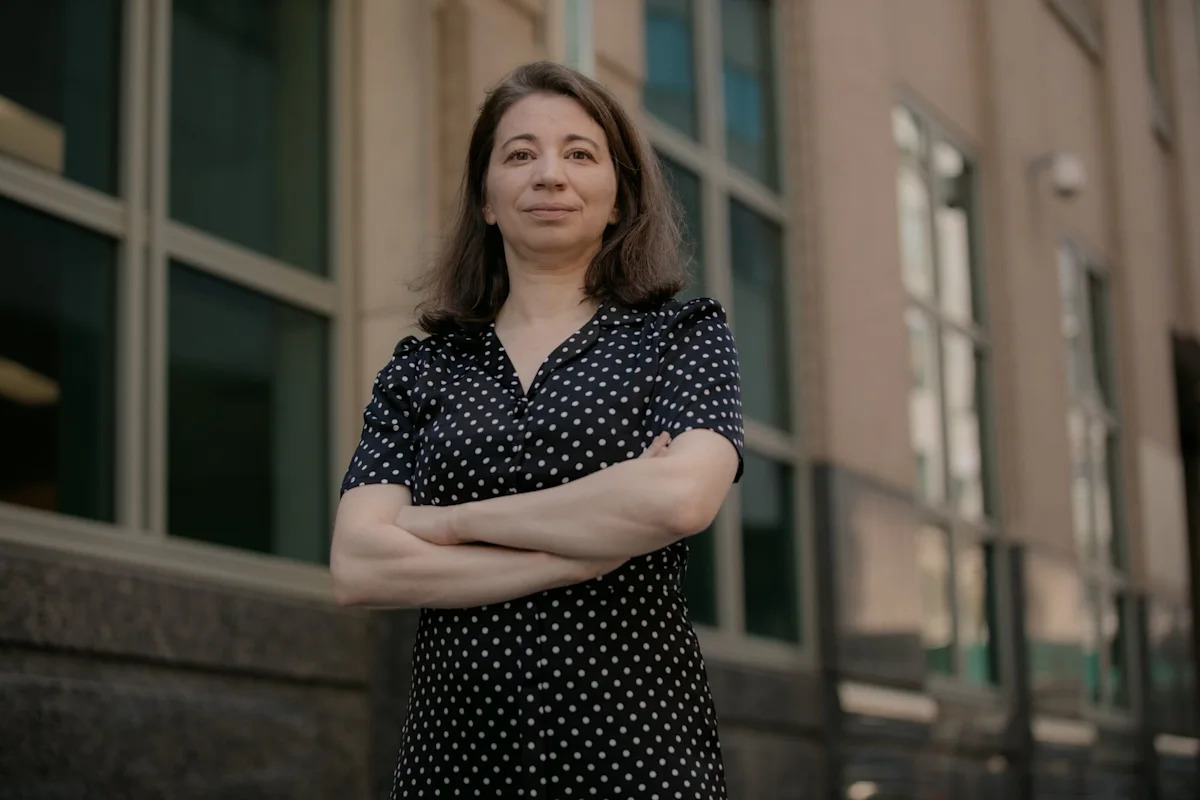
(Bloomberg) — By the time Alona Katz hurried home from her office in downtown Brooklyn late on Oct. 6, the trap was already set. After months of planning, the chief of Brooklyn’s crypto fraud unit was about to orchestrate one of the most sweeping international crackdowns a local prosecutors’ office had ever attempted.
Most Read from Bloomberg
The operation, which took place across three time zones, was the culmination of a chase Katz had begun almost as soon as she was appointed chief of Brooklyn District Attorney’s Virtual Currency Unit three years ago.
If things went according to plan, Katz would shut down a computer crime network run out of Eastern Europe that had been victimizing Brooklyn residents and had stolen tens of millions of dollars.
The tension grew as the countdown began to start the operation.
“We couldn’t entirely control what happened next,” Katz said.
At 2 a.m., dozens of computer servers that Katz’s team had targeted started going down. She would get no sleep that night.
As crypto use has become more widespread, the global crypto fraud economy has exploded in size. In 2025, reported US losses from cryptocurrency fraud reached $11.4 billion, roughly triple from three years earlier, according to the Federal Bureau of Investigation.
This new frontier of fraud has flummoxed traditional law enforcement agencies, particularly at the local level. Before the Brooklyn DA opened the VCU office, victims who sought help from the New York Police Department were often told to go elsewhere because the NYPD didn’t understand the scams, Eric Gonzalez, the Brooklyn District Attorney, said in an interview.
“They would say, ‘Go to civil court.’ Sometimes they would say, ‘Call the FBI, because we don’t have the ability to help here because it’s an international scam.'”
Federal prosecutors weren’t much help either. Most of the fraud targeting citizens in Brooklyn ranges from hundreds to tens of thousands of dollars, significant for the victims but too small to be of interest to the federal authorities, who largely only look into scams of six- or seven-figure dollar amounts, Gonzalez said.
An NYPD spokesperson said its Financial Crimes Task Force investigates cryptocurrency crimes and pointed to a recent case in which the department helped bust a $3.5 million crypto scam. An FBI spokesperson said the agency seeks to prevent crypto fraud through community outreach and working with the private sector.The Black Sheep
Frustrated as the number of fraud victims soared, Gonzalez decided he needed to set up a special unit to handle it, and hired Katz in 2023 from the Manhattan DA’s cybercrime and identity-theft bureau.
At first glance, she seemed an unlikely pick to be a crypto cop. Katz, who is in her 40s and was born and raised in New York, doesn’t have a background in computer programming. She reads poetry, and most of her family are artists.
“I was the black sheep for going to law school,” she said.
Her phone lit up as soon as she started her new job. Cases flooded in, nearly all of them crypto investment frauds. They haven’t stopped since.
Katz soon noticed a pattern in the calls coming into her office. Many victims were from Brighton Beach and Sheepshead Bay, Brooklyn communities heavily populated by Russian and Ukrainian immigrants. The scammers, who typically conversed in Russian, identified themselves as fellow immigrants who’d found success trading in America.
The pitch: You can do it, too.
The cons were simple. Victims were contacted on social networks like Facebook and were persuaded to put a few hundred dollars into cryptocurrency trades. They were then shown accounts that appeared to generate impressive returns. As the supposed profits grew, the scammers encouraged their marks to invest even more.
The perpetrators often let victims make small withdrawals of a few hundred dollars to give the false appearance of legitimacy.But when the victims eventually tried to cash out, they were told they had to pay costly fees to get their gains, or were simply ghosted. By then, some had poured tens or hundreds of thousands of dollars into the scheme.
A Flood of Fraud
“Transnational crime is stealing a generation’s worth of wealth from us,” said Erin West, a former US prosecutor from Santa Clara County, California, who started Operation Shamrock, a nonprofit group that investigates crypto scam call centers. Despite the soaring fraud, most state and federal law-enforcement officials don’t have the staff or technology to respond, she said. Katz is an outlier.
Adding to the local law enforcers’ challenge: Most of the fraud originates overseas, in countries like Cambodia, Malaysia and Ukraine, making it nearly impossible for US prosecutors in the cities and states where the victims live to locate and charge the perpetrators.
“How does a local prosecutor’s office respond to crime being committed across an ocean?” asked Katz.
Unable early on to find a way to get the bad guys, Katz focused on protecting their victims.
The Brooklyn DA’s office began running Russian-language public service announcements on the radio warning about the fraud. Katz added a crack team of analysts with backgrounds in computer science, cryptocurrency and banking to her unit, which worked in downtown Brooklyn out of a cramped office decorated with cat posters.
Rather than pacing the halls outside courtrooms like she did at the Manhattan DA, Katz was spending most of her working hours staring at a computer screen watching Bitcoin and Tether tokens flow from wallet to wallet, trying to learn the lineaments of vast underground international fraud networks — and how to stop them.
Tracking digital clues is akin to a traditional detective picking up bullet casings, taking pictures and dusting for fingerprints, Katz said. The beauty of crypto for crime fighters is that much of it is transparent. Transactions are recorded on a public ledger, called a blockchain, allowing investigators with the right software to follow money as it moves from one digital wallet to another.
By tracing the transactions and locating the victim connected to them, Katz and her team were able to identify websites the scammers had set up and the digital wallets they used, and moved quickly to shut them down.
As Katz and her team tracked the scams, patterns emerged. Many scam-operation websites had similar branding. The team began to realize they weren’t dealing with a network of dozens or hundreds of operations. Just a small number of groups were behind them — and they appeared to be using cyber infrastructure located in Eastern Europe, including Ukraine.
Whack-a-Mole
In June 2024, just 10 months after Katz was hired by the Brooklyn office, the VCU seized a network of 70 scam domains linked to a plot that stole $5 million from Russian-speakers across the US. Losses ranged from $18,000 to roughly $117,000, with the total topping $1 million in Brooklyn alone.
But the calls kept coming.
Mark, a 74-year-old Ukrainian immigrant living in Brooklyn, said he responded to an ad on Facebook targeting Russian-speakers in September 2024. A representative got in touch and within days, he was sending money to fund what he believed was a trading account.
Initially, his investments appeared to grow. “They’re so polite and correct at first, but when you start asking for your money back, they get rude,” Mark said. After about a month, the scammers disappeared. He had lost about $200,000.”There was stress, anger,” Mark said. “It was very tough to tell my family.”
Katz said she has worked with crypto exchanges to identify and blacklist suspect wallets involved in frauds, but the scammers often move to another exchange and the chase begins again. It’s like a game of whack-a-mole, she said.
The Bearer of Bad News
Katz and her team tried other strategies to get ahead of the scammers. They got warrants to lock scammers out of the email accounts linked to their websites and then scraped the sites for customer emails to get contact information for victims, whom they notified.
Yuliya Marynenko had been at home with her baby early last year when she came across a Facebook ad promoting huge returns from an AI-powered trading app. Fifteen minutes after she entered her personal information, she got a call on WhatsApp from a person who spoke to her in Russian.
Soon, the 36-year-old floral designer from Kazakhstan believed she was scoring big wins trading everything from currencies to commodities. She and her husband decided to add more cash, bringing their total commitment to $10,000.
Things took a darker turn when the scammers told Marynenko she had incorrectly entered a trade and was on the hook for tens of thousands of dollars. She was scrambling to find the money, which the people also offered to loan her.
Then Marynenko’s husband got a call from Katz.
Katz’s team had been monitoring a known scam crypto cluster when they detected a deposit of several hundred dollars in Bitcoin. Many scams begin with small amounts transferred to suspect accounts on crypto exchanges.
Katz subpoenaed the exchange for know-your-customer information and got the number for Marynenko’s husband.
“It was a shock,” said Marynenko. She and her husband had grown so convinced the profits were real they were considering using what they thought was a $50,000 windfall for a down payment on a house. Instead, they lost the very real $10,000 they had given the fraudsters.
“My job description is that I am the bearer of bad news,” Katz said.
It is often impossible to claw back cash already handed over to the scam networks, but Katz tried to seize as much of the stolen cryptocurrency as she could and return it to victims.
As of early October, her team was in the process of returning about $300,000 from schemes targeting Brooklyn’s Russian-speaking community.
A Big Nerdy Breakthrough
Katz felt good about getting money back to victims. But cases like Marynenko’s and Mark’s reinforced a problem Katz had faced from the beginning: by the time she reached a victim, much of the damage was already done.
Seizing and closing fraudulent websites alone wasn’t enough.
Earlier this year, she began to craft a strategy that would do more lasting damage by attacking the machinery that allowed the scammers to stay in business. Rather than just seize websites, she would go after the guts of the scam operations.
“The big, big nerdy breakthrough was the servers,” she said.
Katz’s team figured out how to identify which servers were behind the scams, using techniques she declined to describe to protect operational secrets.
Realizing that many of the servers were located in Eastern Europe, the Brooklyn DA brought in the FBI to help.
From her home, Katz sat at her screen when the operation began and watched as her team seized and disrupted more than 240 crypto-fraud websites and 112 computer servers controlled by the fraud group. It’s the biggest bust of Katz’s career and, while no arrests were made, the Brooklyn DA trumpeted it as “one of the biggest operational cyber disruptions undertaken by a local prosecutors’ office.”
Days later, calls from victims seeing warning notices on the seized websites started rolling in.
“We’re back to breaking more bad news now,” Katz said.
–With assistance from Marie Monteleone.
Most Read from Bloomberg Businessweek
©2026 Bloomberg L.P.