
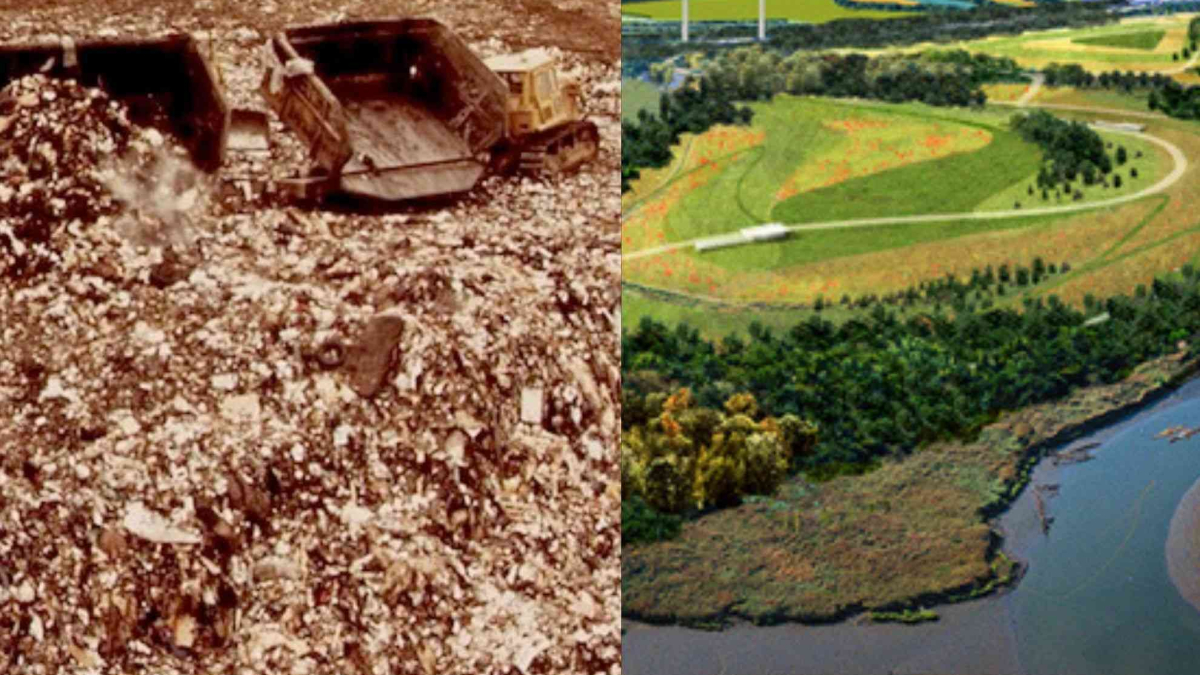
For decades, New York City sent its garbage to Staten Island, where a landfill intended as a temporary solution grew into a mountain of trash so enormous that its tallest peak rose higher than the Statue of Liberty’s torch. Fresh Kills Landfill opened in 1948 with the approval of Robert Moses, the influential New York city builder who helped shape the city’s parks, highways and parkways. The plan was for the site to serve as a three-year fix. Instead, the dump became one of the largest landfills in the world, eventually accumulating approximately 150 million tons of waste.
Today, that towering mass of discarded material is being transformed into something radically different: Freshkills Park, a sprawling green space nearly three times the size of Central Park that is intended to give New Yorkers a place to explore nature, watch wildlife and enjoy the outdoors.
A celebrity encounter that’s almost impossible to believe in New York
The story of Fresh Kills is one of the city’s most extraordinary transformations, from an ambitious waste-disposal experiment to a landscape that demonstrates both the scale of modern urban consumption and the possibilities of environmental restoration.
A temporary landfill that became a giant
When Fresh Kills opened in 1948, the landfill was supposed to operate for only three years. But New York’s mounting waste problem kept the site in business. By 1955, it had become the largest landfill in the world, according to NYC Parks. As the decades passed, the garbage continued to accumulate across the Staten Island site, which eventually developed four enormous mounds.
At its busiest, Fresh Kills received as many as 20 barges a day, each carrying approximately 650 tons of garbage, according to Waste Management World. The steady stream of waste helped turn the landfill into a defining feature of Staten Island’s landscape.
The scale was difficult to comprehend. By 1991, the volume of buried waste had surpassed that of the Great Wall of China, according to Audubon. The landfill’s four mounds eventually held about 150 million tons of trash, according to NYC Parks. The tallest, located in the West Park section, rises approximately 200 feet above sea level.
That height puts the mound above the Statue of Liberty itself if the comparison is made from the top of the statue’s base to the torch, a distance of 151 feet. Include Lady Liberty’s pedestal, however, and the monument’s total height of 305 feet remains greater. Still, the comparison captures the extraordinary dimensions of a place built from the remnants of everyday life in one of the world’s biggest cities.
The final garbage barge, and an unexpected return
Fresh Kills finally stopped accepting regular municipal waste after a 1996 state law required the landfill to close by the end of 2001. The last garbage barge arrived on March 22, 2001, ending an era that had begun more than half a century earlier. But the site’s history did not end with the final load of household trash.
Following the September 11, 2001, terrorist attacks, Fresh Kills became part of the enormous recovery effort. The landfill received approximately 1.2 million tons of debris from the World Trade Center site. Processing of that material concluded in July 2002, according to Audubon.
The site later experienced a very different kind of delivery. Ten years after the final garbage barge arrived, a barge returned carrying young trees, according to NYC Parks, a symbolic reversal for a place long associated with waste rather than renewal. The trees were part of the broader effort to turn the former landfill into a public park.
From garbage mountain to 2,200-acre park
Construction on Freshkills Park began in 2008 across approximately 2,200 acres of Staten Island. The project is unfolding in stages, with the goal of turning the former landfill into a landscape of open space, recreational areas and wildlife habitat.
The first section, North Park, opened in October 2023. Covering 21 acres, it features an overlook deck, a bird-viewing tower and a composting restroom that operates without water, according to the New York City mayor’s office.
The opening offered the public an opportunity to experience a portion of a site that had been closed to ordinary recreational use for decades. “What was once an eyesore is now becoming a world-class park,” former Mayor Eric Adams said in the announcement. Wildlife is also part of the transformation. More than 200 bird species have been recorded at Fresh Kills, according to Audubon, underscoring the site’s growing importance as a place for observing birds and other wildlife.
The park’s eventual footprint, almost three times the size of Central Park, makes it one of New York’s most ambitious efforts to reclaim a former industrial landscape for public use. The transformation, however, does not mean the garbage has simply disappeared. The buried waste remains beneath the landscape, and the site requires specialized engineering and environmental management. Turning it into a park is a long-term process rather than a conventional cleanup followed by new construction.