
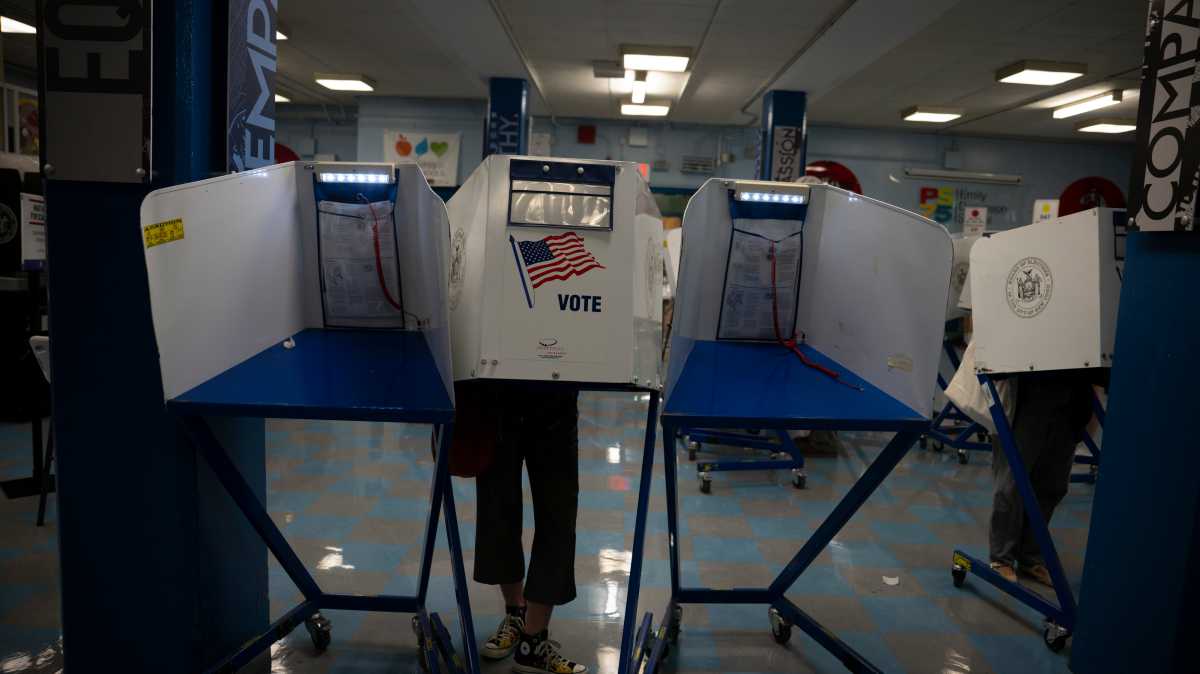
New Yorkers heading to the polls for the Nov. 3 general election will be asked to decide on five ballot questions that could change how City Hall approves outdoor dining, awards contracts, builds street safety projects and saves money for future financial emergencies.
Early voting begins Saturday, Oct. 24, with the five questions appearing on city voters’ ballots alongside state and federal races. The proposals were advanced by Mayor Zohran Mamdani’s Commission on Government Efficiency (COGE), which was tasked with finding ways to cut red tape and speed up city government operations.
The 15-member commission, chaired by Patrick Gaspard, unanimously approved the measures in July following public hearings across the five boroughs.
Supporters say the changes could shorten lengthy government approval processes and save businesses money. But some would also eliminate mandatory public hearings or remove City Council oversight, raising concerns about whether efficiency would come at the expense of public accountability.
At an Oct. 20 forum at New York Law School, COGE Chair Patrick Gaspard defended the commission’s approach, arguing that additional layers of bureaucracy do not necessarily prevent corruption and can instead make government decisions harder for the public to scrutinize.
COGE Executive Director Ann Cheng said commissioners examined which existing requirements genuinely safeguard against wrongdoing, rather than assuming every public hearing or additional approval provides meaningful oversight. She said the commission sought to preserve existing anti-corruption safeguards and labor protections while simplifying contracting procedures.
Three prominent good-government groups — Citizens Union, the Citizens Budget Commission (CBC) and Common Cause New York — have issued their own assessments, with differing recommendations on several questions.
Each proposal would amend the City Charter, the city’s governing document, and can be approved or rejected independently.
Here’s what New Yorkers need to know before casting their ballots:
Proposal 1: Speed Up Process for Granting a Revocable Consent to Use Public Space
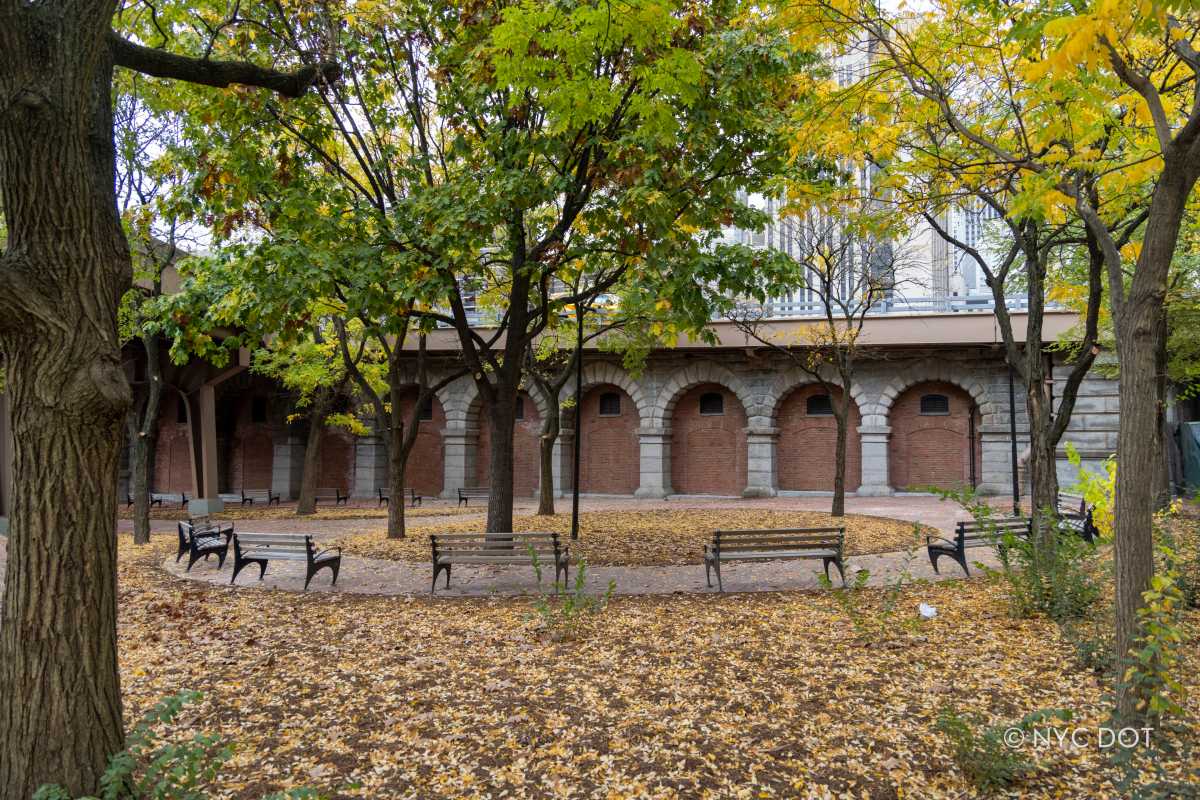 Public Space at Brooklyn Bridge Arches, Manhattan.Photo: DOT
Question on Ballot: Simplify process to use public space for uses such as ramps, planters and cafes, by removing mandatory hearings and Council disapproval of sidewalk cafes, while maintaining community and Council input.
Voting Yes: Streamlines the approval process for private uses of public space, eliminates mandatory hearings and removes the City Council’s authority to disapprove individual sidewalk cafe applications.
Voting No: Maintains the existing approval process, including mandatory public hearings and Council review of sidewalk cafes.
The first proposal focuses on the city’s system for granting businesses and property owners permission to use public streets and sidewalks for outdoor dining, accessibility ramps, benches, planters and similar structures.
These permissions, known as “revocable consents,” allow private use of public property while giving the city the right to revoke that permission.
Currently, restaurants seeking sidewalk and roadway dining approvals must navigate separate application processes, which can take months.
The amendment would combine those applications and eliminate mandatory public hearings, although agencies could still hold them when necessary.
Community boards, borough presidents and local Council members would generally receive at least 15 days’ notice before applications are approved and have at least 15 days to submit comments. They could waive notices for certain categories of applications. Agencies would also be directed to seek additional community input through online postings and other methods.
COGE estimates the changes, combined with a separate Department of Transportation initiative to clear an application backlog, could reduce outdoor dining approval times from as long as eight months to about two months and save businesses up to $1,800 in application-related costs.
Citizens Union and CBC support the measure, arguing that the existing process is unnecessarily expensive and time-consuming, although both acknowledge concerns about reduced public input.
Common Cause New York opposes it, arguing that faster approvals should not come at the expense of public participation and legislative oversight.
If approved, the changes would take effect March 1, 2027, and would not apply to applications already submitted.
Proposal 2: Reduce City Contractor Paperwork; Require Regular Meetings of Procurement Policy Board
Question on Ballot: Reduce paperwork for City contractors by authorizing the Procurement Policy Board to simplify the contractor questionnaire. Require quarterly meetings of the Procurement Policy Board. Remove mandatory hearing for required client services report.
Voting Yes: Allows the city to simplify contractor disclosure requirements, requires quarterly Procurement Policy Board meetings and authorizes certain contract approvals to be delegated to agency officials.
Voting No: Keeps existing Charter requirements governing contractor questionnaires, approval authority, and the affected hearings.
The second proposal targets New York City’s complex contracting system, which governs how agencies purchase goods and services from businesses and nonprofits.
Currently, vendors seeking city contracts must complete extensive questionnaires, regardless of their size or the type of work involved.
The measure would allow the Procurement Policy Board to tailor disclosure requirements based on factors such as contract size, industry and whether a vendor is a small business. Existing requirements would remain until replacement rules are adopted.
It would also require the board to meet at least once every three months, allow the mayor to delegate certain contract approvals to agency officials and eliminate a mandatory public hearing associated with the city’s annual client services plan.
Another provision would make permanent the use of written public comment instead of hearings for certain contract awards, with that change taking effect in October 2030.
COGE estimates the Charter changes could shave about 30 days off some procurement processes.
The commission has also projected that separate administrative reforms could reduce contracting times for certain nonprofit providers from 13 months to six months. Those improvements depend on planned agreements with preapproved providers, rather than passage of the ballot question itself.
Citizens Union supports the measure but warns that giving the Procurement Policy Board greater authority over vendor questionnaires could weaken safeguards intended to prevent corruption. The group has urged the city to involve the Department of Investigation when drafting the new rules.
Common Cause also supports the proposal, citing its potential to reduce administrative burdens on small businesses and nonprofits while increasing oversight through regular board meetings.
CBC did not issue a recommendation on this question in its October analysis.
Proposal 3: Speed Up Street Safety Projects, Disposition of Unused City Property, Office Leasing
Question on Ballot: Simplify review of street safety projects to reduce construction timelines. Fast-track disposition of unused City property with approval from City Planning Commission. Expedite leasing offices used for City workforce.
Voting Yes: Streamlines reviews for street safety projects, speeds up certain city-owned property transactions, and removes some City Council oversight of public property dispositions and office acquisitions.
Voting No: Keeps existing review requirements for street safety projects and City Council oversight of the affected property transactions and office acquisitions.
The third proposal combines several changes to how the city builds street safety infrastructure, handles unused public property and acquires office space for government workers.
For transportation projects, the measure would simplify consultation requirements that can delay construction of bike lanes, bus lanes and other roadway improvements.
Agencies could still consult specialized staff, but they would no longer be required to confer with multiple offices within the same agency. The Department of Transportation commissioner could also accelerate projects when an immediate safety need is identified.
The proposal would also allow certain city-owned lots measuring 10,000 square feet or less, along with transfers of unused development rights from city-owned landmarks, to undergo a shorter land-use review process.
Community boards and borough presidents would retain advisory roles, but the City Planning Commission would make the final decision instead of the City Council.
The amendment would also remove certain City Planning Commission and Council review requirements for city office acquisitions, giving the Department of Citywide Administrative Services greater authority over those transactions.
COGE estimates the transportation changes could speed up affected projects by at least one-third and shorten authorization for sales of eligible small city-owned properties from seven months to approximately 90 days.
The commission also projects that selling certain surplus lots and unused development rights could eventually generate more than $200 million in city revenue.
Another provision would allow the city to sell certain undevelopable properties directly to neighboring owners without an auction. Those sales would still require safeguards, including a fair-market-value appraisal, public hearing and a finding that the transaction serves the city’s interests. That provision would take effect Dec. 31, 2030.
Citizens Union and CBC support the overall proposal, arguing that the changes could reduce unnecessary delays while retaining some public oversight.
However, Citizens Union criticizes the decision to combine unrelated policies into one ballot question, leaving voters unable to support the street safety reforms while opposing the changes to public property or office leasing.
The group also calls for close oversight of transactions involving unused development rights from city-owned landmarks.
Common Cause takes no position, saying the proposal primarily concerns transportation, land use and real estate policy beyond the scope of its assessment.
The Municipal Art Society of New York (MAS) is urging voters to reject Question 3, warning that it could make it easier to sell public land and development rights without guarantees that the transactions will benefit surrounding communities.
In an Oct. 16 statement, the planning and preservation group argued that smaller city-owned lots could instead be used for affordable housing, parks or flood protection. It called for stronger requirements governing public property sales, including permanent affordability protections.
Asked about those concerns, Cheng said the commission deliberately chose not to add restrictions on who could purchase city property or how it could be used, focusing instead on shortening the approval process. She said the city already has authority to sell such properties and that the proposal would change how those sales are approved.
Proposal 4: Simplify Building Permitting and Move Waterfront Permitting to Department of Buildings
Question on Ballot: Create centralized construction permits hub to simplify permitting. Move waterfront permitting from Department of Small Business Services to Department of Buildings. Allow construction approval by additional Department of Buildings officials.
Voting Yes: Directs the city to develop a centralized construction permitting system, shifts waterfront construction permitting to the Buildings Department and expands the number of officials authorized to issue certain approvals.
Voting No: Maintains existing Charter rules governing construction permitting responsibilities and approval authority.
Proposal 4 seeks to simplify the process for obtaining construction permits, which can require applicants to navigate multiple city agencies with different paperwork and approval systems.
The amendment would direct the Department of Buildings to develop a centralized hub where applicants could submit and manage construction-related permit applications across agencies.
According to COGE, the system would bring together 40 permits and approvals currently handled by 18 agencies and offices.
It would also expand the number of senior Buildings Department officials authorized to approve certain construction documents and certificates of occupancy, while shifting responsibility for waterfront construction permitting from the Department of Small Business Services to the Buildings Department.
The proposed system would have a target launch date of Dec. 1, 2029, although its development would depend on funding and the Buildings commissioner could extend that deadline if more time is needed.
Individual agencies would retain their authority to review applications and enforce existing laws. The proposal would not change zoning rules or determine what kinds of developments are permitted.
All three good-government groups — Citizens Union, CBC and Common Cause — support the measure, citing its potential to modernize permitting and improve coordination among agencies.
CBC notes that some of the changes, including a centralized permitting portal, could be pursued administratively without changing the Charter. Common Cause emphasizes the importance of preserving transparency, safety protections and independent oversight.
Proposal 5: Set Contribution Targets for Rainy Day Fund to Promote Sufficient Budgetary Reserves
Question on Ballot: Set target amount of money to hold in reserve funds, including rainy day fund, to address unexpected financial hardships in future years, and require development of methodology to calculate contributions.
Voting Yes: Establishes a city reserve target of at least 12% of the previous fiscal year’s tax revenue and requires a methodology for calculating deposits to the rainy day fund, subject to the city budget process.
Voting No: Leaves the current framework in place, without the proposed Charter savings target or contribution methodology.
The final question concerns how New York City saves money for economic downturns and other financial emergencies.
The city’s rainy day fund, formerly known as the Revenue Stabilization Fund, was established to provide a financial cushion during fiscal crises.
The amendment would establish a target for city reserves equal to at least 12% of the previous fiscal year’s tax revenue. It would require the Mayor’s Office of Management and Budget, in consultation with the city comptroller, to develop a methodology for calculating deposits when reserves fall below that target.
The methodology would have to be published by May 1, 2027, and updated at least every four years. It would consider revenue growth, operating surpluses and other fiscal factors.
But the proposal would not guarantee annual deposits. Even if reserves fall below the 12% target, the methodology could determine that no contribution is required in a given year. Any deposits would also remain subject to appropriations through the city budget.
The target could also include money in other qualifying reserve accounts, meaning the rainy day fund itself would not necessarily need to reach 12%.
The amendment would additionally write existing state-law withdrawal restrictions into the Charter, requiring the mayor to certify a compelling fiscal need before withdrawing more than half the rainy day fund in a single fiscal year.
The proposal has produced a notable disagreement among fiscal watchdogs.
Citizens Union supports it as a step toward clearer rules around the city’s financial reserves, although the group acknowledges that stronger requirements for deposits and withdrawals would have been preferable.
Common Cause also supports the measure, emphasizing the publicly maintained contribution methodology and the formal role for the independently elected comptroller.
CBC, however, opposes it, arguing that the proposed rules are too weak to ensure the city builds sufficient savings during strong economic periods.
The budget watchdog estimates the rainy day fund contains $2 billion, compared with the nearly $14 billion it believes would be needed to cover two years of recession.
CBC warns that counting other reserve accounts toward the 12% target could leave the rainy day fund itself substantially smaller than needed. It has called instead for stronger deposit requirements, tighter withdrawal restrictions and a reserve target equal to 16% of annual tax revenue.
At the Oct. 20 forum, Cheng acknowledged that the 12% target was a compromise rather than a precisely determined figure, explaining that commissioners weighed recommendations ranging from 10% to 16%. She said they also chose to mirror existing state withdrawal rules rather than impose additional restrictions