
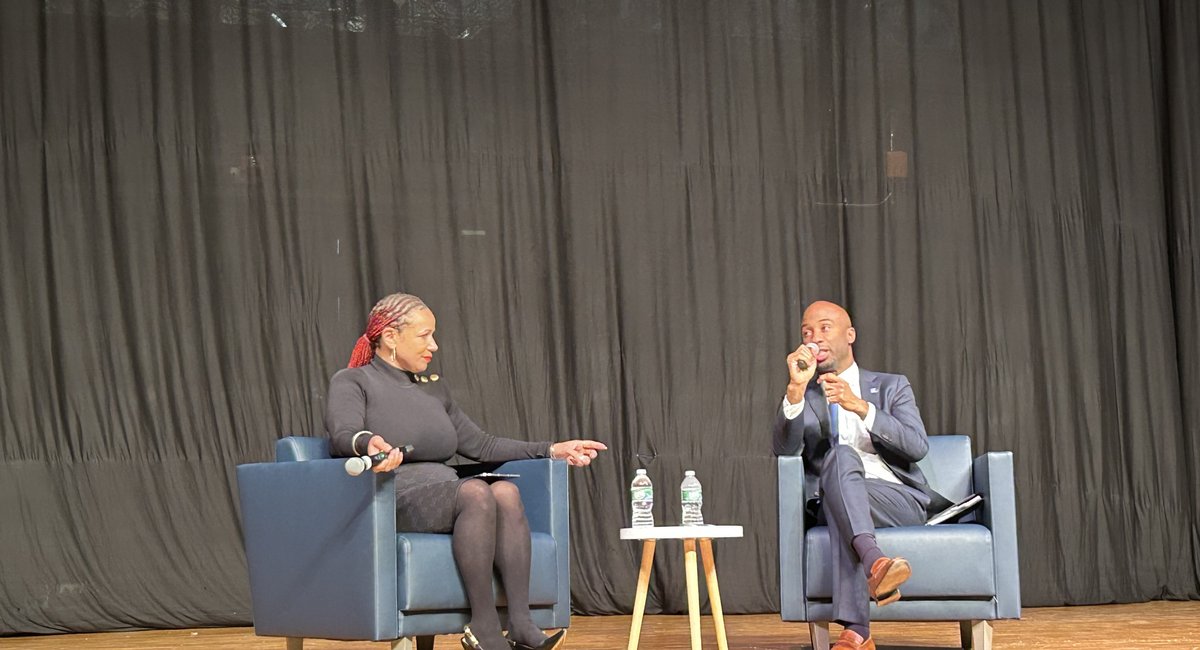
Schools Chancellor Kamar Samuels faced a frustrated, impatient crowd Tuesday as he insisted the Mamdani administration is committed to integrating New York City public schools, even as he declined to share a specific plan.
In the auditorium of the Washington Irving Campus near Union Square, Samuels was met with groans from the audience while facing tough questions from New York Times journalist Nikole Hannah-Jones.
Her recent article on her daughter’s experience in public schools has fueled urgent discussions about addressing one of the most segregated systems in the country. Mayor Zohran Mamdani has faced mounting criticism that he hasn’t delivered a clear education platform — including how to address segregation.
Samuels insisted he and Hannah-Jones agree on the goal of integration.
“We will address segregation,” he said. “We are disagreeing in some ways on the how.”
He touted working groups he’s launched in a handful of communities across the city, with more to come, saying local communities “need to be primed” for the fraught process of implementing new policies to advance integration. Samuels launched the working groups last summer to address intertwined challenges of declining enrollment, class size and segregation.
But Hannah-Jones insisted that the Mamdani administration, already 10 months into its term, should be executing policies integration advocates have been promoting for years. She, along with many audience members, made clear they felt Samuels was not meeting the moment.
“I know you were coached not to actually answer my question,” Hannah-Jones said. “You keep talking about what you did. I want to talk about what you’re going to do.”
She asked Samuels whether he intends to implement the recommendations of a de Blasio-era diversity task force that includes replacing Gifted & Talented programs, reforming selective admissions policies that can serve as a barrier for Black and brown students, and redrawing school zones. Samuels demurred, noting he “really tackled” some of those policies in previous roles as superintendent in districts covering parts of Brooklyn and Manhattan, and promised more details on future efforts soon.
Afterwards, Hannah-Jones said she’d expected more from Samuels.
“I don’t think anyone left here convinced we’re going to see transformative change around this issue right now. I hope to be proven wrong,” Hannah-Jones said. “I’m disappointed. This whole night can be redeemed if we see a real plan.”
The town hall was sponsored by the student journalism nonprofit The Bell and New York Appleseed. Organizers said around 800 people attended.
The audience was largely filled with students, parents and educators galvanized by Hannah-Jones’ New York Times article making a deeply personal case for integration policies.
Ayanna Behin, a former Community Education Council president, said Samuels was in a “tricky spot.”
“I don’t want us to be so upset that we can’t have a conversation about it,” Behin said. “Nikole did not give him an inch. A lot of audience members and parents are visibly and audibly frustrated.”
She said she understood why some parents might not be satisfied with Samuels’ answers. But she said she got to know him when he was a superintendent, and trusted he would deliver.
“I can see why those answers piss people off,” Behin said. “If I didn’t know there was truth behind those words I would be really pissed off right now.”
But parent Nadera Kaita left feeling nothing will change in the nation’s largest school system. “Integration is not going to happen in my lifetime. I know that,” she said. Kaita said school integration requires leadership and a willingness to weather the fallout. “You have to take a stand. Make the rules, rip off the Band Aid and get it done.”
Just before Hannah-Jones’ anticipated interview of Samuels, a panel of high school students spoke about the mix of challenges and opportunities they have faced in under-resourced schools serving mostly Black and brown students. They said those tight-knit communities often lack electives, extracurriculars and Advanced Placement classes.
“I feel like there’s so much beauty in all the different school communities that exist in New York, in all the differences, but I also feel like what school you go to should not so sharply define what opportunities you have access to,” said Camilla Spillmann, a high school senior.
Hannah-Jones said she could “cry in shame” hearing the students speak about the gap between the education they want and the one they received.