
A new film invites you to eavesdrop on one of the greatest conversations in New York City history.
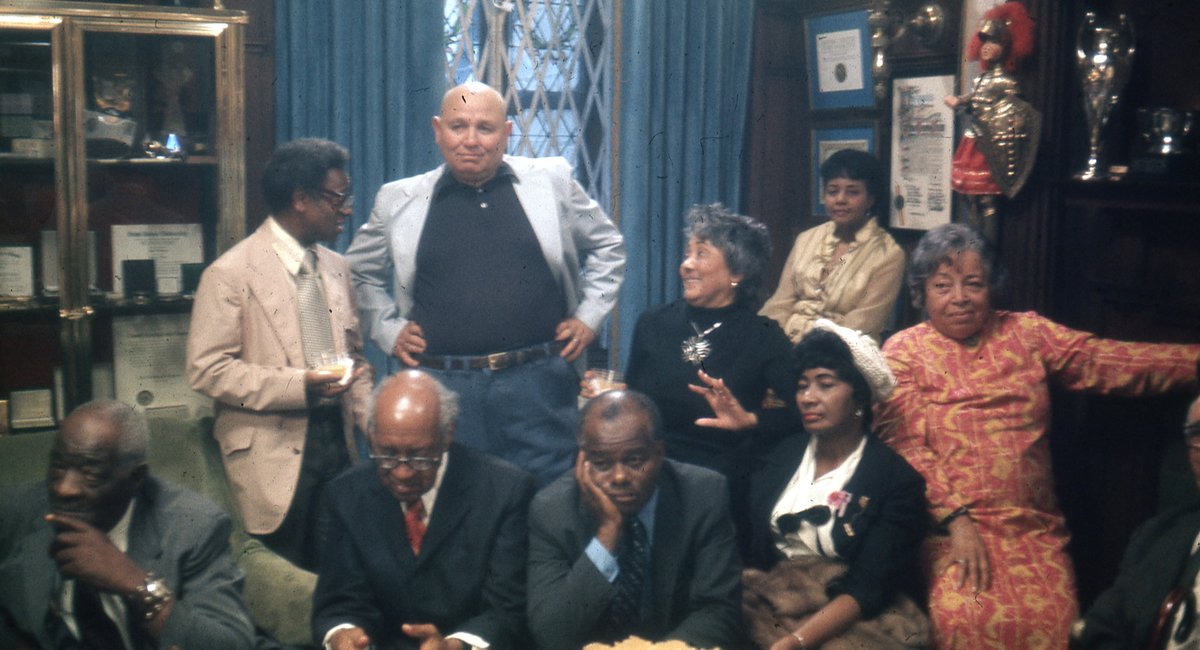
In 1972, legendary documentarian William Greaves filmed a party he threw for Harlem Renaissance luminaries. With help from his family, “Once Upon a Time in Harlem” brings that decades-old footage to theaters.
On Aug. 6, 1972, Greaves invited roughly two dozen Harlem Renaissance luminaries to Duke Ellington’s apartment on Riverside Drive. He threw a cocktail party for the aging artists, writers and intellectuals, with an unusual request: He wanted to film their lively conversations and have several of them return the next day for one-on-one interviews.
Some of the attendees hadn’t seen each other since the 1920s. Greaves ended up with 60,000 feet of 16 mm film capturing their reflections on what it was like to be part of such an influential artistic movement. He worked on the film for the remainder of his life, editing short segments and filming some additional B-roll, but died in 2014 without ever completing the project.
After his death, the footage remained in storage, largely unseen by the public — until now. Greaves’ son, David Greaves, and granddaughter, Liani Greaves, stepped in a few years ago to pick up where he left off. The resulting 100-minute documentary, “Once Upon a Time in Harlem,” premiered to great acclaim at the Sundance Film Festival, where critics described it as “exquisitely crafted” and “a vital reclamation of a precious history.” It is now playing at Film Forum and Lincoln Center.
“My grandfather considered it to be the most important thing that he’d ever put on film,” Liani, credited as a producer on the film, said in a recent interview. She and her father, the film’s director, also worked with editors Anne de Mare and Lynn True.
I met up with David and Liani outside Ellington’s Riverside Drive apartment building on a recent afternoon. They were still basking in the glow of having screened the film for working artists — many of whom resided in Harlem — at the Studio Museum the previous night. While the Ellington family no longer lives in this particular building, Liani said she likes to imagine something creative is still happening up there.
David and Liani each worked with Greaves during his lifetime. As we made our way to an outdoor cafe in Riverside Park, they told me about their goal of carrying on his legacy. They do so not only to honor him but also his wife and fellow artist, Louise Archambault Greaves. Louise managed finances and distribution of documentaries such as “Still a Brother: Inside the Negro Middle Class” and “Symbiopsychotaxiplasm.” She made it her mission to restore Greaves’ work and create an archive of it until her own death in 2023.
“My grandfather has a quote in which he says, ‘God created the dynamic of conflict and only out of this cosmic play can anything be created or manifested or condensed. The play is the thing,’” Liani said. “At the very beginning of this process, even when Louise was passing away, this was a sort of tenet of who we would be moving forward and how we would think about this film.”
David, who was in his 20s at the time, was one of the camera operators who attended the Harlem party with his father. (There were four cameras overall.) He said he has few actual memories from that day in 1972, but relived the experience through the footage. Electric energy pulses through “Once Upon a Time in Harlem” as attendees like photographer James Van Der Zee, painter Aaron Douglas, civil rights advocate Frank Horne and activists Richard B. Moore and Louise Thompson Patterson take turns reminiscing, reflecting and delivering impassioned odes to their contemporaries.
Years ago, Greaves gave David general advice on the editing process: “If something affects you viscerally, David, go with it,” the son recalled his father saying. What stirred David and Liani most throughout the tens of hours of footage were all the debates. Partygoers go back and forth on Black nationalism, especially as espoused by Marcus Garvey, and the feasibility of socialism. Patterson wonders whether the assembled group of people undervalued the role of women like the late sculptor Augusta Savage. This sparks conversations about her contributions, as well as those of Zora Neale Hurston, a leading writer of that era.
George Schuyler, a journalist and social critic who became more conservative as he aged, says in the film that “the mark of a civilized community” is its ability to debate. This resonated with Liani, who said she considers it an important reminder amid “such a lack of empathy in the political climate.”
“I think that’s one of the things that this film does, is really remind us of who we are as a nation and what we’re capable of doing and being,” she said.
Liani recalled another quote from her grandfather, which opens the film: “A man’s social history is his essence.” As we sat in Riverside Park, she recited the rest: “And it’s from this that he draws his motivation, strength and his will.”
David and Liani bookend “Once Upon a Time in Harlem” with Greaves’ writing; he narrates his poem “In Quiet Wood” over the final scene. It was important to them to preserve as much of his perspective as possible.
Film Forum is showing the documentary alongside several others from Greaves’ extensive filmography. The retrospective, which lasts through Oct. 29, celebrates this long-awaited release and what would have been Greaves’ 100th birthday.
Ina Archer, a filmmaker and media conservationist who curated the Film Forum programming, expressed admiration for Greaves’ willingness to mine for the sometimes difficult truth in his subjects’ experiences. But she also thinks of his work as being characterized by a certain playfulness.
“Not always in the sense of being playful or silly,” she clarified, but rather in his ability to “look at people particularly and see them in context of the chaos that comes around them … out in the world, out in the culture.”
The world that the Harlem Renaissance luminaries occupied no longer exists. Harlem is a new place. But that doesn’t mean all is lost, David said.
As he squinted in the sun’s bright light in Riverside Park, David compared the experience of watching “Once Upon a Time in Harlem” to observing a celestial wonder through a telescope.
“This film brings you as close to the Harlem Renaissance as you’re going to get,” he said. “You’re not going to see the thing itself, but golly, you can see the glow from it.”