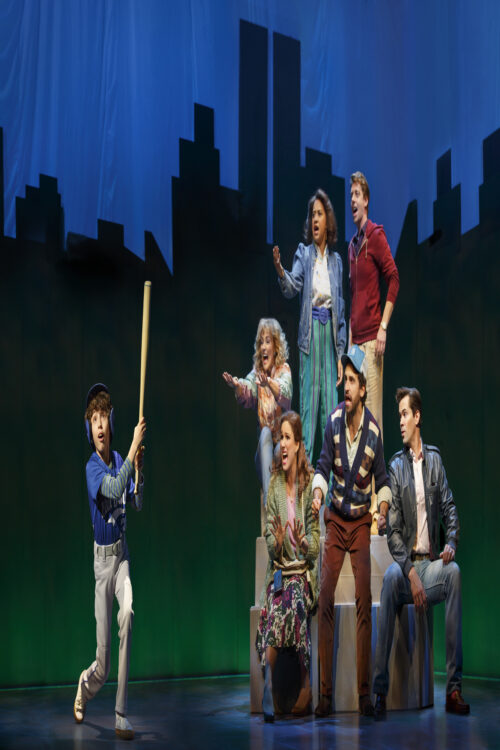
When William Finn began work on what would become Falsettos, he had no idea he was writing what remains, to date, the best musical to ever deal head-on with the AIDS crisis.
I do not use the word best lightly, or without heavy consideration. As both a historian and a critic, I resist ranked thinking whenever I approach art. In this very particular case, however, there is simply no other word for it: Falsettos is, and has remained for more than 30 years, the best.
Bitter on the tongue yet soft on the ear, Falsettos is a wonder: Once an ever-evolving piece of living memory made manifest onstage from the hands of the late Finn and present steward James Lapine, the musical has gone on to become one of the guiding lights for musical theatre in a post AIDS world. Initially a one-act called In Trousers that was so miserably received Finn considered abandoning the profession altogether to go to medical school, the short musical soon had a sibling. It was a second one act called March of the Falsettos that brought Lapine into the fold, as Finn continued to scrape away at the story of Marvin, a Jewish man struggling with his sexuality at the end of the 1970s.
Then came the 1980s, the devastation of the crisis, and the cratered emotional core of the theatrical community. Finn and Lapine came together again in 1990, completing the so-called “Marvin Trilogy” with Falsettoland, penned more than decade after In Trousers. Two years later, March of the Falsettos and Falsettoland were married together as a two-act narrative, titled Falsettos. Both 1992 Falsettos and its 2016 revival were well-received, the former earning Finn two Tony Awards, and the latter giving birth to a new generation of Falsettos fans.
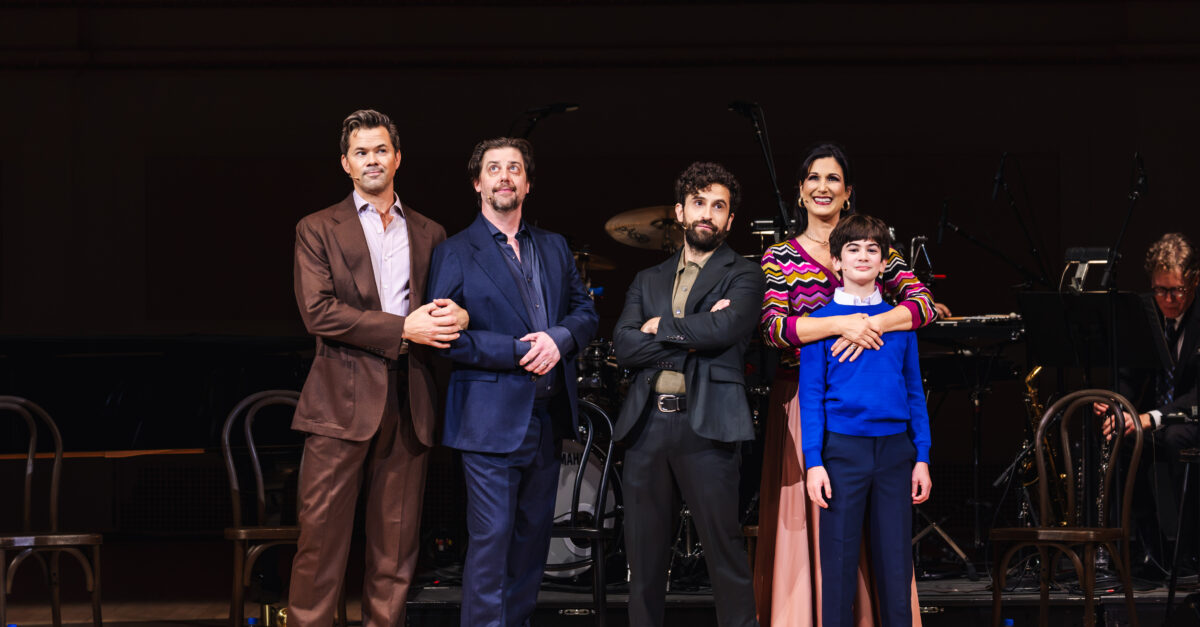
Now, 10 years on from Falsettos’ radically successful 2016 Broadway revival, that merry cast of seven: Christian Borle, Andrew Rannells, Stephanie J. Block, Brandon Uranowitz, Betsy Wolfe, Tracie Thoms, and Anthony Rosenthal (with new-to-the-production child actor Matthew Eby stepping in as Jason) have reunited in a truly spectacular show of craft at Carnegie Hall.
Held October 18 at the famed venue, the reunion will return to New York November 2 and February 8, 2-27, with a run scheduled for London’s Palladium February 23, 24, and 25, 2027. If you couldn’t make it, don’t worry. Below is a series of highlights from the performance, including an incredibly affecting surprise: Tread carefully if you intend to attend one of the future reunion performances and don’t want to be spoiled!
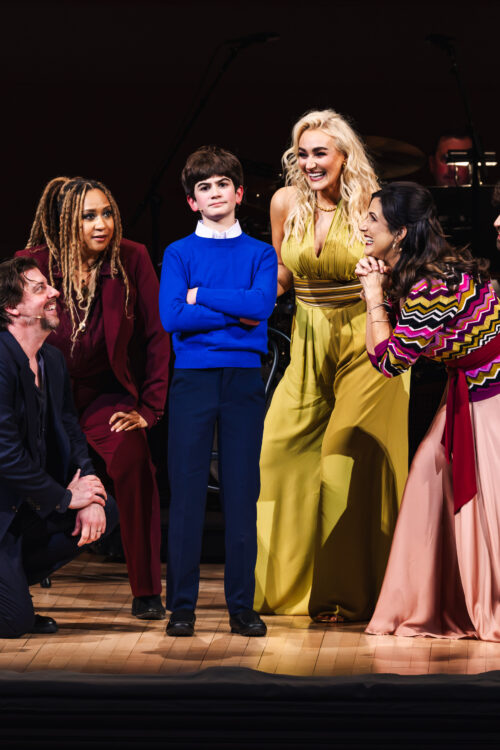
Thank You, Betsy Wolfe
It has been a long time since this writer has felt the need to cover her ears in Carnegie Hall, but the sheer decibel level achieved by the crowd at Betsy Wolfe’s pre-show entrance forced my hands to move. This show, and this revival in particular, are beloved, and fans can thank Wolfe for its return 10 years on.
A hurricane of bouncing blonde curls, Wolfe was positively bursting with energy as she delivered the following introductory speech. “I want to tell you a very, very quick story of how we ended up here tonight. In April of 2025, our cast reunited to perform a number for Lincoln Center Theater, who originally produced our Broadway revival. It was the first time all seven of us original revival cast members had been together since the premiere of our PBS recording, and I had been looking forward to that reunion for a very specific reason, because I had five very dangerous words I wanted to ask them. I have a crazy idea. These people are very intelligent, very talented people. They could have stopped me. Instead, they said, ‘We love it. Let’s do it’ which, in hindsight, was incredibly irresponsible of them. And that very night, we decided that we were going to do it, and we were going to do it at Carnegie Hall. It is so rare to get to revisit a piece of theatre, and it is even rarer to do it with the people who made you fall in love with it in the first place. And none of us would be standing here tonight if it weren’t for two extraordinary artists. The incomparable, late great William Finn, and our elegant original director of our revival and book writer, James Lapine.”
As Wolfe singled out Lapine, the Pulitzer winner was coaxed out of his seat on the aisle where he had quickly run during the show’s pre-show blackout. As he stood, a spotlight appeared, highlighting Lapine as the audience roared to an even higher fever pitch, nearly bowling him over as he physically shook off its impact, smiling wide. Eventually, Wolfe was able to continue over the din. “There really aren’t enough words to express how grateful we are to you and Bill for giving us this extraordinary show… Thank you for helping make tonight possible. And thank you to all of you who I’m sure have already silenced your cell phones (if you haven’t, this is your moment). Whether you were with us 10 years ago or whether you found your love through the PBS recording and are now seeing it live for the first time tonight, I cannot tell you how much it means for all of you to be here.”

Tracie Thoms and Betsy Wolfe in Falsettos’ 10th Anniversary Reunion Concert
(Jenny Anderson)
Bless Good Casting Directors
One of the most legendary details of this particular production of Falsettos is its cast. Casting directors Tara Rubin and Eric Woodall deserve endless praise for the company they assembled 10 years ago, pulling together a tight-knit-family that still crackles with chemistry a decade on. In the intervening decade, all seven of them have lived a whole lot of life. Both Uranowitz and Block have become Tony winners (for Leopoldstadt and The Cher Show, respectively), Wolfe and Borle were Tony nominated (for & Juliet and Some Like It Hot, respectively), Rannells has published two best-selling books, Thoms added to her extensive film and television resume with the smash hit procedural 9-1-1, and Anthony Rosenthal (who was only 11 when he made his Broadway debut as Jason in Falsettos) is now a man of 22—Rosenthal returned to Broadway with Uranowitz in Leopoldstadt before embarking on his own journey into adulthood.
To see them all together once more was a thrill, augmented by the addition of a new child performer, Matthew Eby, who took on the role of Jason with energetic aplomb. It isn’t easy joining a company as closely aligned as the 2016 Falsettos crew. Pat Goodwin at the Telsey office should be proud of the coup they achieved with Eby. The moment the side door of the legendary concert hall opened to allow the cast to enter, the crowd was on its feet, arms thrust in the air in adoration as the cast walked out, with Block already tipping over into tears. What a difference a decade makes: simultaneously a lifetime ago, and yesterday.

Christian Borle, Andrew Rannells, and Brandon Uranowitz in Falsettos’ 10th Anniversary Reunion Concert
(Jenny Anderson)
Best on the Block
Speaking of Stephanie J. Block: I have another best to give. In an era where many composers are pushing women to the very top of their vocal range as a pyrotechnic party trick that distracts from otherwise weak constructions, Block remains the best belter on Broadway. Perfectly placed and supported, with a ping that could hit a bullseye across a crowded room, Block’s natural instrument is transcendent, cutting through the air with a precision that has yet to be equalled by the thousands of “Broadway style belters” that have flooded the industry from every manner of BFA program. From the second she opened her mouth in the musical’s opening number, “Four Jews in a Room Bitching,” the audience was rapt, roaring with approval as she soared through vocal lines that would make many a singer wince with worry.
By the time she had reached her Act One showstopper, “I’m Breaking Down,” the room was practically vibrating with anticipation. Before she had even entered, both Borle and Uranowitz could be seen laughing with wonder and applauding at the look of determination on her face. She, of course, navigated the number to near perfection, even finding the time to break the fourth wall during a brief instrumental interlude to remind the audience that the number was even harder to perform without the props and costumes she had utilized in the full 2016 revival. By the end, the audience was on its feet, screaming for her as Block wiped a new round of tears from her cheek.
It is truly surreal that Block won her first Tony for The Cher Show, and not Falsettos. In future years, her lack of Falsettos recognition will almost certainly be a bafflement to Tony Trivia Players across the world. It is, of course, a reminder of the inherent fallibility of artistic awards, and their inability to honor multiple exemplary performances in a single season. In a just world, Block would have a second statue on her mantle. In our present reality, at least we get to relive her excellent performance on PBS and in these reunion concerts.

Stephanie J. Block in Falsettos’ 10th Anniversary Reunion Concert
(Jenny Anderson)
A Woman, A World
Block’s astonishing performance cannot be wholly chalked up to her natural gifts; she is aided by the character of Trina herself, one of the most complexly written women in the musical theatre canon. Falsettos is one of the few stories about a man leaving his wife for another man that treats the woman like a victim to the situation, rather than an obstacle. While the musical is, of course, sympathetic to Marvin’s sexuality struggles, it deftly avoids the trap of painting Trina like some one-dimensional harpy keeping him from true happiness. Instead, she is approached with a humanity rarely afforded to female characters in these situations—her frustrations, self esteem issues, and insistence on Marvin taking responsibility for his actions are depicted as justified.
She is a shining example of what I think is Lapine’s greatest calling card as a writer: his women. While Finn was deeply involved in the creation of Trina, I feel Lapine’s influence is the very spine of her. Whether it be Dot in Sunday in the Park with George, Fosca in Passion, or The Baker’s Wife in Into The Woods, Lapine’s female characters are much more vividly realized than the majority of women in musical theatre. They are complex, they are complicated, and they are undeniably, irrepressibly human in a way that must be lauded in comparison to the “plot device” female characters that continue to riddle many musicals, both historic and modern. When Block took to center stage for “Trina’s Song,” a exhausted ode to the many men who insist on perfection from her, in spite of their own cavernous failings, the audience was deathly still, hanging on every word.
I’m tired of all the happy men who rule the world
They grow, of that I’m sure
They grow, but don’t mature
I’d like the chance to hide in that world
I’m listening
To these men who aren’t quite men yet
But aren’t boys
Make noise
And throw their knives
Their toys are people’s lives
They fight too hard
And play too rough
They sometimes love, but not enough
My heart will beat at will, but still
It’s crazy how they’re acting
It’s crazy my response
It’s stupid how I love them
So dumb, how I anticipate their wants
But as long as they amuse me
That alone is what’s required
So I’ll roar
Like I’m wired
I’ll explore what I’m feeling
Except what I’m feeling is tired
I’m tired
So tired of all the happy men who rule the world
Happy, frightened men who rule the world
Stupid, charming men
Silly, childish jerks
That said, I’ll be his wife
I’ll wed and change my life
I’ll laugh, I’ll smile, I’ll welcome cheer
The time is right, the men are near
Now happiness and love appear
As Block wiped a renewed round of tears from her face, a second partial standing ovation dotted the auditorium. Catharsis complete.

Andrew Rannells, Betsy Wolfe, Tracie Thoms, Christian Borle, Anthony Rosenthal, Brandon Uranowitz, and Stephanie J. Block in Falsettos’ 10th Anniversary Reunion Concert
(Jenny Anderson)
You’ll Be, Kid, A Man, Kid
Depending on the scene, the men of Falsettos are caustic, charming, viperous, vulnerable, nervous wrecks. Borle, known as one of the great comic actors of his generation, is astonishingly good at playing Marvin, the asshole you can’t help but root for at the center of the narrative. Marvin is selfish, he is cruel, and he is controlling to the nth degree. But as embodied by Borle, he is also witty, engaging, and vividly present when someone he loves is up against the wall. “What More Can I Say,” “Unlikely Lovers,” and “What Would I Do” is a perfectly arc’d trio of songs from Finn. As performed by Borle and Rannells, they are soul shattering with vulnerability: to love someone is to see them, scarred as they may be, and to embrace them anyway.
The role of Whizzer Brown, unintentional homewrecker turned suffering patient during the worst years of the AIDS crisis, is a hard needle to thread. His arc across the two act version of the narrative is precipitous, and Rannells navigated his characters decline from effortless charmer to a man stripped of all but his dignity with aplomb. His performance of “You Gotta Die Sometime” remains bone chilling.
As Mendel, the extraordinarily unethical yet endearing psychiatrist, Uranowitz is the grounding force from which every other member of the company can fly. Funny, empathetic, manipulative, vulnerable, and altogether stretched taut, Uranowitz’s physicality as he roared through “Everyone Hates His Parents” alongside young Eby had the audience cackling from cakewalk to aborted cartwheel.
The greatest emotional reaction of the night, however, came from the man barely seen onstage. During “Jason’s Bar Mitzvah,” after Eby was ushered offstage to don the prayer shawl, Rosenthal emerged for the first time all night, dressed the same as Borle. As father lays hands upon his son, ushering him through the marker of maturity, Borle visibly wept as he looked upon the boy who had grown over the last decade to become the man before him. In Falsettos, Marvin is plagued by fears surrounding how his choices will affect his son. In this reunion concert, without a single altered word, Rosenthal’s mature presence, dressed in the mirror of his father, silently answers: He’s going to be alright. As Rosenthal turned forward to recite his Torah portion, audible sobs could be heard echoing throughout the hall. By the end, the cast was embracing at center stage, shoulders shaking as they held their prodigal son. It was the kind of emotional moment that transcends stagecraft and requires the influence of reality to exist.
It was bliss. It was beauty. It was a singular moment in time.

Company of Falsettos’ 10th Anniversary Reunion Concert
(Jenny Anderson)
For Now, For Forever
For 47 years, Falsettos (and all of its predecessors) has been a living monument to artistic evolution. From the very first workshop of In Trousers to the refining work Finn and Lapine did for the 2016 revival, Falsettos never felt like it was frozen in amber. With each new appraisal came a new approach, a new thought, a new future.
As Finn stated in the publication notes for the collected Marvin musical librettos, “What’s poignant about Falsettoland is that none of what happens to the characters could have been predicted at the time of March of the Falsettos. We all thought we were heading toward a better world where gay men and women could live freely and openly, without shame and without discrimination. Who back then was counting on AIDS, on increased violence toward gay people, on homophobic right-wing attacks on the National Endowment for the Arts and its funding policies? Everything we believed in and hoped for around the time of March of the Falsettos seems impossibly naive today. And yet, I choose to believe that the theatre still has the power to move people, perhaps even to change them or call them to action. The final image of Falsettoland has such power, I think. Marvin is alone at the end, aware that he too may die, yet he sings defiantly, proudly, that he would like to believe that he would ‘do it again and again and again.’ Suddenly, from the darkness, his family arrives and circles him protectively, lovingly; his ‘family’ consists of all the characters—gay, straight, male, female, unlikely lovers all. They’re a tiny band, perhaps, but they are there. I hope that support system is there for all of us. We may not have in 1990 what we thought we’d have 10 years earlier, and I’m afraid that we stand to lose a whole lot more, but we have each other. And that is a comfort.”
When the 2016 revival was filmed for PBS, it preserved that specific version of the show for generations, and created a fanbase that has only grown in the past decade. While Lapine is thankfully still with us, Finn’s passing has essentially ensured that this is the final version of Falsettos, laying to rest a decades’ long exercise in creative curiosity and tenacity. What began as a single character study exploring the internal struggles of a man named Marvin blossomed into something so emotionally expansive that fans could be seen sobbing on the sidewalk outside of Carnegie Hall.
How lucky we are that Finn kept exploring, up until the very end.