
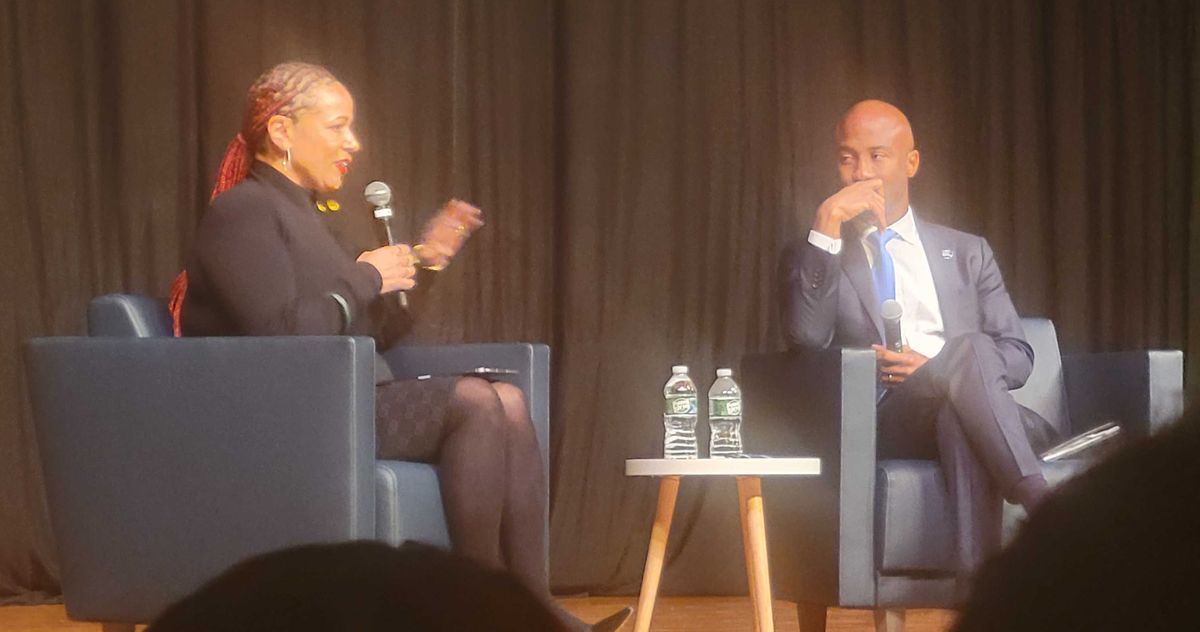
Journalist Nikole Hannah-Jones and New York City schools chancellor Kamar Samuels had a tense conversation at the Washington Irving Campus on Tuesday.
Photo: Nia Prater
The Knicks home opener against the 76ers wasn’t the only highly anticipated matchup playing out in Manhattan on Tuesday evening. Less than 20 blocks away at the Washington Irving Campus, about 800 education advocates, students, and parents packed an auditorium to watch journalist Nikole Hannah-Jones face off with New York City schools chancellor Kamar Samuels in a contentious one-on-one. “While they said it’s going to be a conversation, it’s about to be an interrogation,” Hannah-Jones said at the start, drawing applause from the crowd. It was an accurate description of what followed.
The conversation was the marquee event of a town hall co-hosted by the school-integration advocacy group New York Appleseed and the Bell, a student-journalism organization.
A month ago, Hannah-Jones reignited the school-integration debate with a New York Times Magazine essay detailing the challenging aftermath of her decade-old decision to send her daughter to a segregated public school in Brooklyn. When Mayor Zohran Mamdani was later asked about the essay and his plan to address the problems it illustrated, he signaled that his administration was in the process of developing a plan but provided slim details as to what it might be. Samuels didn’t seem to have more news to share at Tuesday’s town hall either — a fact that didn’t go over very well onstage or in the seats.
Hannah-Jones thanked Samuels for agreeing to take part in the event and for his past work tackling segregation when he served as a superintendent, acknowledging that previous mayors likely limited how much he could accomplish. But, she added, “There is no buck to be passed now. You head the system. So while I appreciate the work you have done, today we want to talk about the work you will do.”
When she asked Samuels if he had a “real and substantial” plan for system-wide school integration and when that would be made public, he responded without those specifics. Hannah-Jones interjected: “No, I know you were coached not to actually answer my question. My question is: When will we see a plan to address comprehensive integration across the city?”
Samuels insisted that the outline of the plan can already be seen. “First of all, part of it is making sure that you are engaging and being thoughtful with communities, which is why I’m here,” he said. “And secondly, it’s also making sure that you are building the structures to have those conversations and build the capacity of superintendents who are going to have to lead the work.”
“I don’t believe the best way to integrate schools is by large proclamations,” he added. “We’ve seen that happen before and we’ve seen that that hasn’t necessarily worked because you have an organized resistance against that.”
He continued, “We will have and we will come to you with a more robust conversation. But right now, there are things we are already doing. And so this is not a matter of being coached to not answer your question.”
By this point, it was clear that many members of the audience were not satisfied with what Samuels had to say — or rather, what he hadn’t come prepared to say.
In response, Hannah-Jones pointed to reports put out in 2019 by the School Diversity Advisory Group, a panel of educators, experts, and scholars assembled under former mayor Bill de Blasio who made numerous recommendations about how to tackle school integration, but very few were implemented. “These issues have been studied,” she said. “There was a task force that was very well equipped to study. They came up with recommendations. So why not just adopt the recommendations?” she asked.
Samuels pointed to how screened admissions, which the SDAG recommended getting rid of in elementary and middle schools, went away during the pandemic and how some schools returned to that process in the years that followed, while others did not. “It’s important to me that we engage those communities again to actually see are these screens working for its intended purpose or what is it that our goals are.” Samuels began.
Hannah-Jones volleyed back the chancellor’s response. “What’s the intended purpose of a screen?” she asked to more cheers from the audience.
The crowd also joined in on the interrogation. When the chancellor spoke of having the “necessary conditions” in place to address segregation, one woman shouted, “Create the conditions!” When Samuels, as he has before, raised his recent creation of five district-based community working groups — an effort expected to expand to additional districts down the line, one audience member shouted, “What’s your timeline?”
When Samuels started to respond, saying this was something the administration was working on, there were audible groans throughout the room.
Hannah-Jones chimed in: “So there’s not a timeline. You have to understand kind of the discontentment. It’s ten months in. This is not a surprising conversation. This is not a new issue. So ten months in, when a timeline can’t be offered, you can understand why people feel like that means you are just delayed.”
In brief remarks given onstage prior to his sit-down with Hannah-Jones, Samuels framed the matter of solving school segregation as an ongoing conversation, one he implored parents to be a part of. “We need you to stick with us, even when these conversations get hard, and they certainly will,” he said.
Despite the many tense exchanges, the chancellor also indicated he would be up for another round. “We’ve got to do a part two,” Samuels said after a planned question-and-answer session had to be cut short.
Hannah-Jones quipped, “Oh, you’re a brave man.”
Sign Up for the Intelligencer Newsletter
Daily news about the politics, business, and technology shaping our world.
Vox Media, LLC Terms and Privacy Notice
Related