

A new survey from Queen’s University has revealed the current attitudes of boys and young men in Northern Ireland about masculinity and violence against women and girls.
Researchers questioned males aged 16-24 about what it means to be masculine today, and their understanding of gender-based violence and their own responsibility in preventing it.
Most young men were found to reject physical violence against women and girls and described masculinity in positive terms of respect and caring for others.
80% rejected views that masculinity should reinforce power imbalances with women, and less than one in 10 felt men should have more power than women in marriage.
Alongside this, the research found some young men “uphold expectations of male toughness,” an expectation of financial dominance in relationships and prejudice towards gay men.
This included one in three stating that men should be the main financial provider for their family and one in five agreeing that a gay man was not “a real man.”
A near-universal rejection of physical violence against women and girls was reported, with less that one in 20 stating that a man could have a good reason to hit his wife.
While 97% supported a married woman’s right to refuse sex, one in five agreed that a man had the right to know where his wife or girlfriend was at all times.
The report added that “many young men” did not recognise coercive control, psychological abuse or harassment as forms of violence.
Among the responses quoted in the report, one said: “I guarantee if you got them women to write down what they thought violence was….you could whittle that down to 20%.”
Another aspect showed that while masculinities in Northern Ireland were diverse, they remained shaped by the legacy of the Troubles.
This was said to include “respect for toughness, control and male authority” which remained strong in politics, communities and institutions, which can greatly influence young men in the most affected communities.
With most boys and young men recognising they should challenge harmful behaviour in others, many were uncertain about how to do so.
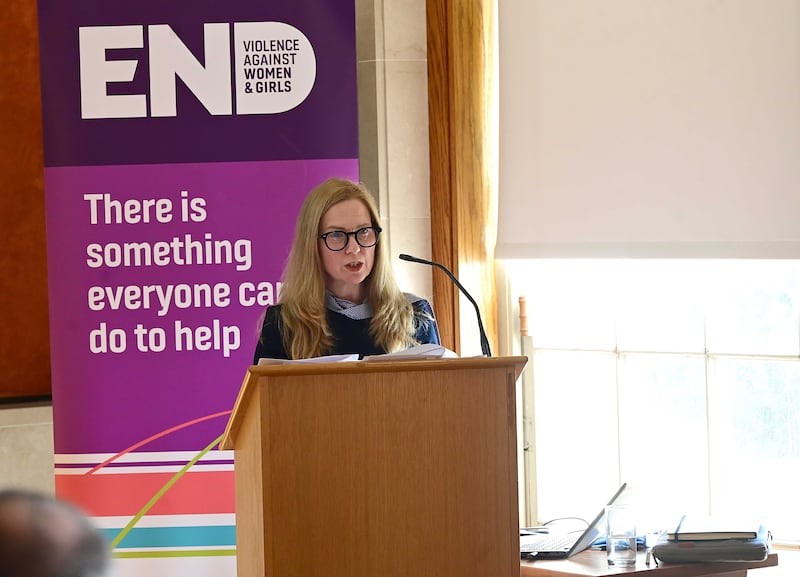 Professor Maria Lohan from the School of Nursing & Midwifery at Queen’s speaking at the launch of the report, Understandings of Masculinities and Attitudes Towards Violence Against Women and Girls in Northern Ireland: Young Men’s and Boys’ Views and Practitioners’ Perspectives. PICTURE: QUB
Their concerns included the fear of a social backlash, violence against them and not knowing how to respond to non-physical abuse.
Suggestions from young men included speaking privately to friends or modelling good behaviour rather than public confrontation.
A minority of young men voiced victim-blaming attitudes, but were often challenged by others.
One commented: “If younger boys were talking rubbish, it was up to us to correct them.”
Professor Maria Lohan from the university’s School of Nursing & Midwifery said there was a clear message from the research.
“Boys and young men concluded for themselves that they need, and want, to learn more about ending violence against women and girls, particularly its less visible forms, such as coercive control,” she said.
“Our task now is to meet that appetite by equipping schools, youth services and the trusted adults around young people to have these conversations. We thank the young people and practitioners who took part.”