
Credit: Far Out / Album Covers
October 22nd, 2026 · 10:00am BST
“The Kings of the Stone Age wear armour and have axes and wrestle. The Queens of the Stone Age hang out with the Kings of the Stone Age’s girlfriends when they wrestle…” frontman Josh Homme once said of the origins of his band’s name.
“Rock should be heavy enough for the boys and sweet enough for the girls,” Homme continued. “That way everyone’s happy, and it’s more of a party. Kings of the Stone Age is too lopsided.”
From its inception, then, Queens of the Stone Age attempted to find some sort of balance: one that would prompt anyone to listen, would strike one chord or another, and would return guitar music to its core. And, at 25 years old, Josh Homme set out to do so.
Queens of the Stone Age formed from the ashes of Kyuss, the pivotal stoner rock band that disbanded in 1995. Its members went on to form or join numerous bands: Fu Manchu, Dwarves, Mondo Generator and more. Homme, meanwhile, joined Screaming Trees as their touring guitarist and formed a band, Gamma Ray, who released a self-titled EP in 1996.
Then, forced to change their name after a German power metal band, also called Gamma Ray, threatened to sue, Queens of the Stone Age was born, with Homme alongside his former Kyuss bandmate Alfredo Hernández. Two years later, their eponymous debut album would be unleashed.
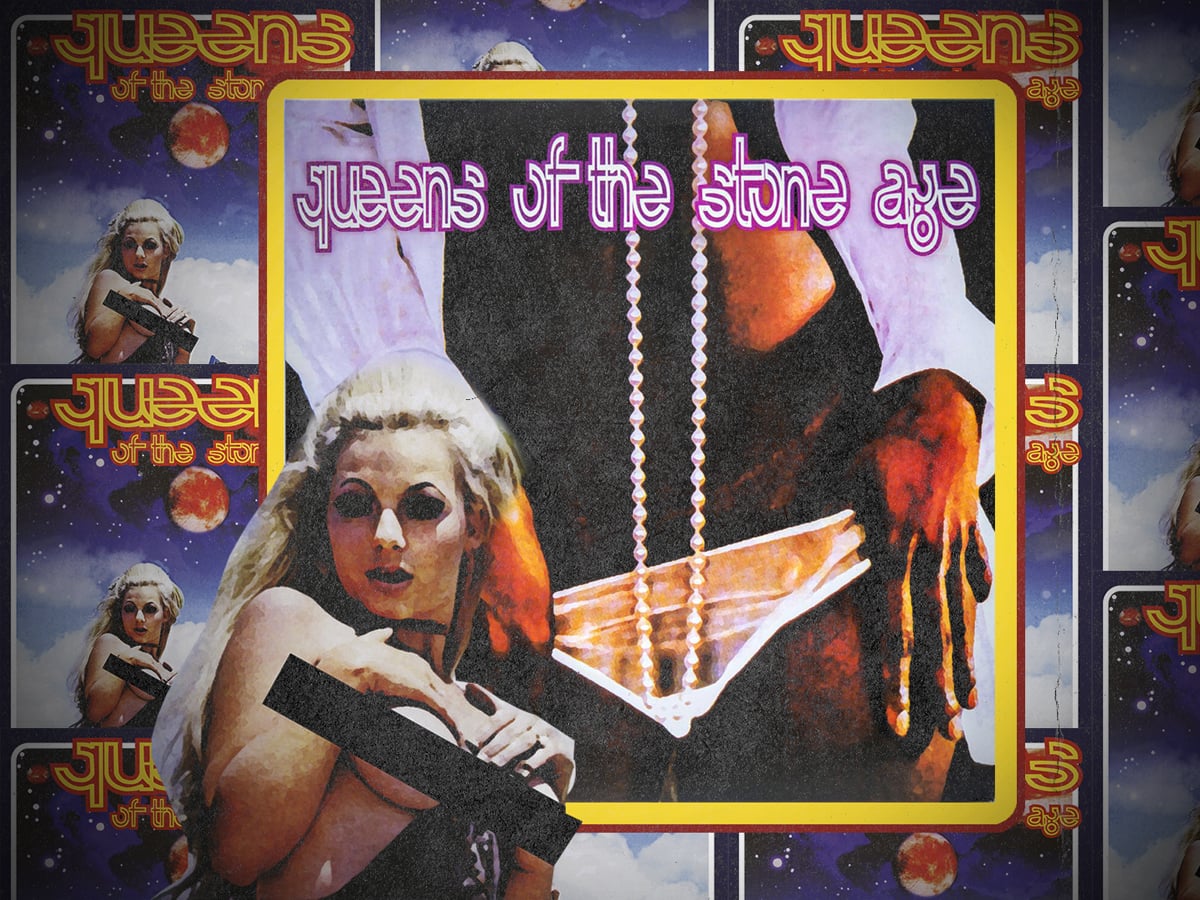
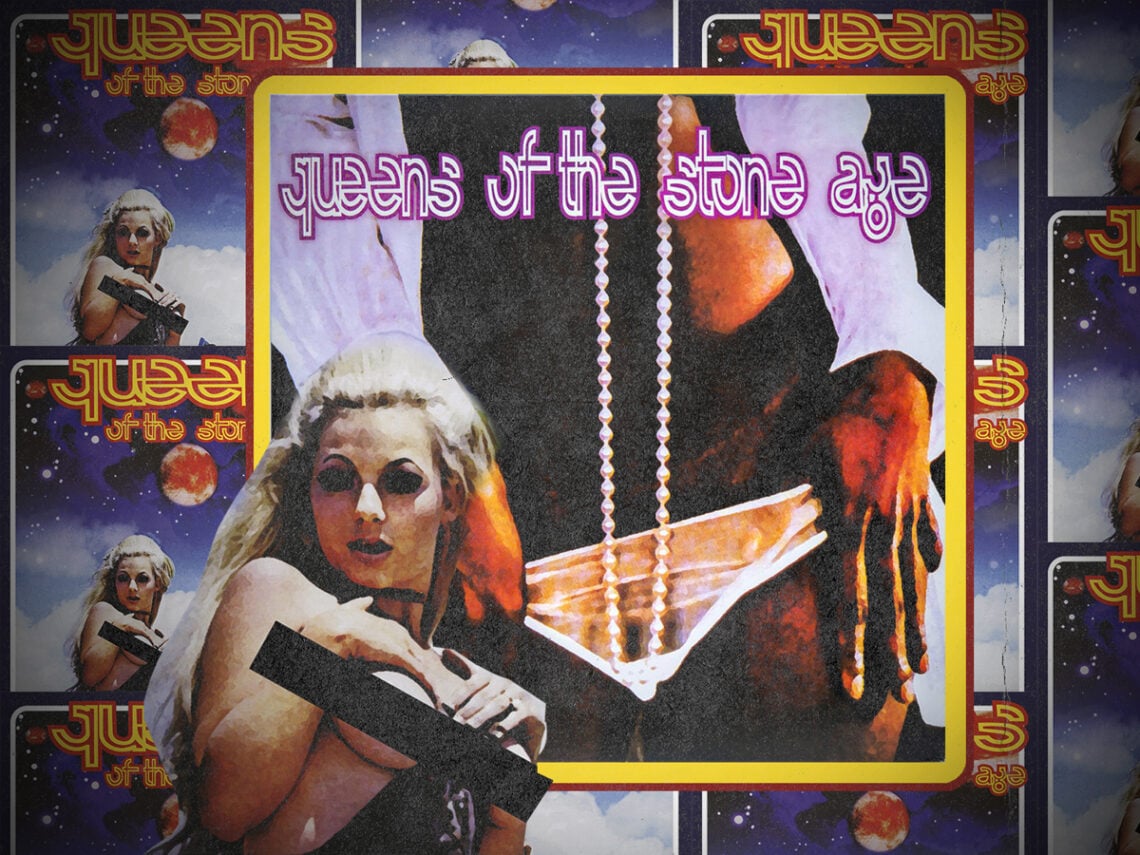
The original artwork for Queens of the Stone Age was laid out by Homme, in collaboration with graphic artist Frank Kozik. Reminiscent of an image one would find on the cover of an erotic science-fiction thriller in the 1970s, the album’s full cover is a photograph of a woman dressed in leather, posing semi-nude against a bright red motorcycle (the official cover is cropped for censorship, but the full photograph was included in the vinyl’s gatefold). Behind her is a mountainous landscape and a sky turned galaxy, with dark purple clouds, stars and an orange moon. The band’s name is emblazoned in a font akin to the logos of Back to the Future or Star Wars.
“I was part of the trash world. I was a no-education loser person, and was definitely into hedonistic experiences.”
Frank Kozik
The design was perfectly suited to Kozik’s style: provocation met with a certain darkness. He told Riot Fest in 2018, noting his preference for punk rock shows over museums or academia, with an emphasis on lived realities, “It was all stuff that we could kind of reproduce in our own lives; we could get a shitty car and drive around real fast, and we could hang out with fun people and party… and a lot of that stuff is really visually arresting. It’s all power imagery, and it really gets basic impulses across: sex, drugs, violence, weird shit.”
The unknown woman’s photograph captured everything that Queens of the Stone Age were to represent: sex, danger and adrenaline echoed in every chord, bass line and drum beat. From the opening whine of guitars on the album’s opener, ‘Regular John’, we are led into a world both sinister and strangely enticing: “Who are you, girl?” Homme asks, “‘Cause I’m so bored with myself.”
On a song like ‘Give the Mule What He Wants’, the tumbling opening riff and the harmonies that echo behind it evoke the image of driving in a near-empty desert, with nothing but the unknown blazing ahead.
The bones of Kyuss’s formative stoner rock sound remain in Queens of the Stone Age’s skeleton, but there is more to it: a certain groove that provokes the listener to move and, on their debut in particular, there is a primal simplicity in its execution that strips the guitars to their purest form while remaining as entrancing as ever.
Queens of the Stone Age was released on vinyl with the celestial-meets-biker pin-up photograph adorning it, pressed in three colours (black, green and orange) at only 3,000 copies total, released on Kozik’s label, Man’s Ruin Records. However, when the CD release came along that year – on Loosegroove Records in the United States and Roadrunner in the United Kingdom – an alternative photograph was used: a nude photograph of Trinidadian-British model Sylvia Bayo from the 1972 book The Pin-Up: A Modest History by Mark Gabor.
For the CD’s cover, the photograph of Bayo was cropped to centre her stomach and waist, and this would become the more widely circulated and better known of the two album covers. The original vinyl and its cover art continue to sell for hundreds, if not thousands, a rarity circulating among resellers, but it was reissued in 2022, with Kozik’s art and the initial vinyl sequence.
