
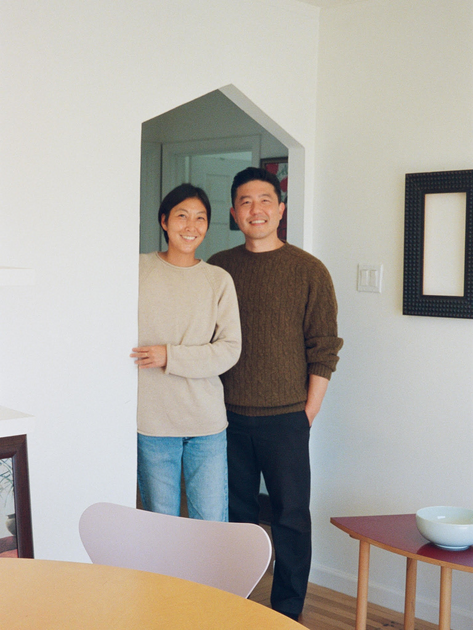
Clara Lee, left, and Eddo Kim. | Source: Madeline Shields
Inner Sunset locals may remember Queens, the quirky Korean superette that served comforting kimchi stews and pajeon larger than the plate it came on. The cafe and market, which sold take-home banchan and Korean pantry staples, closed in 2023, vacating the angular space that’s now occupied by the French bistro Caché. Clara Lee and Eddo Kim, the owners of Queens, took their business back to where it originated: the internet, where they sell a range of homemade and imported offerings.
Now, with a cookbook soon to hit shelves, the couple are starting another chapter — and hoping to connect with audiences in a new way.
 Source: Excerpted from Korean Soups by Clara Lee and Eddo Kim (Workman Publishing). Photographs by Scott Barry. Copyright © 2026.
 Source: Excerpted from Korean Soups by Clara Lee and Eddo Kim (Workman Publishing). Photographs by Scott Barry. Copyright © 2026.
“Korean Soups: Recipes for Soups and Stews That Nourish, Restore, and Delight” is an evolution in their relationship with the robust Korean pantry and its role in home cooking. The subject came together after several rounds of brainstorming and pitching. “We felt that it was not only the thing that we loved eating and cooking the most,” Lee says, “but also the perfect opportunity to highlight the diversity of this single subject and the importance of fundamental ingredients for building flavor in Korean cooking.”
The book guides home cooks through various applications of the condiments and fermented goods that Kim and Lee have focused on in the last few years through their online store. Some of their retail staples — like bright-red kimchi and gochugaru paste — can be easily spotted in Bay Area specialty stores and markets, such as Bernal Cutlery and On Waverly in San Francisco and Preserved in Oakland.
Even before the Sunset brick-and-mortar came to be, the two were dedicated to spreading the word about Korean cuisine, making and packaging products in their home kitchen. “The truth is, we never started Queens with the aspiration to disrupt and expand the local Korean food scene,” Kim says. “Rather, it was mainly a curiosity and inquiry of how to elevate the conversation around Korean food; specifically, Korean ingredients.”
 Source: Excerpted from Korean Soups by Clara Lee and Eddo Kim (Workman Publishing). Photographs by Scott Barry. Copyright © 2026.
The goal, he says, was rather humble: to make Korean ingredients more accessible. That included accessibility for professionals, as their chef friends had said they found large Korean markets overwhelming and were unsure whether the products they bought were of the highest quality.
Nevertheless, when Queens opened as a cafe in late 2020, Lee and Kim were held up as trailblazers of sorts — a title, Kim says, that made them feel “honored and a bit bashful.” Were they disheartened when Queens closed just as the Bay Area dining scene began to recover from the pandemic? “Extremely,” Kim says, because that meant “we would not be able to see our community of patrons day in and day out.”
Since the closure, the San Francisco Korean dining scene has witnessed glitzy openings like ABSteak and SSAL, and waves of Korean-inspired bars and daytime cafes such as Jilli, Anju, The Buoy, and Sohn. “It’s been great to see the excitement around Korean food in the city and the diversity of concepts that are sprouting up,” Lee says, though the couple’s Korean dining most usually takes place at home. On the other hand, she adds, there’s an understandable gravitation toward more high-end restaurants to accommodate the city’s shifting demographics. “We always think about the mom-and-pop shops and restaurants; as they continue to dwindle, we hope the next generation of entrepreneurs, restaurateurs, and chefs will continue to revive concepts like these that were so vital to our Korean American food and cultural upbringing and experience.”
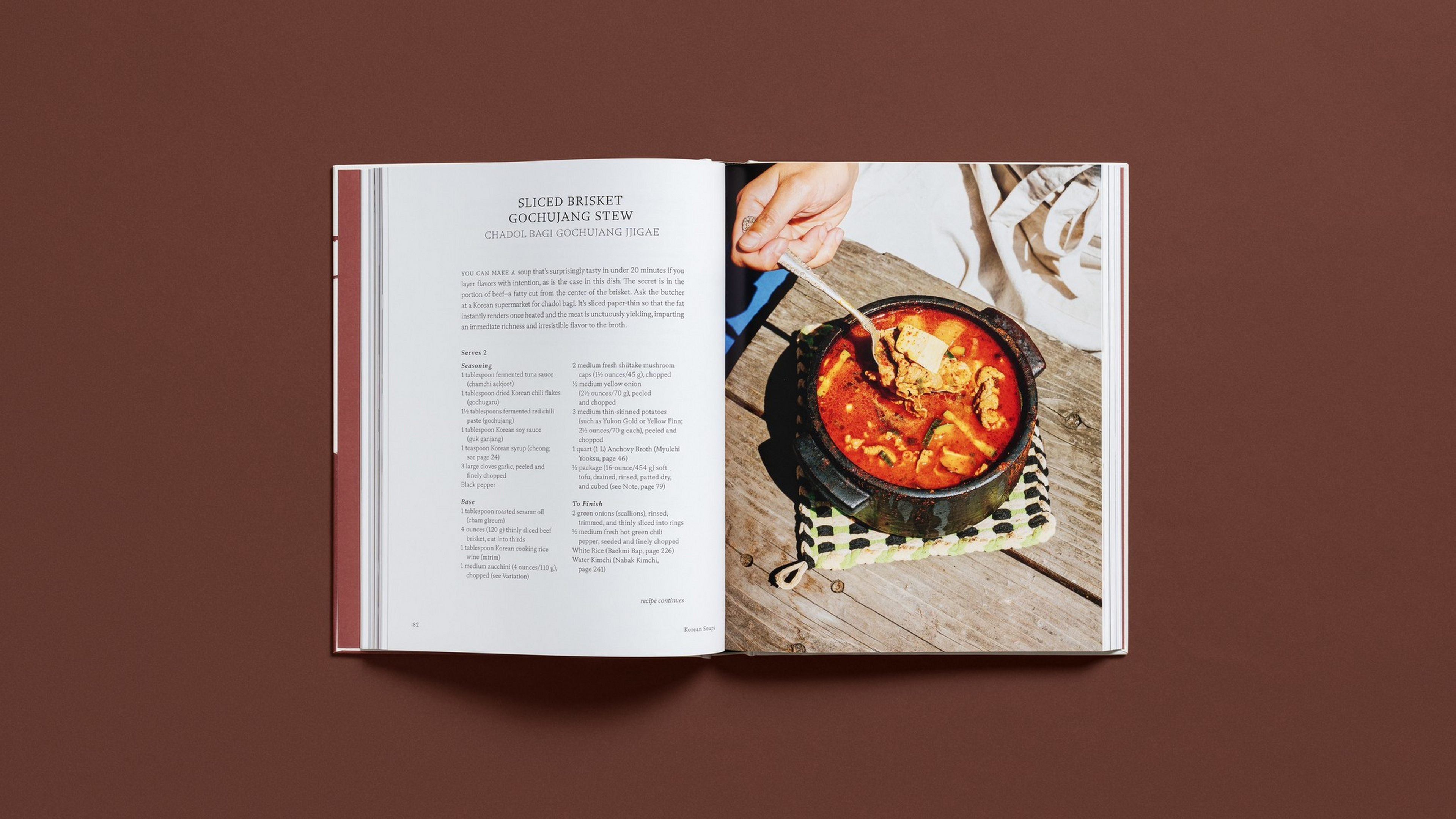 Source: Excerpted from Korean Soups by Clara Lee and Eddo Kim (Workman Publishing). Photographs by Scott Barry. Copyright © 2026.
Following the closure of their own mom-and-pop-meets-next-gen spot, shifting gears to focus on the packaged-goods brand allowed the two to keep developing their network. It was around that time that Lee and Kim started ideating the cookbook, plunging into recipe development once the proposal was sold.
As “Korean Soups” hits the shelves, the two can allow themselves to look back at the twists and pivots that led here. “We feel extremely grateful,” Lee says. “The truth is, neither Clara nor I come from any formal training or restaurant background. We’re just byproducts of a food community and ecosystem here in the Bay Area that has supported us from the start and continues to inspire us.”
Quite poetically, he adds, the stamp on the side of Queens jars — “Made in SF” — feels apt. “It describes us,” he says. “San Francisco made us.” And, while the book isn’t technically a Queens cookbook, there’s a tint of nostalgia built in, Lee says. “I think anyone who picks it up and reads through will feel like they’re walking down the aisle of our former store once again.”