
For a fleeting moment this past summer, JR gave people a reason to pause. He created a mountain in the middle of Paris.
The French artist transformed Paris’ oldest standing bridge into “La Caverne du Pont Neuf,” an immersive mountainscape constructed of inflated canvas arches. The piece, on view for a few weeks in June and the largest public installation of JR’s career, was an homage to Christo and Jeanne-Claude’s monumental 1985 work “The Pont Neuf Wrapped.”
“When it appeared in Paris overnight, it stopped the city. It had the ability to stop time,” says JR, describing the installation’s scale and presence. “People would stop and look and take a photo and try to understand what they’re looking at. What in our life makes us stop from the crazy nonstop of things?”
Inside the illusory structure, visitors could walk through a cavelike interior, which included a soundscape by Daft Punk’s Thomas Bangalter, earthy olfactory experience, and an augmented reality component.

“La Caverne du Pont Neuf,” June 16, 2026, 20h37, Triptyque, Paris, 2026.
Courtsey
JR has leaned into the symbolism of caves in recent installations, bringing rocky trompe-l’oeils to distinctive landmarks that include the Palais Garnier and Milano Centrale railway station. Like those earlier works, “La Caverne” taps into Plato’s Allegory of the Cave and exploration of reality versus perception. JR drops in the idea of “Picnolepsy,” a term coined by Paul Virilio to describe the state of momentary absences from reality, and likens it to a familiar activity: doomscrolling.
“We’re scrolling, but we’re not even looking at what we’re scrolling. We’re just zoned out, and so we disconnect from the outside world,” he says. “And you need to get out of these states. You need something that’s bigger than life to make you disconnect from that.”
In early September, the artist and photographer is back in his Paris studio after taking the month of August off for its annual summer closure. It’s late afternoon, but inside his cavernous work space — which features zinc plates from Parisian rooftops overhead — you could be tricked into thinking it was anytime of day or year.
“ There’s not even an outside window in this office. It helps me to focus,” says the artist, donning his signature black sunglasses and appearing relaxed and unhurried after his time away. “After the bridge, I was kind of exhausted. I really needed a break,” he adds. “I couldn’t have handled another day, you know? It was really one of those things where I pushed too much.”
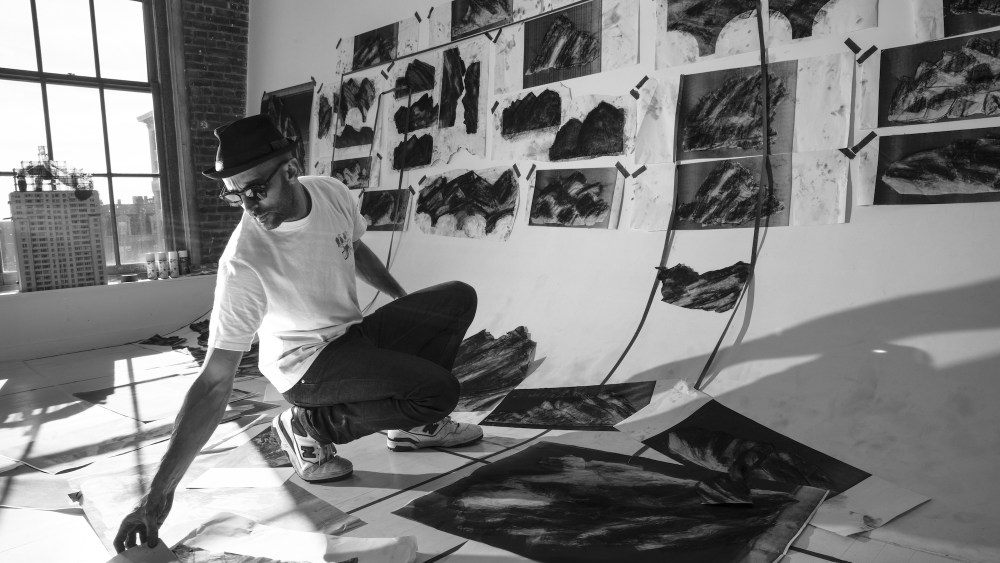
JR
claire dorn/courtesy photo
A few days before the public opening of “La Caverne,” the piece was damaged by severe wind and rain. A disaster, but his team was able to repair the damage and opened the installation almost two weeks later. The setback has since become an integral part of the piece’s legacy.
“ I realized a bit during the project, but even more now, how much people lived with this piece and with the story of this piece — not just the piece itself,” JR says. “That crazy storm became part of the narrative. When people mention the piece to me today, they always mention the storm.” It drove home the undercurrent of fragility inherent to any artwork, particularly one exposed to the elements in a public space.
“From far it’s the strongest mountain, indestructible. But if you come close, you realize it’s just fabric and air, and it’s very light. And that’s the beauty of it,” he says of the illusion of his piece. “When it got damaged by the storm I was like, ‘Oh my god. The fragility is really there.’ Who knows if it’s gonna hold for another two weeks?’”
The damage also highlighted the link between JR’s installation and Christo and Jeanne-Claude’s body of environmental works, which confronted the persistent threat of nature.
“When I spoke more with Christo’s family and their nephew, Vladimir, he said that on every project they had a storm of some kind. Working in public space makes you have zero control on the environment, and you gotta live with that,” says JR, adding that although he’s run into weather issues across his various public projects, it’s “never to that scale.”
The incident led to another unexpected synergy: “La Caverne” ended up being open to the public for only 14 days, the same duration of many of Christo and Jeanne-Claude’s projects, including “The Pont Neuf Wrapped.”
“At the end, it brought it back to exactly the duration it should be,” JR says. “There’s a lot of weird strange connections like that, that only made sense after.”
The threat — and consequence — of force majeure was top of mind heading into his next public installation, at the Vatican Apostolic Library in Rome. JR is one of three creatives who contributed to “AQCA,” the first chapter of the library’s five-year exhibition cycle “Catastrophe and Wonder,” inaugurated on Sept. 14 by Pope Leo XIV. While the interior exhibitions are available to the public by reservation, only JR’s exterior contribution, “Diluvium,” installed on the building’s facade, is openly visible and accessible.
“Diluvium,” Sept. 12, 2026, 07h18, Vatican, 2026 (c) JR
The piece, a giant cresting wave, was inspired by 19th-century artist Gustave Doré’s engraving depicting the biblical flood from Noah’s Ark. JR stripped away the figures from the illustration, leaving only the water. “It’s like the wave taking over the building,” he says, describing the affect. “Like it’s gonna swipe it away.”
“Diluvium” confronts the threat of loss, the omnipresent fear of losing the documents, archives and books that have been entrusted to the Vatican Library for safekeeping from manmade conflict and natural disasters throughout the years. While biblical in context, the piece also speaks to contemporary anxiety.
“This wave also reminds us of what’s happening in the world right now with climate change, and how we won’t be able to save everything,” JR says. “And so what do you keep?”
“Diluvium,” Vatican, 2026 (c) JR
While many of JR’s works are ephemeral in nature, the process of creation and documentation yields artifacts that persist beyond the brief physical iteration of his installations.
This fall, JR is bringing the essence of “La Caverne” to New York. “Les esquisses de la Caverne,” a solo exhibition that highlighted JR’s sketches for the bridge design, ran concurrently this summer at Perrotin in Paris. An expanded version, “In the Making: La Caverne du Pont Neuf,” will travel to the gallery’s New York location Oct. 28 through Dec. 19, and feature the addition of new photography of the completed bridge installation.
While the Paris Tourist Office estimates 6.4 million people saw “La Caverne” in-person, the project reached far beyond Paris thanks in part to social media. “A lot of people have never seen the physicality of it,” JR says. “And those artworks are the only trace that brings you the closest to the physicality of it. They carry the energy and the emotion of the bridge — but for eternity, and I love that they’ll travel through generations. The same way I go places and I see Christo’s and Jeanne-Claude’s work [related to their installations], and I can feel the energy they put into that artwork.”
“La Caverne du Pont Neuf, Esquisse #18,” 2026
Courtesy of Perrotin/Photo by Claire Dorn
“La Caverne du Pont Neuf, Esquisse #38,” 2026
Courtesy of Perrotin/Photo by Claire Dorn
And, thinking about another one of Christo and Jeanne-Claude’s most significant works — “The Gates” in Central Park in 2005 — has JR mulling the potential of following suit in New York, his home outside of Paris.
“I would love to do a big thing in New York,” he says. “It won’t be a bridge, it would be something else. But it will be the same energy as the bridge, of gathering people, doing something bigger than life, fighting with the elements. Because that’s always part of the recipe. There’s no avoiding that.”
Despite the setbacks and difficulty of “La Caverne,” JR was deliberate about enjoying the totality of the experience. He was onsite for much of the installation’s duration, casually interacting with visitors and documenting the work.
“People associated with me were like, ‘Yeah, you just get to the bridge, you’ll find JR,’” he says. “I never missed one day. I was there all the time. It took me a lot of energy, and I feel those drawings and those photographs are the essence of that, because I was there every day photographing. Each time I would see the sky changing or whatever, I ran with my bag in another location. People saw me climbing lamp posts to try to be higher to take a photo, or climbing roofs. I would always try to search for a better angle.”
On the last day of the installation, after the closing night party, JR biked away from the bridge, well aware that he would never see the mountain in its current iteration ever again. “And when I came back, there was no trace left,” he says.
Today, the bridge is back to how it always was: a piece of utilitarian infrastructure, now with even more history.
“I biked on it just yesterday, and there’s no trace whatsoever. You could almost question, did this really happen?” JR says. “At some point it’s like a myth; it’s a legend: ‘There was a mountain on that bridge.’ Until you see the image, it’s something you can barely believe.”
JR. Photographed and edited by Claire Dorn
claire dorn