
In a victory for animal welfare advocates who have been pushing the issue for decades, the New York City Council has officially approved a bill that will ban the horse carriage trade in New York City by 2028, ending roughly 200 years of the practice.
Carriage workers are both shocked and furious—and immediately sued in federal court, via their union, to block the law.
Romanch’s Law, named after an 18-year-old Indian tourist who died during a carriage accident in Central Park this summer, awaits Mayor Zohran Mamdani’s signature to officially become law. He indicated that he would sign the bill last week, after striking a deal with City Council Speaker Julie Menin.
The bill was sponsored by Council Member Christopher Marte, who represents Lower Manhattan, and passed on October 22. While prefacing his vote on the bill he has shaped, Marte personally thanked Romanch Majahan’s family for “their bravery.”
“It was really your spiritual powers, and your leadership, that helped us get here today,” he said. Majahan was flung out of the carriage he had been riding in alongside his family on June 17, fatally hitting his head against the pavement.
Carriage horse supporters said they believe that stray electrical voltage, which has been known to plague the park in the past, may have spooked the horse.
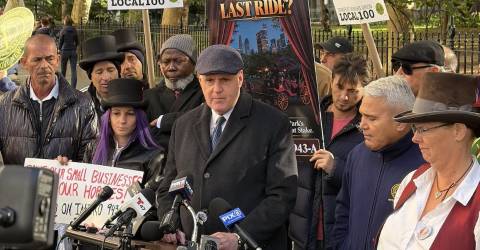
At a rally held next to City Hall on the morning of the vote, carriage workers affiliated with the Transport Workers Unions expressed dread and disbelief at the impending demise of their livelihoods. Christina Hansen, the union’s shop steward and a carriage worker for 13 years, estimated that there were about 180 carriage horses still being used in the city.
At one point, Council Member Marte boldly strolled by the assembled protestors, some of whom immediately proceeded to heckle him as a “traitor to the working man” and a “traitor to small businesses.”
The workers were joined by their lawyers, Ben Kallos and Arthur J. Schwartz, who will argue in their pending lawsuit that Romanch’s Law constitutes a violation of their Fifth Amendment rights; specifically, they believe that it represents a “taking” of their property without “just compensation.”
Kallos, who served in the same City Council seat as Julie Menin, told Straus News that he believed the law would render carriage worker medallions all but worthless: “If you know that there’s a sunset of medallions in 2028, pending litigation, why would anybody want to pay for it?”
Former City Council Speaker Adrienne Adams had stalled bills to ban horses in committee, so such a law had never came to a vote before. Menin, who steered this year’s bill, applauded its passage.
“Our landmark vote to pass Romanch’s Law is a demonstration of this Council’s commitment to animal welfare, public safety, and worker protection,” said Menin. “The tragic and preventable death of 18-year-old Romanch Mahajan this summer underscored the need for urgent action after decades of mounting concerns.”
“From longstanding animal welfare concerns and increasingly extreme heat conditions to historic overcrowding in Central Park, which now welcomes more than 42 million visitors annually, the status quo has become unsustainable and unsafe for horses and people alike,” she added.
Supporters of the carriage horses have argued that e-bikes and scooters, which the Parks Department now allows to use Central Park’s roadways after years of banning them, are far more dangerous that the horse carriages, which has had only one human fatality in 150 years.
Jill Adamski, a carriage worker, echoed Kallos in opposing the ban.
“Even if they [City Council] have some opposition to having carriage horses here at all, this isn’t the bill to do it. This bill doesn’t give [carriage workers] anything, it doesn’t consider having real conversations with us” she told Straus. “We should be able to meet with the mayor, meet with the speaker, and come to some type of solution if there’s no other choice.”
Yet some supporters of the bill have described the carriage trade as “outdated,” including Council Member Harvey Epstein—who represents the Lower East Side—in his remarks before the vote.
“I think about my grandma who used to deliver milk in this city,” he said, by way of analogy. “No longer a job that we need today.”
“I stand together with so many of the organizations who fought for this moment,” Epstein added.