
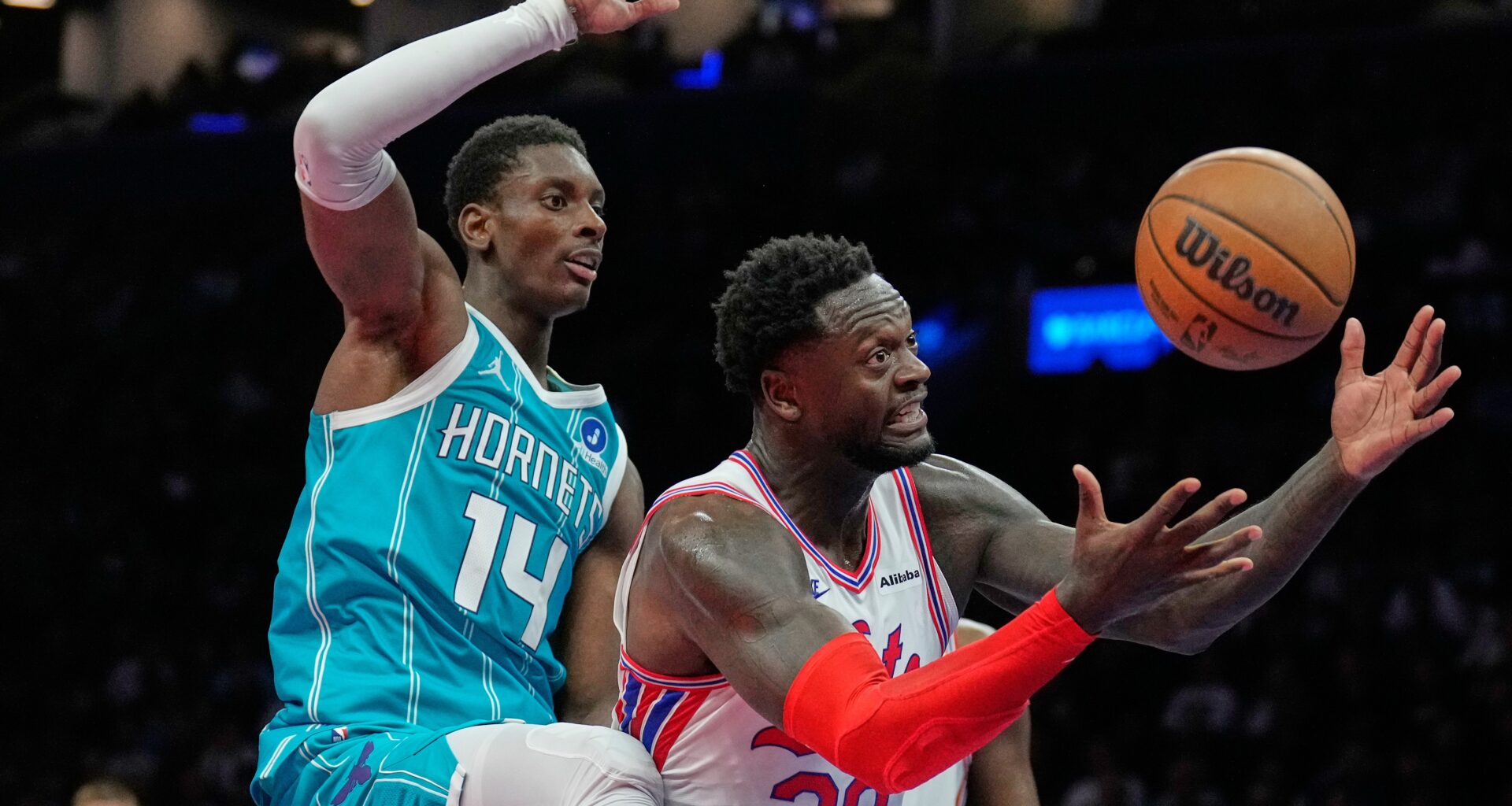
Michael Porter Jr. and Julius Randle don’t have to put the ball in the basket to make the Nets’ offense more dangerous. For a team eager to push the pace, the first step toward easy points often comes at the other end of the floor, with a defensive rebound. It’s a simple game, really.
Porter pulled down seven rebounds in Brooklyn’s season-opening loss to the Charlotte Hornets, trailing only Randle and Day’Ron Sharpe, who grabbed eight apiece. A respectable showing on the stat sheet, but Porter wasn’t satisfied. He could still picture the rebounds he should’ve had.
“I had seven rebounds. I need to be closer to the 10-rebound range,” Porter said. “I think I can really help the team in that area. There were some rebounds I missed as well.”
Charlotte made Brooklyn pay for its failure to finish the job on defense. The Hornets crashed their way to 15 offensive rebounds and a 20-8 advantage in second-chance points, a costly difference in their 110-103 victory.
One fourth-quarter sequence was particularly painful. Ryan Kalkbrenner and Naz Reid each chased down an offensive rebound after a missed 3-pointer, giving Charlotte three cracks at the basket. Reid made sure the third one counted, cleaning up the mess with a putback.
Porter and Randle accounted for 14 of Brooklyn’s 27 defensive rebounds against the undermanned Hornets, already doing more than half the heavy lifting. But Porter wasn’t looking for someone else to pick up the slack. He wanted an even bigger share of the work.
“As far as being a good rebounding team, I know a lot of that is on me. A lot of it’s on Julius. It’s not all on Day’Ron,” Porter said.
As Brooklyn navigates its first season without Nic Claxton, Porter has stressed the importance of recognizing when a teammate needs an extra hand. Sharpe offered a more concrete example of what that looks like, and where the Nets fell short against Charlotte.
Challenging a shot on the perimeter was only half the battle. Sharpe still had to get back inside and help a teammate fighting for position under the basket. By his own admission, there were times he didn’t make that second effort.
Charlotte missed 33 of its 48 attempts from beyond the arc, sending plenty of rebounds bouncing into open space. Sharpe pointed to the importance of hunting down those loose balls rather than getting a head start in transition or watching from the 3-point line.
And the responsibility doesn’t end with the players closest to the basket. Players whose opponents aren’t chasing the rebound still have a job to do. Jordi Fernández wants bodies on opponents, teammates helping with box-outs and nobody left to wrestle for a rebound on an island.
“If your man doesn’t crash, you can go sandwich and help,” Fernández said after the opener. “It’s all these things that we’ve worked on that obviously we didn’t execute, but I don’t think it was a matter of effort. Our guys played hard. They tried their best.”
For Porter and Randle, making an impact on the glass doesn’t always require coming away with the ball. Sometimes, simply putting a body on an opponent and clearing a path for Sharpe or another teammate is enough.
Fernández found plenty to like about Brooklyn’s defensive effort in the opener, particularly its ball pressure and ability to limit attempts at the rim and trips to the free-throw line. But all that good work loses some of its value when the other team gets another crack. Securing the rebound is what turns a strong defensive stand into a stop.
And Charlotte’s second chances came with a double penalty. Not only did the Nets have to defend all over again, but they also lost opportunities to race up the floor against a defense that hadn’t yet gotten its feet set.
“It’s hard to run if you don’t rebound at all,” Fernández said.
Randle, for his part, wasn’t waiting for someone else to initiate the contact. He made it his responsibility to put a body on someone first.
“We have to impose our physicality on those things and hit people first,” Randle said. “So, I’ll set a tone with that.”