
Diane Anderson-Minshall pops on Zoom with a ‘60s Pop Art background that makes everything instantly fun. “I’m trying to do a lot of color in my life to, like, bring up the happiness quotient,” the longtime award-winning LGBTQ+ journalist says, grinning behind her polka-dot glasses.
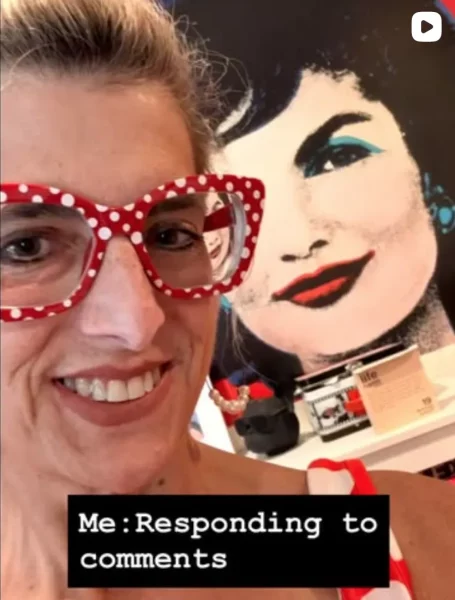 Diane Anderson-Minshall via Instagram
At this moment, Diane embodies the joy she is seeking. She is a Pop Art poster for the First Amendment and Freedom of Expression. She is never too nervous to explore intersectionality, with an eye on authenticity.

During her time at the lesbian publication Curve, Diane told OutNW, “I did a fellowship feature on Native American lesbians, on the reservation and off. I was nervous to write about the subject since I am mixed-race Native American but raised by a white-identifying family. I was still trying to figure out why public records like the Dawes Rolls and private accounts didn’t match up, and I felt very inauthentic and vulnerable as a white-passing Indigenous woman.
“But talking with other Native queer women changed a lot of that, and it was a good experience personally, even if I was talking about how hard it was on all these women in my story. I don’t read it now and think, oh great work of journalism; but the feeling the experience gave me lingers,” she said.
Identity matters. In fact, identity can be a joyful resting space for one’s true, authentic self, or it can be an imposed cage – or a creative temporary description on the way to individual liberation.
Identity can also be dangerous. Even though intersectional LGBTQ+ people are still not considered an official demographic, the Trump administration’s Project 2025 calls for the “cultural wars” total erasure of sexual orientation and gender identity. Stonewall was not just about sexual liberation – it was about the individual’s right to decide who they are or who they want to be at any given time. Without that reality, “individual freedom” is just a pipe dream.
But homosexuality – just like similar discriminatory effects of political, ideological, and biblical training about race, gender, and non-Christian religions – has been inculcated as a “sexual deviation” in society through generations since the McCarthy witch hunts of the 1950s.
In 1952, the American Psychiatric Association (APA) classified homosexuality as a “sociopathic personality disturbance“ in the same category as “transvestism, pedophilia, fetishism, and sexual sadism.” In 1968, the APA expanded “sexual deviation” to a mental disorder.
After Stonewall, gay and lesbian activists disrupted APA meetings, protesting the supposedly “scientific” basis for that diagnosis when existing research by Alfred Kinsey and Evelyn Hooker indicated otherwise – that homosexuality is normal and non-pathological. In 1973, the APA voted to remove homosexuality from its list of mental disorders, substituting instead “Sexual Orientation Disturbance.”
Two years later, the APA issued a statement saying, “Homosexuality per se implies no impairment in judgment, stability, reliability, or general social and vocational capabilities,” and urged civil rights legislation and repeal of all discriminatory legislation.
But America didn’t shift with the APA. Diane Anderson-Minshall’s description of the French Quarter community’s reaction to the devastating fire at the UpStairs Lounge in New Orleans in 1973 is painful.
In her June 24, 2013 story for The Advocate, “Remembering the Worst Mass Killing of LGBT People in U.S. History,” Diane wrote that in “the swelteringly humid last day of gay pride in the South’s most tolerant city,” the gay bar on the second floor was hosting a two-hour beer bust. When that ended, remaining patrons joined members of the Metropolitan Community Church after a sizable MCC service to discuss a fundraiser for the Crippled Children’s Hospital.
Nobody noticed an ejected troublemaker who vowed revenge by burning down the bar.
The downstairs buzzer sounded at 7:52 p.m., and patron Luther Boggs opened the door to hell – the front staircase was engulfed in flames. Bartender Buddy Rasmussen rushed about 20 people out the back exit to the roof, but everyone else was trapped inside. MCC Rev. Bill Larson couldn’t squeeze through the bars and burned to death in full view of onlookers below.
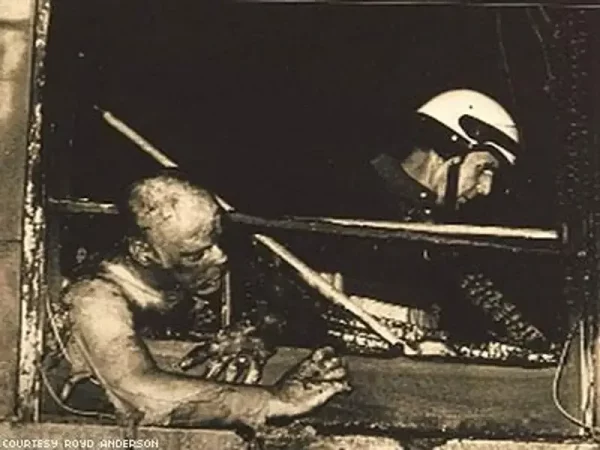 MCC pastor Bill Larson, trapped in the window bars
The New York Times finally published the pastor’s obituary in 2019 and cited a Times article published the day after the fire in the “lavish homosexual bar.” Larson “lay like a mannequin” for four hours “in view of the spectators in the narrow street below, his arm resting on the window ledge and his mouth open in what must have been a scream.”
Firefighters “discovered 28 dead bodies piled up in grotesque mounds atop each other at the bathroom door, the fire escape door, and the windows- any place they could have hoped to escape. Four more people would die either en route to or at the hospital. In all, 32 people were killed that day, including two straight people,” Diane reported.
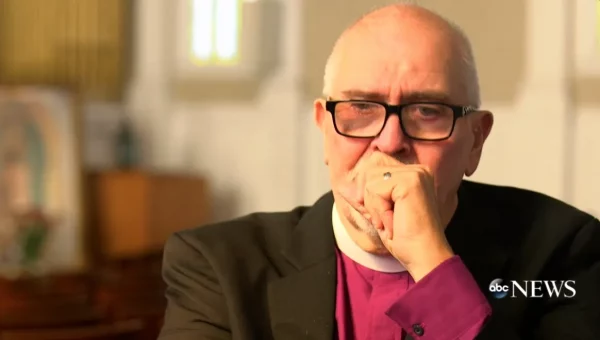 Rev. Troy Perry talking about Pastor Bill Larson on an ABC News Special on Aug. 31, 2018
MCC Founder Rev. Troy Perry and his CSW Pride Parade co-founder Morris Kight “searched for a church to hold services for the 32 victims; the LGBT community looked to local politicians, the mayor, religious officials, and civic leaders to at least recognize the tragedy. None did,” Diane reported.
“The early 1970s were dripping with homophobia,” Royd Anderson, filmmaker of the documentary The UpStairs Lounge Fire, told Diane, noting that Louisiana passed a Crime Against Nature statute in 1974, making sexual acts between gay couples illegal.
Media reports were quick or cruel. “One local radio jockey joked, ‘What will they bury the ashes of queers in? Fruit jars.’ The joke was retold countless times around ‘respectable’ offices in the city. The newspapers printed quotes from ordinary citizens riddled with homophobia, including ‘I hope the fire burned their dress off,’ and ‘The Lord had something to do with this,’” Diane wrote.
“Every little detail about the setting stays with me (that the dead were lined up on the sidewalk, nobody claimed some of them, and they went to unmarked paupers’ graves, while churches refused to do their memorial services and some funeral homes refused to do their burials,” Diane wrote in The Advocate, a publication she would eventually run.
And what of the unknown victims – closeted gay men with fake IDs whose families still think they’ve been missing all these years?
Even today, coming out may take an act of courage not to be erased.
Diane Anderson-Minshall says she’s had “a thousand coming outs, because each time there’s some new coming out.”
Born in Southern California in 1968, she was raised in Payette, Idaho, by her grandmother, who was a Democrat. At the time, Diane preferred Republicans because they had all the money.
“I want to go back and apologize to so many old people at this point, because I’m like, oh, I get it now!” Diane says during our interview.
Diane fell in love with print magazines “really, really early,” causing fights between her mother and her stepfather. “We’re Jehovah’s Witnesses,” Diane says, “so I wasn’t supposed to have magazines. But my mom would just park me in front of the magazine section at the grocery store, and I just loved the smell of newsprint.”
When she was 12, she moved in with her grandmother and her aunt in Payette. She tried to volunteer at a local printing press, but they didn’t take girls. The local newspaper did, however, launching her journalism career in newsrooms full of men.
Diane came out in the mid-80s when friends were dying of AIDS. “We had to navigate a lot,” she says. “It took two years to come out. That was two closeted years in which my girlfriend and I went on double dates with men.”
That led to fights. “We didn’t like the word ‘lesbian.’ It didn’t feel like us…women who didn’t shave, crunchy girls…I thought that you had to be butch…. I hadn’t met any femmes yet, and so I think we, at that point, were like, oh, we’re just two girls who fell in love.”
Diane, her girlfriend, and her best friend moved to New York City, joined ACT UP, and became a family. She was worried that coming out would impact her budding journalism career – until she wasn’t worried.
“So many friends were dying, and I discovered LGBTQ media at the same time and was like, fuck that. I don’t need the New York Times. Like, I literally had a job interview at the New York Times, and they told me, we’re okay with you being gay, but you just can’t be out.”
The family moved to Los Angeles and joined ACT UP LA, Women’s ACT UP LA, and Queer Nation. In the late ‘80s, she was freelancing for everyone before segueing into being an editor-in-chief and, much later, a CEO.
“You’re trying to put out news in a world where you’re still hated, where the president won’t recognize what you’re going through, and you’re fighting just to have your occupations and your colleagues are dying one at a time in front of you,” Diane recalls.
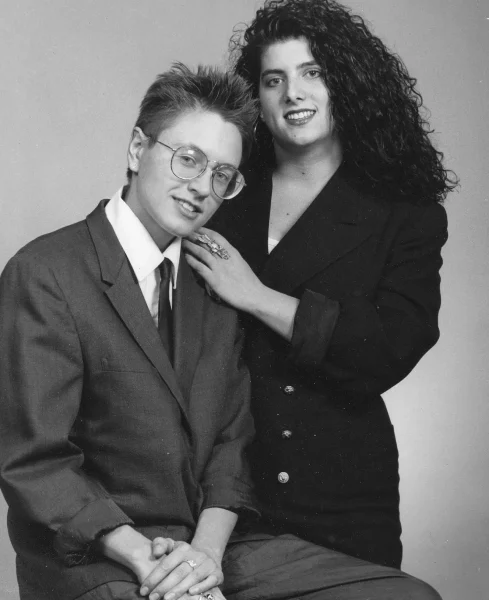 Diane and Jacob’s first year together 1991 (Photo courtesy Anderson-Minshall)
“Jacob and I met when we were both little baby dykes,” Diane says. “After I came out, I cut all my hair off.… I tried to be butch for a hot minute, and then I was in the process of refemining when we met.”
Jacob – who was still female-identified in public – moved in with Diane, her now ex-“wife,” and her best friend. “That was quite a fun ride.”
The couple then engaged in a series of domestic partnerships in different locales, including West Hollywood, and participated with other same sex couples in a virtual marriage ceremony officiated by San Francisco Mayor Willie Brown. They officially wed again after Prop 8 passed, only to have that marriage invalidated.
“The last time we married, after we’d been together 16 years as a lesbian couple, Jake came out as transgender, transitioned, and this time we could legally marry as a husband and wife,” Diane says.
While Diane focused on her career, Jacob focused on finding himself. The couple had already identified as Butch and Femme, but now, at 21, they were living out of a VW bus with their dogs and cats in San Francisco. Diane had a job in the Castro at On Our Backs and, knowing only one trans man, they struggled with not being inadvertently transphobic.
“We both essentially identified as queer,” Diane says.
Diane grew impatient with Jacob’s impending transition. Finally, “I was like, ‘Hey, if this is happening, I need it to happen. I can’t stay in this middle space.” They started having long conversations, “because that’s what lesbians do.”
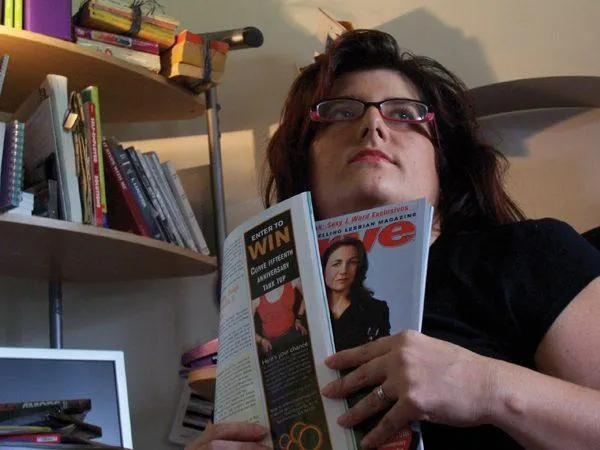 Diane Anderson-MInshall at Curve (Photo courtesy Curve)
They worried about their jobs. By then, Diane was editing Curve magazine, and Jacob, who had co-founded Girlfriends magazine with her, was now a park ranger – plus they had a three-book deal with a publisher. But they found acceptance.
Perhaps their biggest adjustment was within themselves. “When we got together,” Diane says, Jacob “was practically a lesbian separatist, so he had to reconcile a lot more things in his head than I had to.”
For her part, “I was certainly not a gold star lesbian,” Diane says. “Most lesbians have been with a man at some point.”
But there was a struggle. A month after Jacob came out, Diane peppered him with all her anxieties. While shopping for new clothes, she’d point out men and say, “Not that, not that.”
“He got just so fed up one day, and he was like, ‘Oh, for God’s sake, then who can I be?’” she recalls. “I was trying to think of the most metrosexual man in my mind, so I said, ‘Ryan Seacrest.’ And he goes, ‘Okay, I can do that.’
“So we literally bought clothes from Ryan Seacrest’s own fashion label and the other clothes that looked like Ryan Seacrest would wear,” she says. “Until he found out who he was, it was this gap moment where I was like, ‘That would not be too much for me.’”
They were anxious – until they weren’t.
“I was at the grocery store, and the woman clerk said, ‘Oh, I love your blouse.’ And I said, ‘Thank you. It was a gift from my husband. Well, he used to be my wife. He’s transgender. But I’m a lesbian.’ And then she was like, ‘Okay.’”
But that triggered another wave of identification analysis.
“If I still identified as lesbian, then I didn’t respect Jacob as a man. I wasn’t seeing him as an actual man.”
Jacob wanted Diane to identify however she wanted. Diane asked why his transition would change her identity. “My identity is my core identity.”
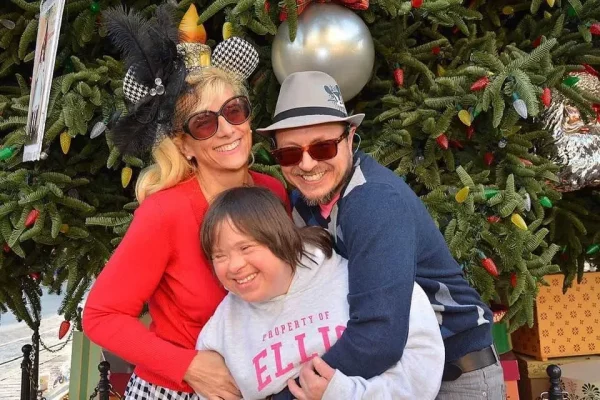 Diane Anderson-Minshall and Jacob Anderson Minshall with Jennye, Jacob’s little sister (Photo courtesy Diane Anderson-Minshall)
Finally, they stopped platforming people who were “selling us the story that this requires a breakup, especially when you’ve been married so long. I mean, we’re 35 years in, so I don’t think I have to justify anything anymore.”
Now, Diane comes out saying, “Well, you can choose. I’m either a lesbian identified bisexual or a bisexual-identified lesbian, or I’m queer.”
And Diane Anderson-Minshall also still identifies as a white-passing mixed-Indigenous woman — brave and personally free enough to be who she wants to be.
Please check out our full conversation in which we discuss LGBTQ+ media, Diane and Jacob’s acceptance of one another, and more.
This is a cross-post from Karen’s LGBTQ+ Freedom Fighters Substack.