
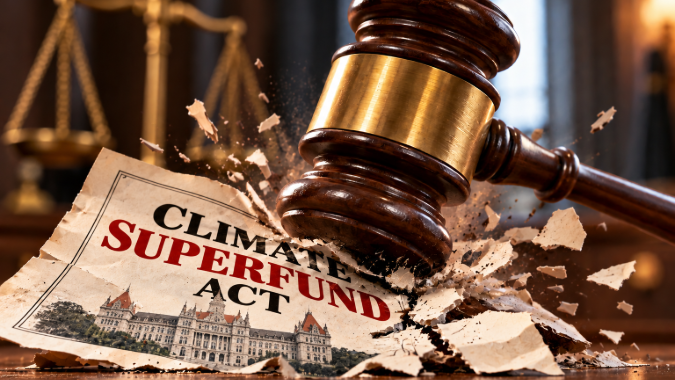
New York’s Attorney General has filed notice that it is appealing two federal court decisions that have blocked the enforcement of its 2024 New York law requiring fossil fuel companies to pay $75 billion for past emissions and climate-related costs.
The legal case is being closely watched in New Jersey, where similar legislation has been introduced but not enacted. NJBIA is leading a coalition of business groups against the New Jersey bill (A-3735/S-2338), citing the economic damage and job losses it will cause in an industry vital to the state, and the added costs that will ultimately be passed to consumers. NJBIA has also warned of the chilling message the bill would send to New Jersey’s business community if the state were to retroactively penalize companies that followed laws and permits.
In both New York court decisions, federal judges found the state’s Climate Change Superfund Act was preempted by federal law. However, on Oct. 23 the office of New York Attorney General Letitia James filed notice to continue its taxpayer-funded legal battle in the 2nd Circuit U.S Court of Appeals.
There are two New York cases: the first was brought in Manhattan by the U.S. Chamber of Commerce, the American Petroleum Institute, and other plaintiffs, and the second case was brought in Albany by 21 states and industry groups. The U.S. Department of Justice also joined in the legal challenge.
Under New York’s Climate Change Superfund Act, the Department of Environmental Conservation has the responsibility of identifying companies it deems responsible for greenhouse gas emissions through fossil fuel production and refining. The department would set rules on how to collect $75 billion in payments over 25 years, and the attorney general’s office would have the authority to enforce payment demands.
So far, the courts have held that the federal law preempts the New York State Climate Change Superfund Law; therefore, the state law cannot be enforced.
Pointing to New York’s unsuccessful efforts to date to implement its controversial law and the two-year legal battle that has been waged at considerable cost to taxpayers, NJBIA has urged legislators in New Jersey not to follow the same path.
The New Jersey bill, which would impose $50 billion in retroactive penalties on fossil fuel companies over a 20-year period, was originally called the Climate Superfund Act, but proponents rebranded it as the Make the Polluters Pay Act to attract more support. The bill stalled in the last New Jersey legislative session before the summer recess, but some proponents are pushing for action this fall.
NJBIA Deputy Chief Government Affairs Officer Ray Cantor has urged legislators to recognize that the bill is “unfair, punitive to consumers, and damaging to New Jersey jobs.”