
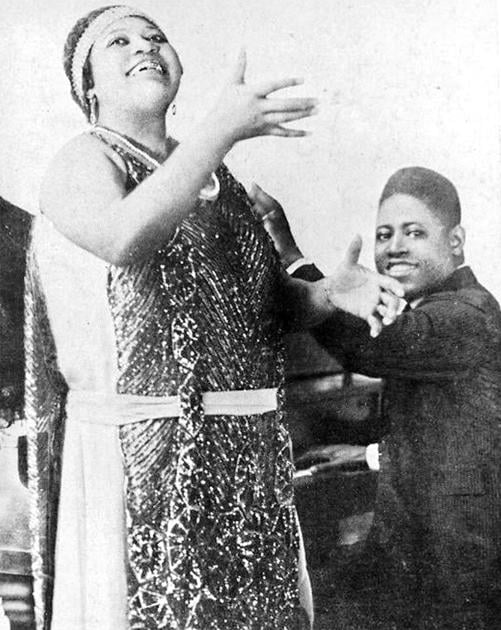
In a decade when Harlem’s clubs pulsed with the rhythm of the Jazz Age, Queens stood quietly on the threshold of greatness.
While plenty of legends of the time later resided in Queens, including Louis Armstrong, Dizzy Gillespie, Billie Holiday, Charlie Mingus, Ella Fitzgerald and John Coltrane, jazz music had not yet placed its mark strongly on the borough in the 1920s.
Musicians were drawn not to the borough’s stages, but to its wide streets and promise of home. Queens was tuning up, getting ready for future decades with the music and the legends who played it.
“Most of the real action and focus was coming out of Harlem,” said Clyde Bullard, a jazz producer with Flushing Town Hall. “The influx of jazz musicians moving into Queens, I believe, really didn’t start until around 1923 and after that with Clarence Williams.”
Williams, a pioneering pianist, composer, publisher and entrepreneur, was among the first to see Queens’ potential.
Williams and his wife, singer Eva Taylor, settled in Jamaica in 1923, laying the groundwork for the neighborhood’s future as a jazz haven.
Throughout his career, Williams worked with icons such as Bessie Smith, Sidney Bechet, Coleman Hawkins and Sara Martin. He is credited for inspiring Armstrong, among the most influential figures in jazz, to move to Queens in the 1940s.
“He asked Louis Armstrong to visit him, and Louis Armstrong came up and really loved the openness of Queens, and that was kind of the genesis of starting this exodus of all these great musicians moving in,” Bullard said.
Williams’ Queens abode turned into a gathering place and community for more Black artists, musicians, writers and other notable figures of the time.
“I think as word started to spread, people were asking these great icons, ‘Where you living?’ and they would say, ‘Man, I’m in Queens. I’m in Addisleigh Park. I’m in Hollis. I’m in Sunnyside,’” Bullard said. “So people start moving to Queens because it was chic.”
Jason Antos of the Queens Historical Society, also the borough historian, echoed the sentiment.
“From what we know, even though there were all of these legendary figures living here and still more to come in the coming decades, there was really no jazz scene in the borough at the time,” Antos said. “There were, of course, speakeasies. They were very popular around the five boroughs in the 1920s because of Prohibition, and it was if there was jazz, it was there.”
He said that records for speakeasies at the time, naturally, are very scant.
“During the ’20s, in terms of entertainment, prohibition really put a damper on a lot of things,” Antos said. “There were so many beer halls, beer gardens and dance halls, as they called them. They were everywhere, all over Flushing, College Point, Whitestone, Corona, Long Island City, Astoria, anywhere. But Prohibition just decimated all of them.”
While the greats mostly stuck to performing in Harlem at the time, it helped that Queens wasn’t too far from the action of all the busy, iconic venues, such as the Apollo.
“So you go, you play music, you make people happy, and you swing out of the club and you go back home to Queens, where it’s nice and quiet,” Bullard said.
One of the main Queens-based jazz musicians at the time was Bix Beiderbecke, an Iowa native whose genius helped shape the genre.
While most musicians who played solos prepared them ahead of time, Beiderbecke enjoyed surprising his audience with improvisation.
Beiderbecke came to New York in 1927 as part of the acclaimed Paul Whiteman Orchestra, but his time in the World’s Borough was short and tragic. He died in his apartment, on 46th Street in Sunnyside, at just 28 in 1931.
“He had this fever, and he was delirious, so he played for like 12 hours on his trumpet, much to the chagrin of his neighbors in the apartment building where he was living,” Antos explained.
As the story goes, after 12 hours of music, Beiderbecke abruptly stopped playing his trumpet and ran into the hallway.
“He said that there were people trying to kill him, trying to stab him to death,” Antos said. “He was very ill, and totally in a state of delirium. They summoned for a doctor, and by the time they got there, he was dead. … His final performance was born out of delusion from fever.”
From the 1920s onward, jazz made its presence known in Queens. In the 1930s, Southeast Queens, including Addisleigh Park, became a hub for the genre and its artists, followed by Corona and East Elmhurst, with Fats Waller, Holiday, Gillespie and Fitzgerald taking up residency in the World’s Borough.